Sharma Shiwani, Burdon Kathryn P, Dave Alpana, Jamieson Robyn V, Yaron Yuval, Billson Frank, Van Maldergem Lionel, Lorenz Birgit, Gécz Jozef, Craig Jamie E
Department of Ophthalmology, Flinders University, Bedford Park, South Australia, Australia.
Mol Vis. 2008;14:1856-64. Epub 2008 Oct 20.
Nance-Horan syndrome is typically characterized by severe bilateral congenital cataracts and dental abnormalities. Truncating mutations in the Nance-Horan syndrome (NHS) gene cause this X-linked genetic disorder. NHS encodes two isoforms, NHS-A and NHS-1A. The ocular lens expresses NHS-A, the epithelial and neuronal cell specific isoform. The NHS-A protein localizes in the lens epithelium at the cellular periphery. The data to date suggest a role for this isoform at cell-cell junctions in epithelial cells. This study aimed to identify the causative mutations in new patients diagnosed with Nance-Horan syndrome and to investigate the effect of mutations on subcellular localization of the NHS-A protein.
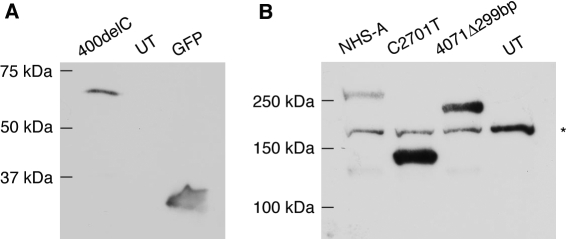
All coding exons of NHS were screened for mutations by polymerase chain reaction (PCR) and sequencing. PCR-based mutagenesis was performed to introduce three independent mutations in the NHS-A cDNA. Expression and localization of the mutant proteins was determined in mammalian epithelial cells.
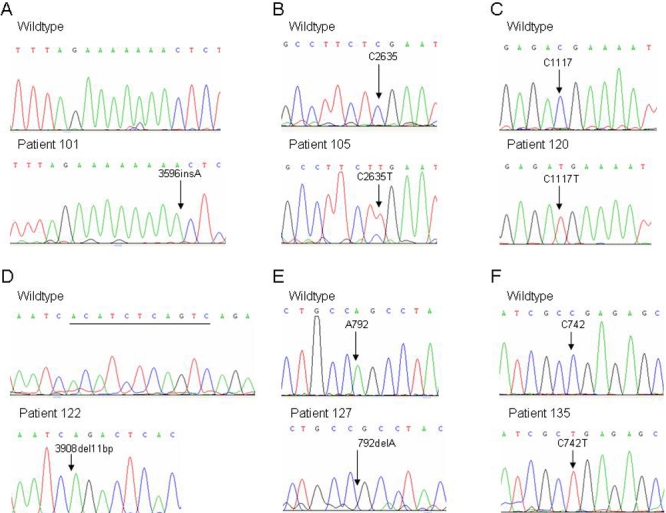
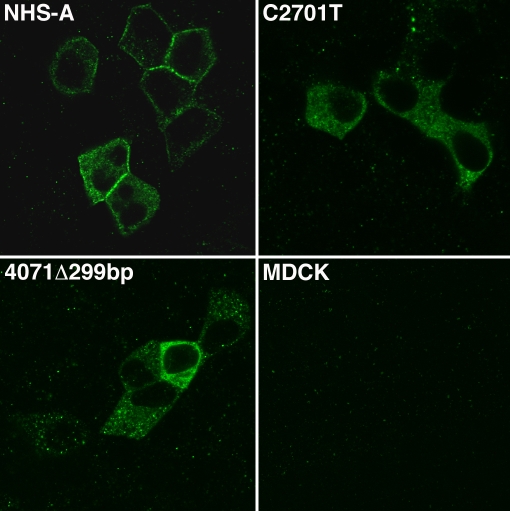
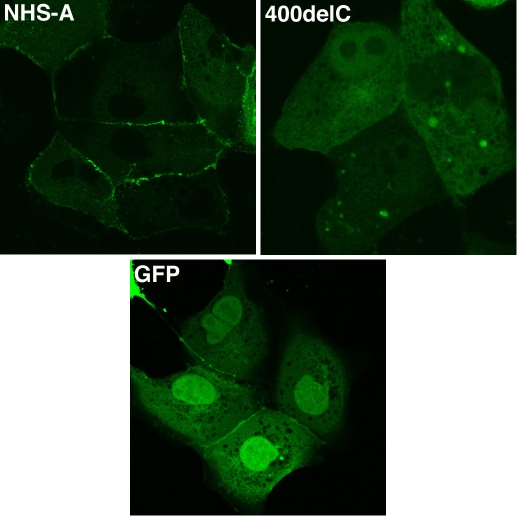
Truncating mutations were found in 6 out of 10 unrelated patients from four countries. Each of four patients carried a novel mutation (R248X, P264fs, K1198fs, and I1302fs), and each of the two other patients carried two previously reported mutations (R373X and R879X). No mutation was found in the gene in four patients. Two disease-causing mutations (R134fs and R901X) and an artificial mutation (T1357fs) resulted in premature truncation of the NHS-A protein. All three mutant proteins failed to localize to the cellular periphery in epithelial cells and instead were found in the cytoplasm.
This study brings the total number of mutations identified in NHS to 18. The mislocalization of the mutant NHS-A protein, revealed by mutation analysis, is expected to adversely affect cell-cell junctions in epithelial cells such as the lens epithelium, which may explain cataractogenesis in Nance-Horan syndrome patients. Mutation analysis also shed light on the significance of NHS-A regions for its localization and, hence, its function at epithelial cell junctions.
南斯-霍兰综合征的典型特征是严重的双侧先天性白内障和牙齿异常。南斯-霍兰综合征(NHS)基因的截短突变导致这种X连锁遗传病。NHS编码两种异构体,NHS-A和NHS-1A。眼晶状体表达NHS-A,即上皮和神经元细胞特异性异构体。NHS-A蛋白定位于晶状体上皮细胞的周边。迄今为止的数据表明该异构体在上皮细胞的细胞间连接中发挥作用。本研究旨在鉴定新诊断为南斯-霍兰综合征患者的致病突变,并研究突变对NHS-A蛋白亚细胞定位的影响。
通过聚合酶链反应(PCR)和测序筛选NHS的所有编码外显子的突变。进行基于PCR的诱变以在NHS-A cDNA中引入三个独立的突变。在哺乳动物上皮细胞中测定突变蛋白的表达和定位。
在来自四个国家的10名无关患者中的6名中发现了截短突变。四名患者中的每一名都携带一种新突变(R248X、P264fs、K1198fs和I1302fs),另外两名患者中的每一名都携带两种先前报道的突变(R373X和R879X)。四名患者的该基因未发现突变。两个致病突变(R134fs和R901X)和一个人工突变(T1357fs)导致NHS-A蛋白过早截短。所有三种突变蛋白均未能定位于上皮细胞的细胞周边,而是存在于细胞质中。
本研究使在NHS中鉴定出的突变总数达到18个。突变分析揭示的突变NHS-A蛋白的错误定位预计会对上皮细胞如晶状体上皮细胞间连接产生不利影响,这可能解释了南斯-霍兰综合征患者的白内障形成。突变分析还揭示了NHS-A区域对其定位及其在上皮细胞连接处功能的重要性。