Idh Jonna, Westman Anna, Elias Daniel, Moges Feleke, Getachew Assefa, Gelaw Aschalew, Sundqvist Tommy, Forslund Tony, Alemu Addis, Ayele Belete, Diro Ermias, Melese Endalkachew, Wondmikun Yared, Britton Sven, Stendahl Olle, Schön Thomas
Department of Medical Microbiology, Faculty of Health Sciences, Linköping University, 58185 Linköping, Sweden.
BMC Infect Dis. 2008 Oct 24;8:146. doi: 10.1186/1471-2334-8-146.
Nitric oxide (NO) is essential for host defense in rodents, but the role of NO during tuberculosis (TB) in man remains controversial. However, earlier observations that arginine supplementation facilitates anti-TB treatment, supports the hypothesis that NO is important in the host defense against TB. Local production of NO measured in fractional exhaled air (FeNO) in TB patients with and without HIV co-infection has not been reported previously. Thus, our aim was to investigate levels of FeNO in relation to clinical symptoms and urinary NO metabolites (uNO).
In a cross sectional study, FeNO and uNO were measured and clinical symptoms, chest x-ray, together with serum levels of arginine, tumor necrosis factor alpha (TNF-alpha) and interleukin 12 (IL-12) were evaluated in sputum smear positive TB patients (HIV+/TB, n = 36, HIV-/TB, n = 59), their household contacts (n = 17) and blood donors (n = 46) from Gondar University Hospital, Ethiopia.
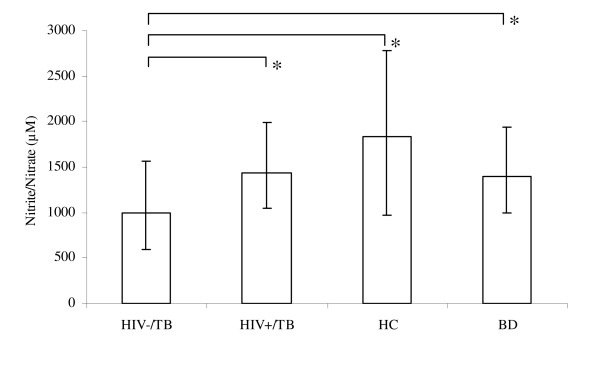
The proportion of HIV-/TB patients with an increased FeNO level (> 25 ppb) was significantly higher as compared to HIV+/TB patients, but HIV+/TB patients had significantly higher uNO than HIV-/TB patients. HIV+ and HIV-/TB patients both had lower levels of FeNO compared to blood donors and household contacts. The highest levels of both uNO and FeNO were found in household contacts. Less advanced findings on chest x-ray, as well as higher sedimentation rate were observed in HIV+/TB patients as compared to HIV-/TB patients. However, no significant correlation was found between FeNO and uNO, chest x-ray grading, clinical symptoms, TNF-alpha, IL-12, arginine levels or sedimentation rate.
In both HIV negative and HIV co infected TB patients, low levels of exhaled NO compared to blood donors and household were observed. Future studies are needed to confirm whether low levels of exhaled NO could be a risk factor in acquiring TB and the relative importance of NO in human TB.
一氧化氮(NO)对啮齿动物的宿主防御至关重要,但NO在人类结核病(TB)中的作用仍存在争议。然而,早期关于补充精氨酸有助于抗结核治疗的观察结果,支持了NO在宿主抗结核防御中很重要的假说。此前尚未报道过在合并或未合并HIV感染的结核病患者中,通过呼出气一氧化氮(FeNO)测量的局部NO产生情况。因此,我们的目的是研究FeNO水平与临床症状及尿NO代谢产物(uNO)之间的关系。
在一项横断面研究中,对埃塞俄比亚贡德尔大学医院的痰涂片阳性结核病患者(HIV+/TB组,n = 36;HIV-/TB组,n = 59)、他们的家庭接触者(n = 17)和献血者(n = 46)测量了FeNO和uNO,并评估了临床症状、胸部X光片,以及血清精氨酸、肿瘤坏死因子α(TNF-α)和白细胞介素12(IL-12)水平。
与HIV+/TB患者相比,FeNO水平升高(> 25 ppb)的HIV-/TB患者比例显著更高,但HIV+/TB患者的uNO水平显著高于HIV-/TB患者。与献血者和家庭接触者相比,HIV+和HIV-/TB患者的FeNO水平均较低。家庭接触者中uNO和FeNO水平最高。与HIV-/TB患者相比,HIV+/TB患者胸部X光片的病变程度较轻,血沉率较高。然而,在FeNO与uNO、胸部X光片分级、临床症状、TNF-α、IL-12、精氨酸水平或血沉率之间未发现显著相关性。
在HIV阴性和合并HIV感染的结核病患者中,与献血者和家庭接触者相比,呼出NO水平均较低。需要进一步研究以确认呼出NO水平低是否可能是感染结核病的危险因素,以及NO在人类结核病中的相对重要性。