Ristuccia Robert C, Spear Linda P
Department of Psychiatry, Columbia University College of Physicians and Surgeons, Division of Developmental Psychobiology, New York State Psychiatric Institute, New York, NY 10032, USA.
Alcohol. 2008 Dec;42(8):623-9. doi: 10.1016/j.alcohol.2008.08.002. Epub 2008 Oct 25.
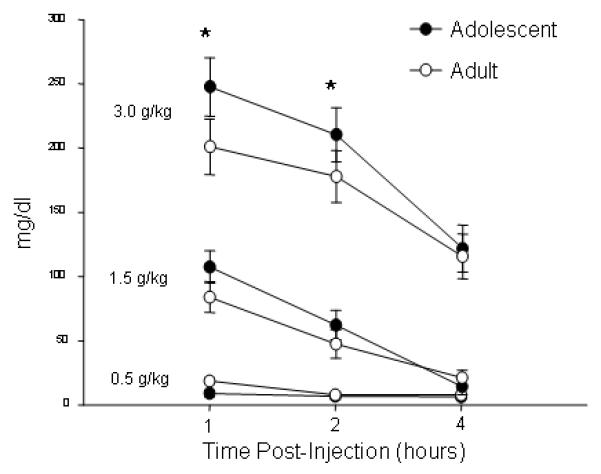
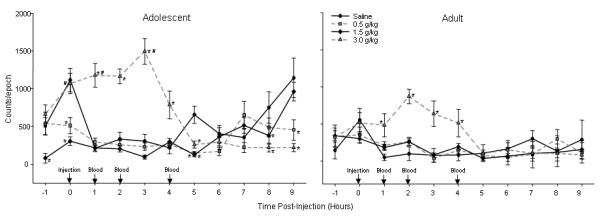
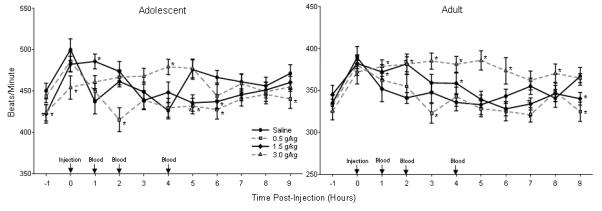
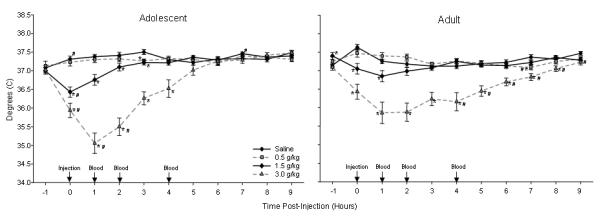
Although the exact cause of the increase in ethanol consumption during adolescence is not known, age differences in sensitivity to some of ethanol's effects may play a contributory role. Prior research has shown little difference in the expression of ethanol-induced tachycardia between adolescents and adults following ethanol inhalation. In contrast, there is mounting evidence of ontogenetic differences in ethanol-induced hypothermia, although the nature of the ontogenetic effect observed has been found to vary across studies and even within labs. Relative ontogenetic differences in body temperature (BT) after ethanol administration appear to be driven in part by the amount of experimental perturbation associated with the test protocol, although differing ethanol exposure levels across studies may also have contributed to the variations in ontogenetic patterns that have been observed. To explore the latter possibility, the present study assessed ethanol-induced hypothermia and tachycardia in adolescent and adult male Sprague-Dawley rats examined in their home cages in the presence of their housing partner following intraperitoneal administration of 0.5, 1.5, or 3.0 g/kg ethanol. The results showed that, although adolescents did not show an adult-typical tachycardic effect at any dose, they proved more sensitive than adults to ethanol's hypothermic effects at the two highest doses. These findings suggest that not only the degree of experimental perturbation, but also the amount of ethanol exposure may differentially effect expression of age differences in ethanol-induced hypothermia, with adolescents showing greater hypothermia than adults at higher doses. Together with previous findings, these data contribute to the emerging picture that age differences in autonomic effects of ethanol appear to be particularly sensitive to dosing parameters and experimental protocols, unlike the generally more consistent ontogenetic findings observed across studies when using behavioral measures of ethanol sensitivity.
虽然尚不清楚青春期乙醇消费量增加的确切原因,但对乙醇某些作用的敏感性存在年龄差异可能起到了一定作用。先前的研究表明,青少年和成年人在吸入乙醇后,乙醇诱发的心动过速表现几乎没有差异。相比之下,越来越多的证据表明乙醇诱发的体温过低存在个体发育差异,尽管在不同研究甚至同一实验室内部,所观察到的个体发育效应的性质都有所不同。乙醇给药后体温(BT)的相对个体发育差异似乎部分是由与测试方案相关的实验干扰程度所驱动的,尽管不同研究中乙醇暴露水平的差异也可能导致了所观察到的个体发育模式的变化。为了探究后一种可能性,本研究评估了在腹腔注射0.5、1.5或3.0 g/kg乙醇后,在其同笼伙伴在场的情况下,于饲养笼中检测的青春期和成年雄性Sprague-Dawley大鼠的乙醇诱发的体温过低和心动过速情况。结果表明,虽然青少年在任何剂量下都未表现出典型的成人心动过速效应,但在两个最高剂量下,他们对乙醇的体温过低效应比成年人更为敏感。这些发现表明,不仅实验干扰程度,而且乙醇暴露量可能对乙醇诱发的体温过低时年龄差异的表达产生不同影响,在较高剂量下青少年比成年人表现出更明显的体温过低。与先前的研究结果一起,这些数据有助于呈现出这样一种新情况:与使用乙醇敏感性行为测量方法时在不同研究中普遍观察到的更为一致的个体发育结果不同,乙醇自主效应的年龄差异似乎对给药参数和实验方案特别敏感。