Collins Natalie, Crossley Kay, Beller Elaine, Darnell Ross, McPoil Thomas, Vicenzino Bill
School of Health and Rehabilitation Sciences, University of Queensland, Brisbane, Australia 4072.
BMJ. 2008 Oct 24;337:a1735. doi: 10.1136/bmj.a1735.
To compare the clinical efficacy of foot orthoses in the management of patellofemoral pain syndrome with flat inserts or physiotherapy, and to investigate the effectiveness of foot orthoses plus physiotherapy.
Prospective, single blind, randomised clinical trial.
Single centre trial within a community setting in Brisbane, Australia.
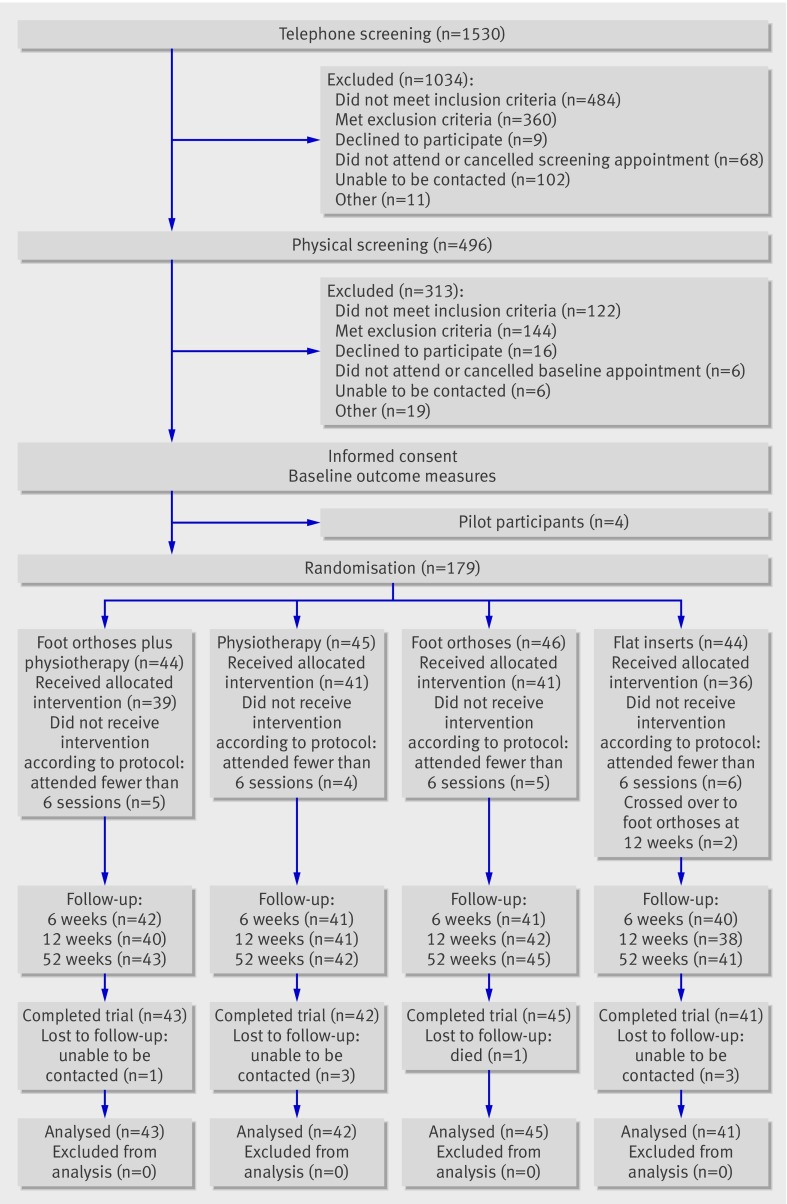
179 participants (100 women) aged 18 to 40 years, with a clinical diagnosis of patellofemoral pain syndrome of greater than six weeks' duration, who had no previous treatment with foot orthoses or physiotherapy in the preceding 12 months.
Six weeks of physiotherapist intervention with off the shelf foot orthoses, flat inserts, multimodal physiotherapy (patellofemoral joint mobilisation, patellar taping, quadriceps muscle retraining, and education), or foot orthoses plus physiotherapy.
Global improvement, severity of usual and worst pain over the preceding week, anterior knee pain scale, and functional index questionnaire measured at 6, 12, and 52 weeks.
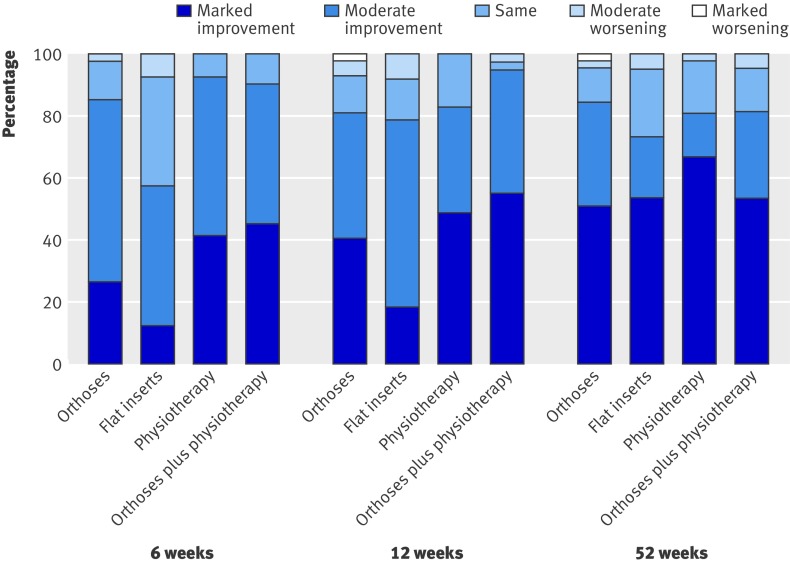
Foot orthoses produced improvement beyond that of flat inserts in the short term, notably at six weeks (relative risk reduction 0.66, 99% confidence interval 0.05 to 1.17; NNT 4 (99% confidence interval 2 to 51). No significant differences were found between foot orthoses and physiotherapy, or between physiotherapy and physiotherapy plus orthoses. All groups showed clinically meaningful improvements in primary outcomes over 52 weeks.
While foot orthoses are superior to flat inserts according to participants' overall perception, they are similar to physiotherapy and do not improve outcomes when added to physiotherapy in the short term management of patellofemoral pain. Given the long term improvement observed in all treatment groups, general practitioners may seek to hasten recovery by prescribing prefabricated orthoses.
Australian Clinical Trials Registry ACTRN012605000463673 and ClinicalTrials.gov NCT00118521.
比较扁平鞋垫或物理治疗与足部矫形器治疗髌股疼痛综合征的临床疗效,并研究足部矫形器联合物理治疗的效果。
前瞻性、单盲、随机临床试验。
澳大利亚布里斯班社区环境中的单中心试验。
179名年龄在18至40岁之间的参与者(100名女性),临床诊断为髌股疼痛综合征且病程超过六周,在过去12个月内未接受过足部矫形器或物理治疗。
六周的物理治疗师干预,包括现成的足部矫形器、扁平鞋垫、多模式物理治疗(髌股关节松动术、髌骨贴扎、股四头肌再训练和教育),或足部矫形器加物理治疗。
在第6、12和52周测量的总体改善情况、前一周通常和最严重疼痛的严重程度、前膝疼痛量表和功能指数问卷。
足部矫形器在短期内的改善效果优于扁平鞋垫,尤其是在六周时(相对风险降低0.66,99%置信区间0.05至1.17;需治疗人数4(99%置信区间2至51)。足部矫形器与物理治疗之间,或物理治疗与物理治疗加矫形器之间未发现显著差异。所有组在52周内的主要结局指标均有临床意义的改善。
虽然根据参与者的总体感知,足部矫形器优于扁平鞋垫,但它们与物理治疗相似,在髌股疼痛的短期管理中,添加到物理治疗中并不能改善结局。鉴于所有治疗组均观察到长期改善,全科医生可能会寻求通过开具预制矫形器来加速康复。
澳大利亚临床试验注册中心ACTRN012605000463673和ClinicalTrials.gov NCT00118521。