Dent Arlene E, Bergmann-Leitner Elke S, Wilson Danny W, Tisch Daniel J, Kimmel Rhonda, Vulule John, Sumba Peter Odada, Beeson James G, Angov Evelina, Moormann Ann M, Kazura James W
Case Western Reserve University, Cleveland, Ohio, USA.
PLoS One. 2008;3(10):e3557. doi: 10.1371/journal.pone.0003557. Epub 2008 Oct 29.
Antibodies that impair Plasmodium falciparum merozoite invasion and intraerythrocytic development are one of several mechanisms that mediate naturally acquired immunity to malaria. Attempts to correlate anti-malaria antibodies with risk of infection and morbidity have yielded inconsistent results. Growth inhibition assays (GIA) offer a convenient method to quantify functional antibody activity against blood stage malaria.
A treatment-time-to-infection study was conducted over 12-weeks in a malaria holoendemic area of Kenya. Plasma collected from healthy individuals (98 children and 99 adults) before artemether-lumefantrine treatment was tested by GIA in three separate laboratories.
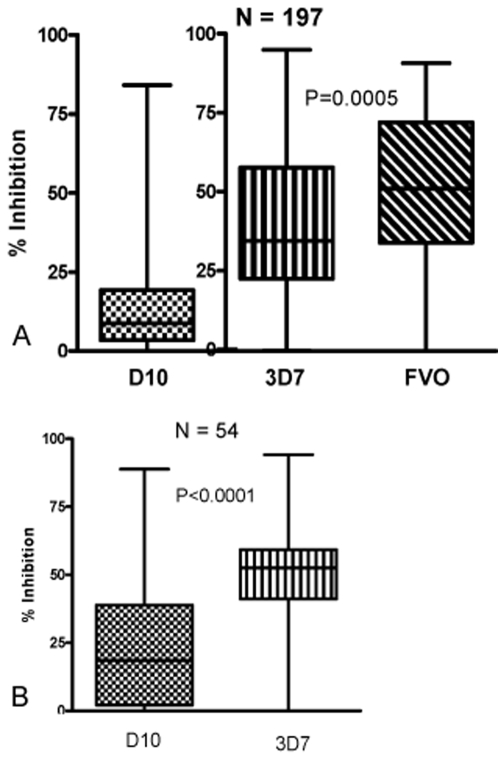
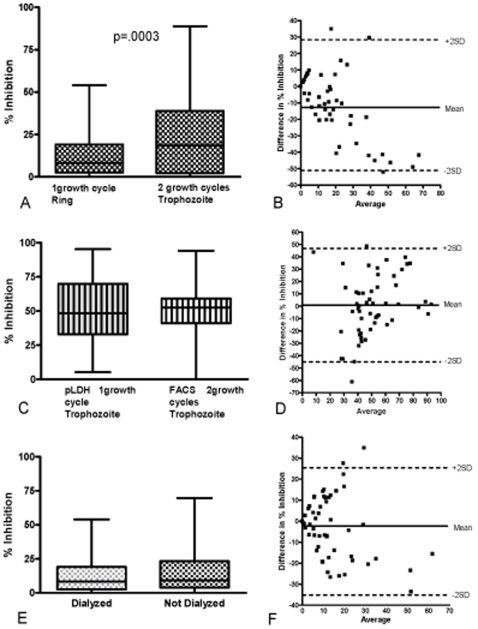
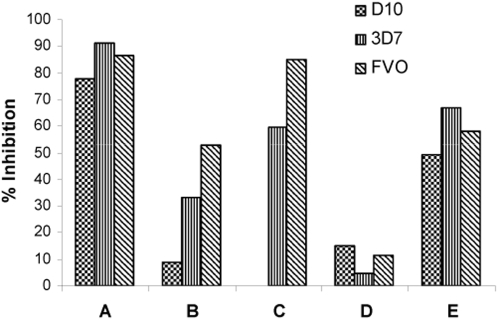
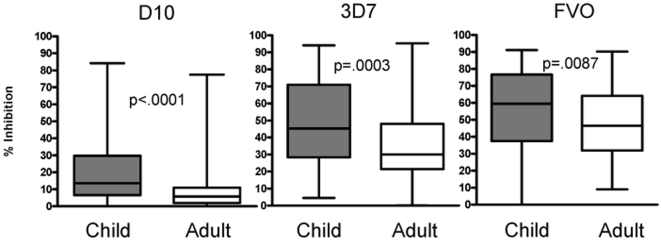
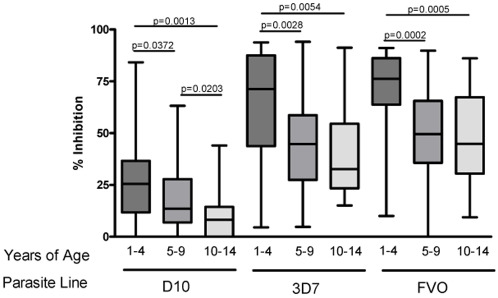
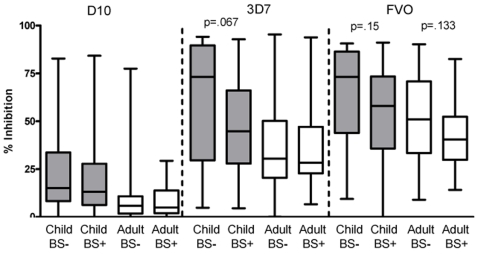
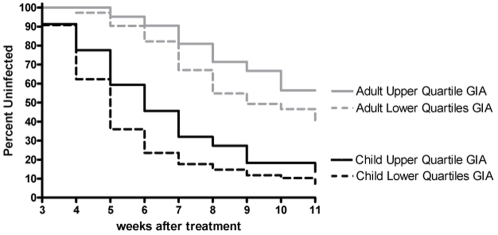
Median GIA levels varied with P. falciparum line (D10, 8.8%; 3D7, 34.9%; FVO, 51.4% inhibition). The magnitude of growth inhibition decreased with age in all P. falciparum lines tested with the highest median levels among children <4 years compared to adults (e.g. 3D7, 45.4% vs. 30.0% respectively, p = 0.0003). Time-to-infection measured by weekly blood smears was significantly associated with level of GIA controlling for age. Upper quartile inhibition activity was associated with less risk of infection compared to individuals with lower levels (e.g. 3D7, hazard ratio = 1.535, 95% CI = 1.012-2.329; p = 0.0438). Various GIA methodologies had little effect on measured parasite growth inhibition.
Plasma antibody-mediated growth inhibition of blood stage P. falciparum decreases with age in residents of a malaria holoendemic area. Growth inhibition assay may be a useful surrogate of protection against infection when outcome is controlled for age.
损害恶性疟原虫裂殖子入侵和红细胞内发育的抗体是介导自然获得性疟疾免疫力的几种机制之一。试图将抗疟疾抗体与感染风险和发病率相关联的研究结果并不一致。生长抑制试验(GIA)提供了一种方便的方法来量化针对血液期疟疾的功能性抗体活性。
在肯尼亚的一个疟疾高度流行地区进行了一项为期12周的治疗至感染时间研究。在三个独立实验室中,通过GIA对在蒿甲醚-本芴醇治疗前从健康个体(98名儿童和99名成人)采集的血浆进行检测。
GIA水平中位数因恶性疟原虫株而异(D10,抑制率8.8%;3D7,34.9%;FVO,51.4%)。在所有测试的恶性疟原虫株中,生长抑制程度随年龄增长而降低,4岁以下儿童的中位数水平最高,高于成年人(例如,3D7分别为45.4%和30.0%,p = 0.0003)。通过每周血涂片测量的感染时间与控制年龄后的GIA水平显著相关。与低水平个体相比,上四分位数抑制活性与较低的感染风险相关(例如,3D7,风险比 = 1.535,95%置信区间 = 1.012 - 2.329;p = 0.0438)。各种GIA方法对测量的寄生虫生长抑制影响很小。
在疟疾高度流行地区的居民中,血浆抗体介导的血液期恶性疟原虫生长抑制随年龄增长而降低。当控制年龄因素时,生长抑制试验可能是预防感染的有用替代指标。