Ikeda Terumasa, Ohsugi Takeo, Kimura Tetsuya, Matsushita Shuzo, Maeda Yosuke, Harada Shinji, Koito Atsushi
Department of Retrovirology and Self-Defense, Faculty of Medical and Pharmaceutical Sciences, Kumamoto University, Kumamoto, Japan.
Nucleic Acids Res. 2008 Dec;36(21):6859-71. doi: 10.1093/nar/gkn802. Epub 2008 Oct 29.
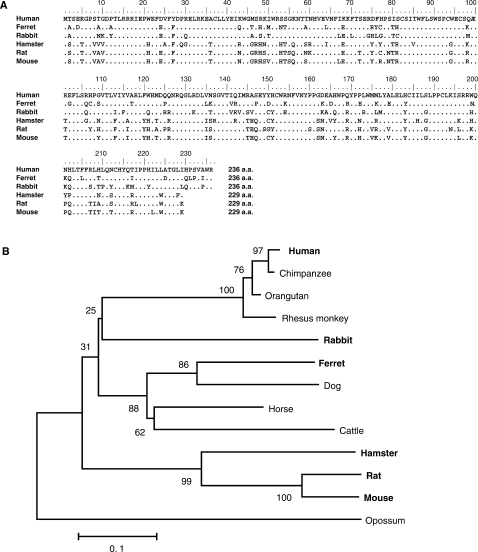
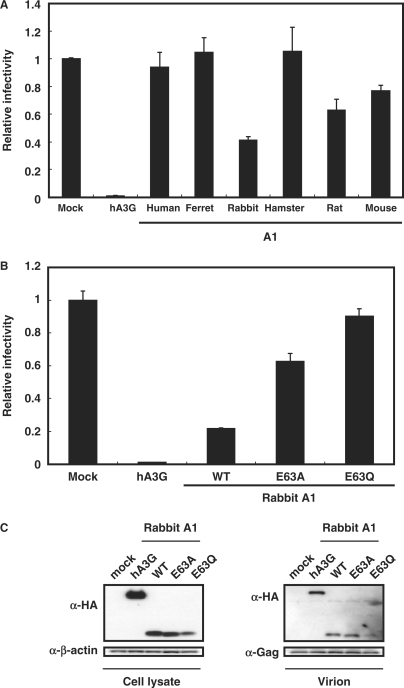
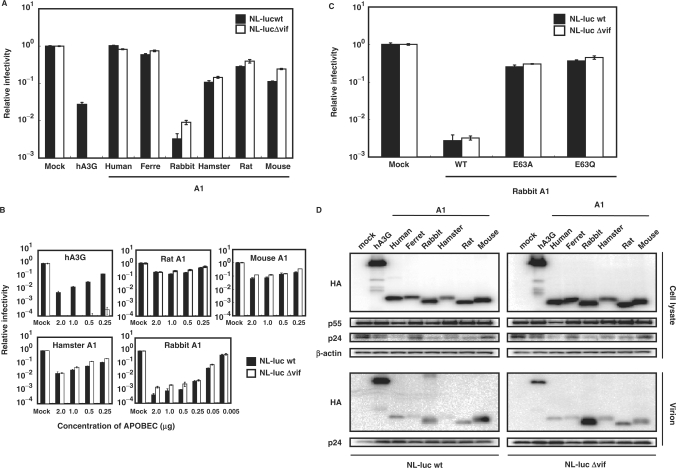
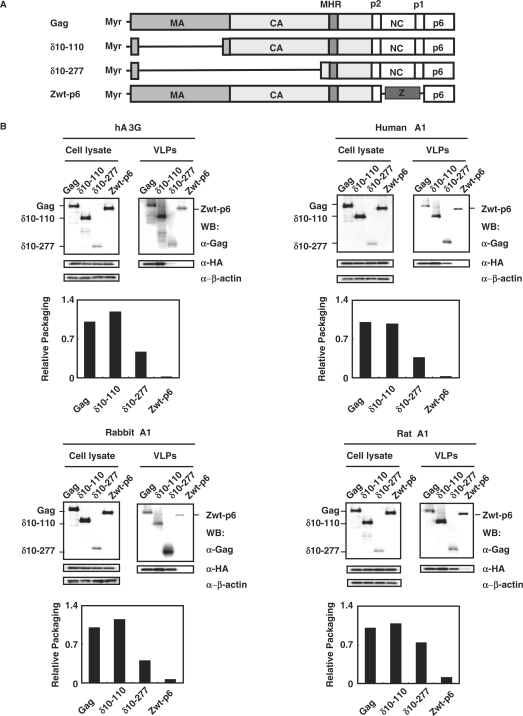
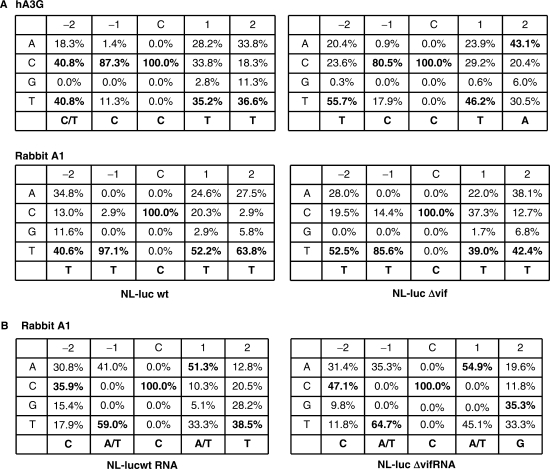
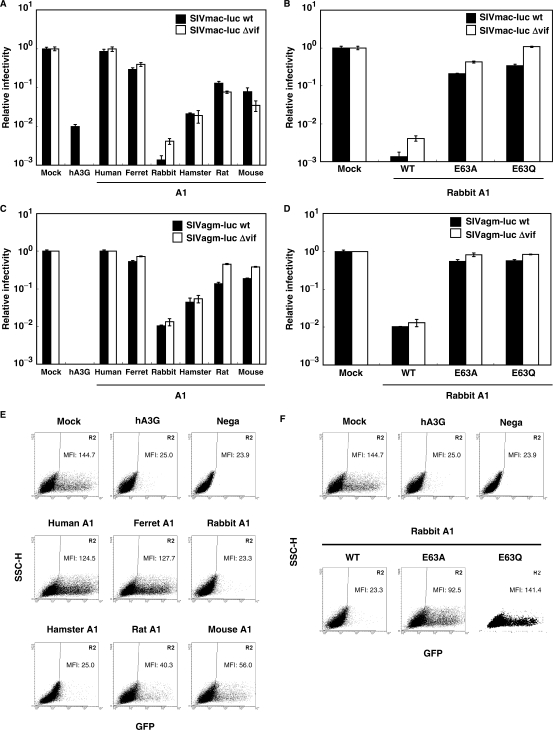
Although the role of the APOBEC3-dependent retroelement restriction system as an intrinsic immune defense against human immunodeficiency virus type1 (HIV-1) infection is becoming clear, only the rat ortholog of mammalian APOBEC1s (A1) thus far has been shown to possess antiviral activity. Here, we cloned A1 cDNAs from small animal species, and showed that similar to rat A1, both wild-type and Deltavif HIV-1 infection was inhibited by mouse and hamster A1 (4- to 10-fold), whereas human A1 had negligible effects. Moreover, rabbit A1 significantly reduced the infectivity of both HIV-1 virions (>300-fold), as well as that of SIVmac, SIVagm, FIV and murine leukemia virus. Immunoblot analysis showed that A1s were efficiently incorporated into the HIV-1 virion, and their packaging is mediated through an interaction with the nucleocapsid Gag domain. Interestingly, there was a clear accumulation of particular C-T changes in the genomic RNAs of HIV-1 produced in their presence, with few G-A changes in the proviral DNA. Together, these data reveal that A1 may function as a defense mechanism, regulating retroelements in a wide range of mammalian species.
尽管载脂蛋白B mRNA编辑酶催化多肽样3(APOBEC3)依赖性逆转录元件限制系统作为针对1型人类免疫缺陷病毒(HIV-1)感染的固有免疫防御的作用正变得清晰,但迄今为止,仅哺乳动物载脂蛋白B mRNA编辑酶1(A1)的大鼠直系同源物已被证明具有抗病毒活性。在此,我们从小动物物种中克隆了A1 cDNA,并表明与大鼠A1相似,野生型和缺失病毒感染因子的HIV-1感染均受到小鼠和仓鼠A1的抑制(4至10倍),而人类A1的作用可忽略不计。此外,兔A1显著降低了HIV-1病毒粒子的感染性(>300倍),以及猴免疫缺陷病毒(SIVmac)、非洲绿猴SIV(SIVagm)、猫免疫缺陷病毒(FIV)和鼠白血病病毒的感染性。免疫印迹分析表明,A1被有效整合到HIV-1病毒粒子中,并且它们的包装通过与核衣壳Gag结构域的相互作用介导。有趣的是,在它们存在的情况下产生的HIV-1基因组RNA中明显积累了特定的C到T变化,而前病毒DNA中的G到A变化很少。总之,这些数据表明A1可能作为一种防御机制,在广泛的哺乳动物物种中调节逆转录元件。