Shin Joo Hwa, Kim Jung Ho, Lee Won Young, Shim Jung Yeon
Department of Pediatrics, Kangbuk Samsung Hospital, Sungkyunkwan University School of Medicine, Seoul, Korea.
Yonsei Med J. 2008 Oct 31;49(5):804-10. doi: 10.3349/ymj.2008.49.5.804.
Obesity is a major risk factor for asthma and it influences airway smooth muscle function and responsiveness. Adiponectin is inversely associated with obesity and its action is mediated through at least 2 cell membrane receptors (AdipoR1 and AdipoR2). Leptin is positively associated with obesity. We investigated whether human airway smooth muscle (ASM) cells express adiponectin receptors and whether adiponectin and leptin regulate human ASM cell proliferation and vascular endothelial growth factor (VEGF) release.
Human ASM cells were growth- arrested in serum-deprived medium for 48 hours and then stimulated with PDGF, adiponectin and leptin. After 48 hours of stimulation, proliferation was determined using a cell proliferation ELISA kit. Human AdipoR1 and -R2 mRNA expressions were determined by RT-PCR using human- specific AdipoR1 and -R2 primers. Concentrations of VEGF, monocyte chemotactic protein (MCP)-1 and macrophage inflammatory protein (MIP)-1alpha in cell culture supernatant were determined by ELISA.
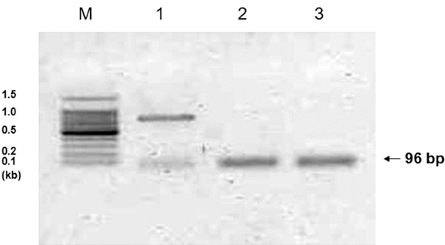
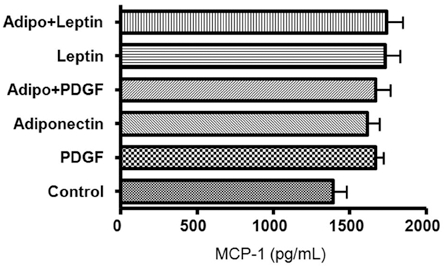
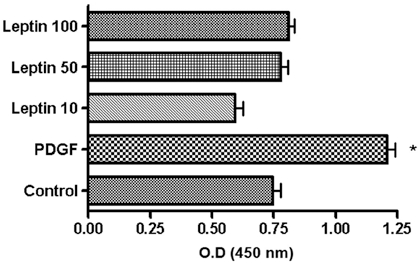
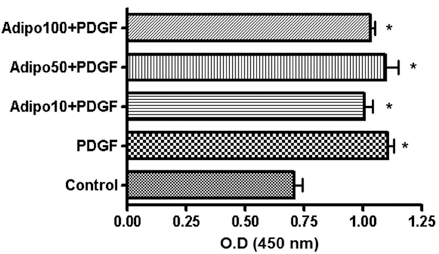
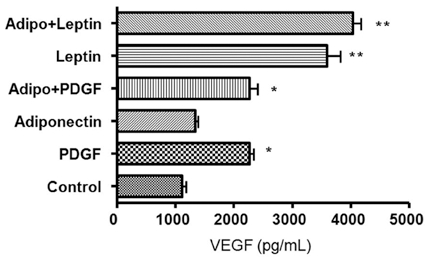
Both AdipoR1 and AdipoR2 mRNA were expressed in the cultured human ASM cells. However, adiponectin did not suppress PDGF-enhanced ASM cell proliferation, nor did leptin promote ASM cell proliferation. Leptin promoted VEGF release by human ASM cells, while adiponectin did not influence VEGF release. Neither leptin nor adiponectin influenced MCP-1 secretion from human ASM cells. Adiponectin and MIP-1alpha were not secreted by human ASM cells.
Human ASM cells expressed adiponectin receptors. However, adiponectin did not regulate human ASM cell proliferation or VEGF release, while leptin stimulated VEGF release by human ASM cells.
肥胖是哮喘的主要危险因素,影响气道平滑肌功能和反应性。脂联素与肥胖呈负相关,其作用通过至少两种细胞膜受体(脂联素受体1和脂联素受体2)介导。瘦素与肥胖呈正相关。我们研究了人气道平滑肌(ASM)细胞是否表达脂联素受体,以及脂联素和瘦素是否调节人ASM细胞增殖和血管内皮生长因子(VEGF)释放。
将人ASM细胞在无血清培养基中生长停滞48小时,然后用血小板衍生生长因子(PDGF)、脂联素和瘦素刺激。刺激48小时后,使用细胞增殖ELISA试剂盒测定增殖情况。使用人特异性脂联素受体1和脂联素受体2引物通过逆转录聚合酶链反应(RT-PCR)测定人脂联素受体1和脂联素受体2 mRNA表达。通过ELISA测定细胞培养上清液中VEGF、单核细胞趋化蛋白(MCP)-1和巨噬细胞炎性蛋白(MIP)-1α的浓度。
脂联素受体1和脂联素受体2 mRNA均在培养的人ASM细胞中表达。然而,脂联素并未抑制PDGF增强的ASM细胞增殖,瘦素也未促进ASM细胞增殖。瘦素促进人ASM细胞释放VEGF,而脂联素不影响VEGF释放。瘦素和脂联素均不影响人ASM细胞分泌MCP-1。人ASM细胞不分泌脂联素和MIP-1α。
人ASM细胞表达脂联素受体。然而,脂联素不调节人ASM细胞增殖或VEGF释放,而瘦素刺激人ASM细胞释放VEGF。