Song Tae Jin, Lee Kee Oog, Kim Dong Joon, Lee Kyung-Yul
Department of Neurology, Yongdong Severance Hospital, Yonsei University College of Medicine, Seoul, Korea.
Yonsei Med J. 2008 Oct 31;49(5):857-9. doi: 10.3349/ymj.2008.49.5.857.
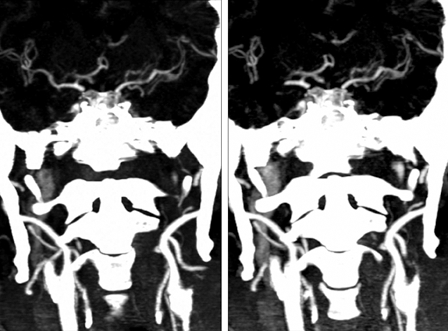
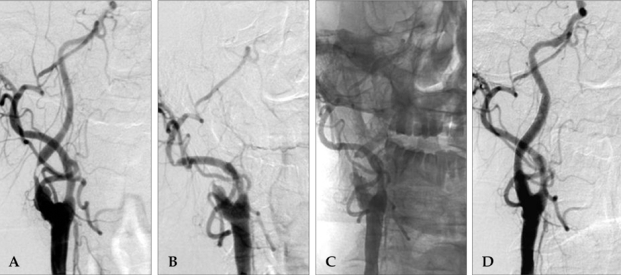
Rapid arterial rethrombosis is associated with high-grade residual stenosis and usually occurs at the site of the initial occlusion, resulting in reocclusion of the recanalized artery. Platelets may play an active role in such rethrombosis after thrombolytic-induced clot lysis. Given that glycoprotein IIb/IIIa receptor blockers, like tirofiban, prevent thrombus formation by inhibiting the final common pathway of platelet aggregation, they may be helpful for treating rethrombosis after thrombolysis. A 64-year-old man presented with an acute ischemic stroke due to internal carotid artery (ICA) occlusion. The ICA was recanalized by intravenous thrombolysis but reoccluded shortly after recanalization. The reoccluded ICA was successfully recanalized using intra-arterial tirofiban. A carotid stent was subsequently inserted to relieve severe stenosis and to prevent recurrent stroke. Here, we report a case of rescue treatment of a successfully recanalized ICA by intra- arterial tirofiban. We suggest that rescue use of intra-arterial tirofiban may be effective and safe, especially in hemorrhage prone situations, due to the relatively lower dose of tirofiban compared with intravenous doses.
动脉快速再血栓形成与高度残余狭窄相关,且通常发生在初始闭塞部位,导致再通动脉再次闭塞。血小板可能在溶栓诱导的血栓溶解后的这种再血栓形成中发挥积极作用。鉴于糖蛋白IIb/IIIa受体阻滞剂(如替罗非班)通过抑制血小板聚集的最终共同途径来预防血栓形成,它们可能有助于治疗溶栓后的再血栓形成。一名64岁男性因颈内动脉(ICA)闭塞出现急性缺血性卒中。ICA通过静脉溶栓实现再通,但再通后不久又再次闭塞。使用动脉内替罗非班成功使再次闭塞的ICA实现再通。随后插入颈动脉支架以缓解严重狭窄并预防复发性卒中。在此,我们报告一例通过动脉内替罗非班对成功再通的ICA进行抢救治疗的病例。我们认为,由于与静脉剂量相比替罗非班剂量相对较低,动脉内替罗非班的抢救性使用可能有效且安全,尤其是在易出血的情况下。