Liu Aizhuo, Wang Jifeng, Lu Zhenwei, Yao Lishan, Li Yue, Yan Honggao
Department of Biochemistry and Molecular Biology, Michigan State University, East Lansing, MI 48824, USA.
Chembiochem. 2008 Nov 24;9(17):2860-71. doi: 10.1002/cbic.200800467.
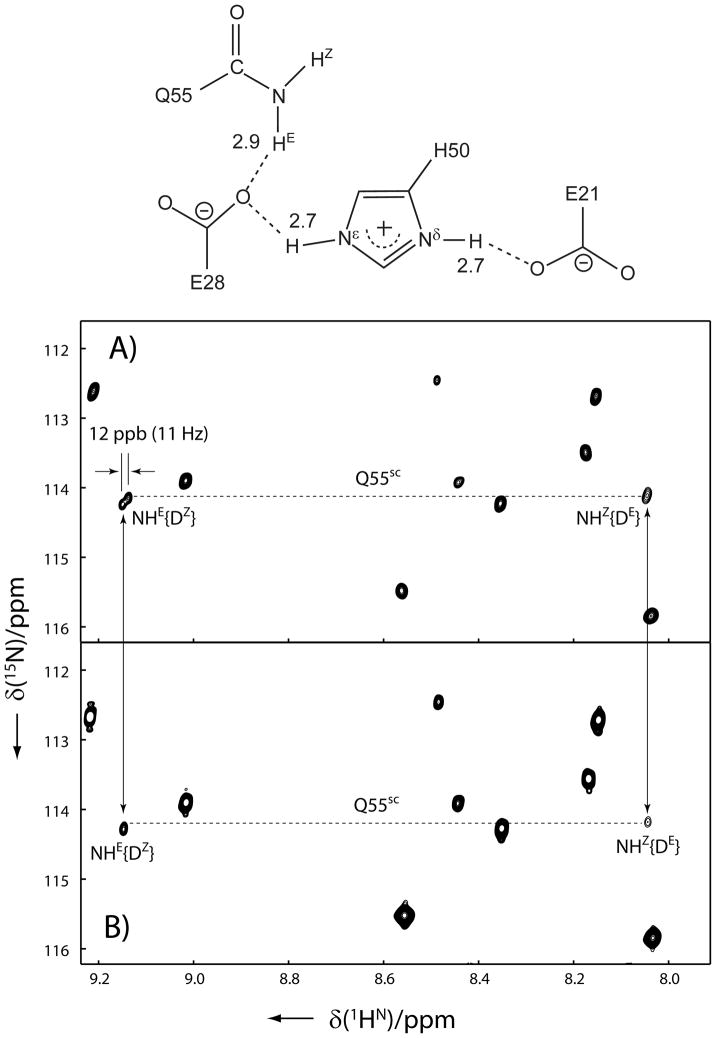
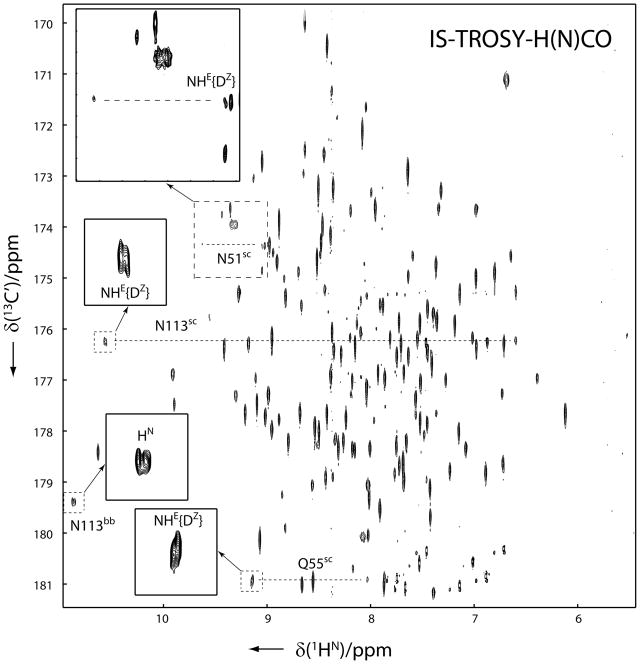
The configuration and hydrogen-bonding network of side-chain amides in a 35 kDa protein were determined by measuring differential and trans-hydrogen-bond H/D isotope effects by using the isotopomer-selective (IS)-TROSY technique, which leads to a reliable recognition and correction of erroneous rotamers that are frequently found in protein structures. First, the differential two-bond isotope effects on carbonyl (13)C' shifts, which are defined as Delta(2)Delta(13)C'(ND) = (2)Delta(13)C'(ND(E))-(2)Delta(13)C'(ND(Z)), provide a reliable means for the configuration assignment for side-chain amides, because environmental effects (hydrogen bonds and charges, etc.) are greatly attenuated over the two bonds that separate the carbon and hydrogen atoms, and the isotope effects fall into a narrow range of positive values. Second and more importantly, the significant variations in the differential one-bond isotope effects on (15)N chemical shifts, which are defined as Delta(1)Delta(15)N(D) = (1)Delta(15)N(D(E))-(1)Delta(15)N(D(Z)) can be correlated with hydrogen-bonding interactions, particularly those involving charged acceptors. The differential one-bond isotope effects are additive, with major contributions from intrinsic differential conjugative interactions between the E and Z configurations, H-bonding interactions, and charge effects. Furthermore, the pattern of trans-H-bond H/D isotope effects can be mapped onto more complicated hydrogen-bonding networks that involve bifurcated hydrogen-bonds. Third, the correlations between Delta(1)Delta(15)N(D) and hydrogen-bonding interactions afford an effective means for the correction of erroneous rotamer assignments of side-chain amides. Rotamer correction by differential isotope effects is not only robust, but also simple and can be applied to large proteins.
通过使用同位素异构体选择性(IS)-TROSY技术测量差分和顺式氢键H/D同位素效应,确定了一种35 kDa蛋白质中侧链酰胺的构型和氢键网络,该技术能够可靠地识别和校正蛋白质结构中常见的错误旋转异构体。首先,羰基(13)C'位移上的差分双键同位素效应,定义为Delta(2)Delta(13)C'(ND) = (2)Delta(13)C'(ND(E))-(2)Delta(13)C'(ND(Z)),为侧链酰胺的构型分配提供了可靠手段,因为环境效应(氢键和电荷等)在分隔碳和氢原子的两个键上大大减弱,且同位素效应落入一个狭窄的正值范围。其次且更重要的是,(15)N化学位移上的差分单键同位素效应的显著变化,定义为Delta(1)Delta(15)N(D) = (1)Delta(15)N(D(E))-(1)Delta(15)N(D(Z)),可以与氢键相互作用相关联,特别是那些涉及带电受体的相互作用。差分单键同位素效应是可加的,主要贡献来自E和Z构型之间的固有差分共轭相互作用、氢键相互作用和电荷效应。此外,反式氢键H/D同位素效应的模式可以映射到涉及分叉氢键的更复杂的氢键网络上。第三,Delta(1)Delta(15)N(D)与氢键相互作用之间的相关性为校正侧链酰胺的错误旋转异构体分配提供了有效手段。通过差分同位素效应进行旋转异构体校正不仅稳健,而且简单,可应用于大型蛋白质。