Genereux Diane P, Johnson Winslow C, Burden Alice F, Stöger Reinhard, Laird Charles D
Department of Biology, University of Washington, Seattle, WA 98195, USA.
Nucleic Acids Res. 2008 Dec;36(22):e150. doi: 10.1093/nar/gkn691. Epub 2008 Nov 4.
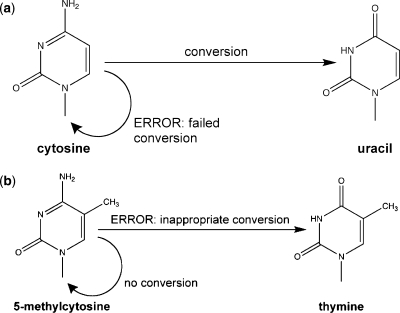
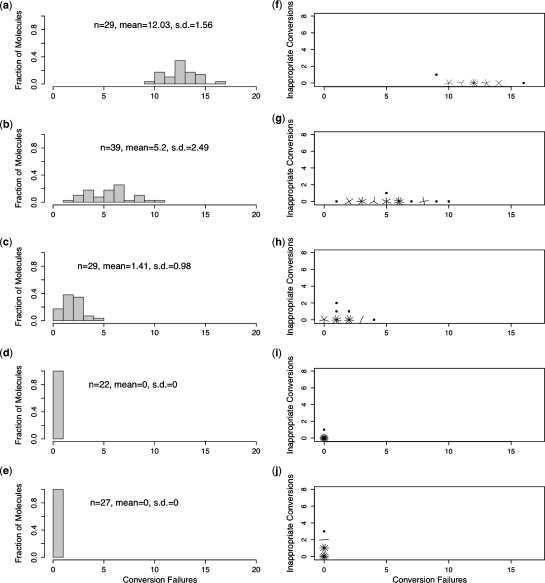
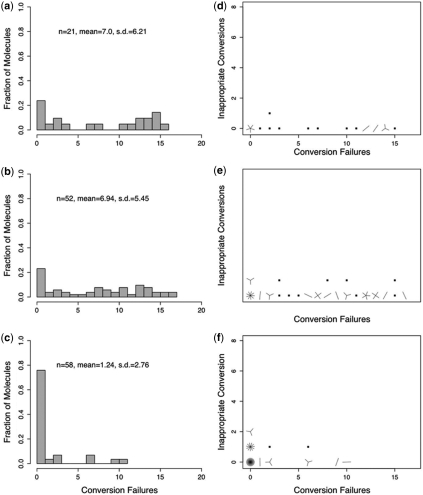
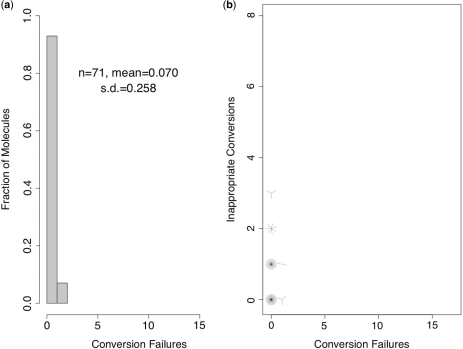
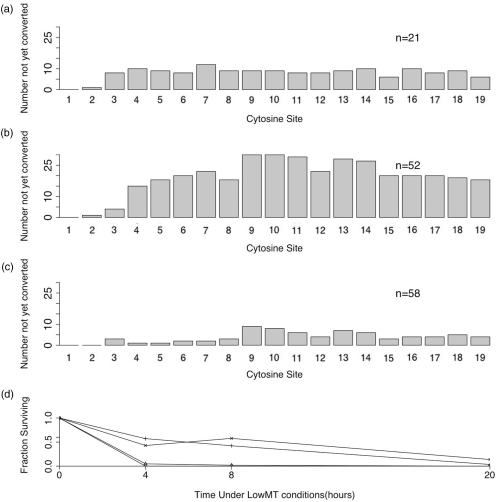
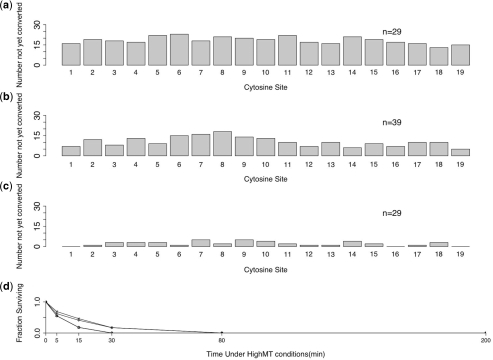
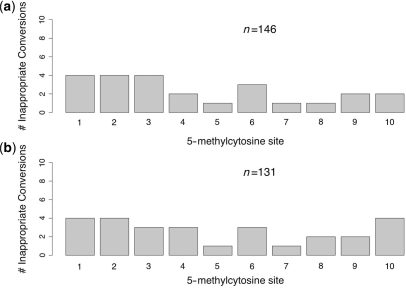
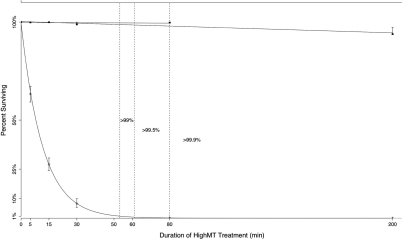
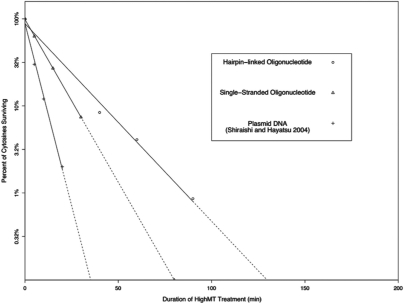
Bisulfite treatment can be used to ascertain the methylation states of individual cytosines in DNA. Ideally, bisulfite treatment deaminates unmethylated cytosines to uracils, and leaves 5-methylcytosines unchanged. Two types of bisulfite-conversion error occur: inappropriate conversion of 5-methylcytosine to thymine, and failure to convert unmethylated cytosine to uracil. Conventional bisulfite treatment requires hours of exposure to low-molarity, low-temperature bisulfite ('LowMT') and, sometimes, thermal denaturation. An alternate, high-molarity, high-temperature ('HighMT') protocol has been reported to accelerate conversion and to reduce inappropriate conversion. We used molecular encoding to obtain validated, individual-molecule data on failed- and inappropriate-conversion frequencies for LowMT and HighMT treatments of both single-stranded and hairpin-linked oligonucleotides. After accounting for bisulfite-independent error, we found that: (i) inappropriate-conversion events accrue predominantly on molecules exposed to bisulfite after they have attained complete or near-complete conversion; (ii) the HighMT treatment is preferable because it yields greater homogeneity among sites and among molecules in conversion rates, and thus yields more reliable data; (iii) different durations of bisulfite treatment will yield data appropriate to address different experimental questions; and (iv) conversion errors can be used to assess the validity of methylation data collected without the benefit of molecular encoding.
亚硫酸氢盐处理可用于确定DNA中单个胞嘧啶的甲基化状态。理想情况下,亚硫酸氢盐处理会将未甲基化的胞嘧啶脱氨基转化为尿嘧啶,而5-甲基胞嘧啶则保持不变。会出现两种类型的亚硫酸氢盐转化错误:5-甲基胞嘧啶不恰当地转化为胸腺嘧啶,以及未甲基化的胞嘧啶未能转化为尿嘧啶。传统的亚硫酸氢盐处理需要数小时暴露于低摩尔浓度、低温的亚硫酸氢盐(“低甲基化温度”)下,有时还需要热变性处理。据报道,另一种高摩尔浓度、高温(“高甲基化温度”)方案可加速转化并减少不恰当转化。我们使用分子编码来获取经过验证的单分子数据,以了解单链和发夹连接的寡核苷酸在低甲基化温度和高甲基化温度处理下的转化失败和不恰当转化频率。在考虑了与亚硫酸氢盐无关的误差后,我们发现:(i)不恰当转化事件主要发生在分子达到完全或接近完全转化后再暴露于亚硫酸氢盐的情况下;(ii)高甲基化温度处理更可取,因为它在转化率方面在位点和分子之间产生更大的同质性,从而产生更可靠的数据;(iii)不同时长的亚硫酸氢盐处理将产生适合解决不同实验问题的数据;(iv)转化错误可用于评估在没有分子编码的情况下收集的甲基化数据的有效性。