Dyck Miriam, Winbeck Maren, Leiberg Susanne, Chen Yuhan, Gur Ruben C, Mathiak Klaus
Department of Psychiatry and Psychotherapy, RWTH Aachen University, Aachen, Germany.
PLoS One. 2008;3(11):e3628. doi: 10.1371/journal.pone.0003628. Epub 2008 Nov 5.
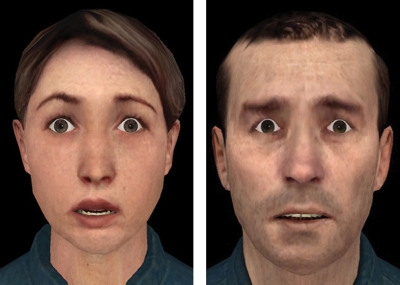
Computer-generated virtual faces become increasingly realistic including the simulation of emotional expressions. These faces can be used as well-controlled, realistic and dynamic stimuli in emotion research. However, the validity of virtual facial expressions in comparison to natural emotion displays still needs to be shown for the different emotions and different age groups.
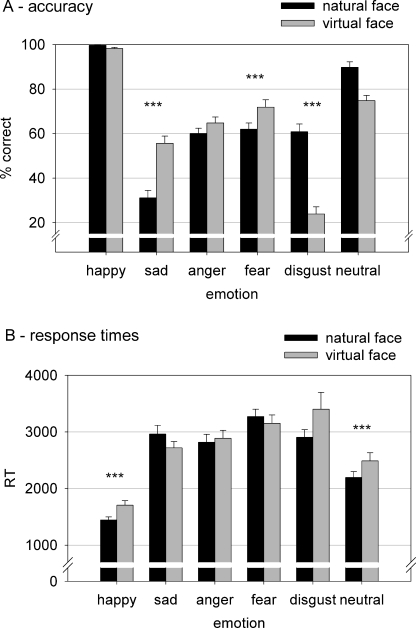
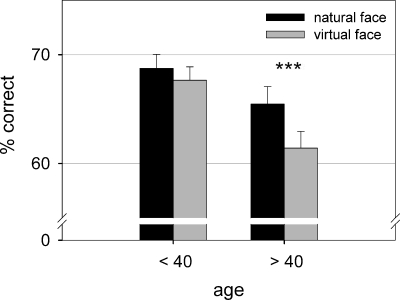
METHODOLOGY/PRINCIPAL FINDINGS: Thirty-two healthy volunteers between the age of 20 and 60 rated pictures of natural human faces and faces of virtual characters (avatars) with respect to the expressed emotions: happiness, sadness, anger, fear, disgust, and neutral. Results indicate that virtual emotions were recognized comparable to natural ones. Recognition differences in virtual and natural faces depended on specific emotions: whereas disgust was difficult to convey with the current avatar technology, virtual sadness and fear achieved better recognition results than natural faces. Furthermore, emotion recognition rates decreased for virtual but not natural faces in participants over the age of 40. This specific age effect suggests that media exposure has an influence on emotion recognition.
CONCLUSIONS/SIGNIFICANCE: Virtual and natural facial displays of emotion may be equally effective. Improved technology (e.g. better modelling of the naso-labial area) may lead to even better results as compared to trained actors. Due to the ease with which virtual human faces can be animated and manipulated, validated artificial emotional expressions will be of major relevance in future research and therapeutic applications.
计算机生成的虚拟面孔越来越逼真,包括对情感表达的模拟。这些面孔可作为情感研究中受到良好控制、逼真且动态的刺激物。然而,与自然情感表达相比,虚拟面部表情在不同情感和不同年龄组中的有效性仍有待证明。
方法/主要发现:32名年龄在20至60岁之间的健康志愿者对自然人脸图片和虚拟角色(化身)的面部图片在表达的情感方面进行评分,这些情感包括:快乐、悲伤、愤怒、恐惧、厌恶和中性。结果表明,虚拟情感与自然情感的识别效果相当。虚拟面孔和自然面孔的识别差异取决于特定情感:虽然当前的化身技术难以传达厌恶之情,但虚拟悲伤和恐惧的识别效果比自然面孔更好。此外,40岁以上参与者对虚拟面孔而非自然面孔的情感识别率有所下降。这种特定的年龄效应表明,媒体接触对情感识别有影响。
结论/意义:虚拟和自然的面部情感表达可能同样有效。与训练有素的演员相比,改进的技术(例如更好地模拟鼻唇区域)可能会带来更好的效果。由于虚拟人脸易于进行动画制作和操控,经过验证的人工情感表达在未来研究和治疗应用中将具有重要意义。