Naqvi Nasir H, Bechara Antoine
Department of Psychiatry, Columbia University and New York State Psychiatric Institute, New York, NY 1032, USA.
Trends Neurosci. 2009 Jan;32(1):56-67. doi: 10.1016/j.tins.2008.09.009. Epub 2008 Nov 3.
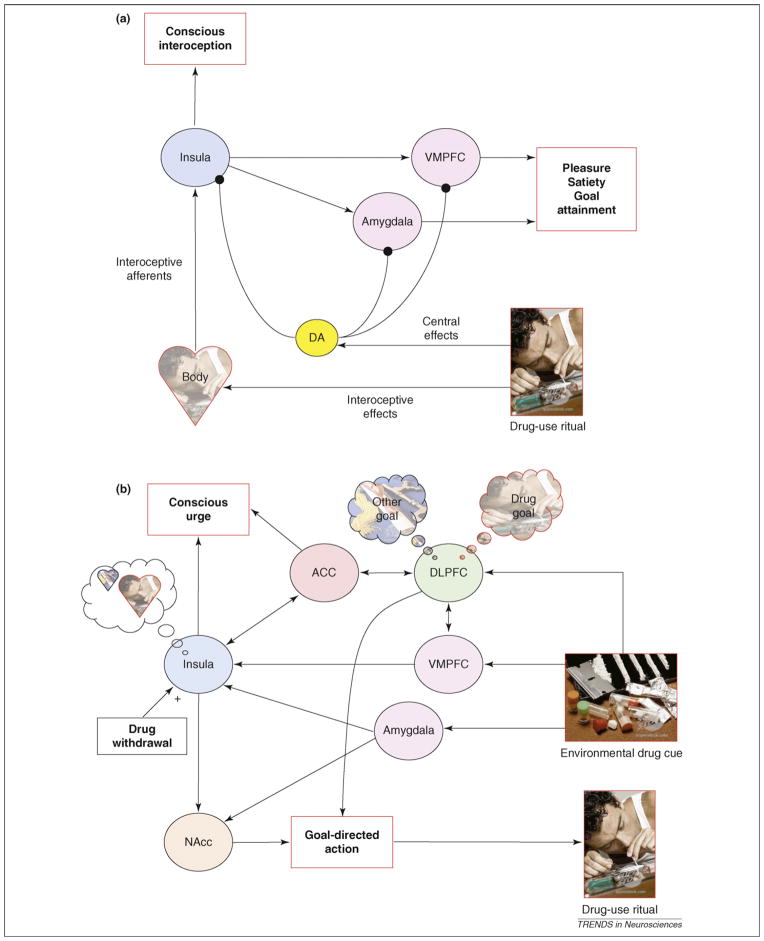
Most prior research on the neurobiology of addiction has focused on the role of subcortical systems, such as the amygdala, the ventral striatum and mesolimbic dopamine system, in promoting the motivation to seek drugs. Recent evidence indicates that a largely overlooked structure, the insula, plays a crucial part in conscious urges to take drugs. The insula has been highlighted as a region that integrates interoceptive (i.e. bodily) states into conscious feelings and into decision-making processes that involve uncertain risk and reward. Here, we propose a model in which the processing of the interoceptive effects of drug use by the insula contributes to conscious drug urges and to decision-making processes that precipitate relapse.
以往大多数关于成瘾神经生物学的研究都集中在皮层下系统的作用上,比如杏仁核、腹侧纹状体和中脑边缘多巴胺系统,它们在促使人们产生寻求毒品的动机方面发挥着作用。最近有证据表明,一个在很大程度上被忽视的结构——脑岛,在有意识的吸毒冲动中起着关键作用。脑岛被视为一个将内感受(即身体)状态整合到有意识的感觉以及涉及不确定风险和回报的决策过程中的区域。在此,我们提出一个模型,其中脑岛对药物使用的内感受效应的处理会导致有意识的药物冲动以及促成复吸的决策过程。