
通过洗手协助痴呆老年人的COACH提示系统:一项疗效研究。
The COACH prompting system to assist older adults with dementia through handwashing: an efficacy study.
作者信息
Mihailidis Alex, Boger Jennifer N, Craig Tammy, Hoey Jesse
机构信息
Department of Occupational Science and Occupational Therapy, University of Toronto, 160-500 University Ave, Toronto, ON, M5G 1V7, Canada.
出版信息
BMC Geriatr. 2008 Nov 7;8:28. doi: 10.1186/1471-2318-8-28.
BACKGROUND
Many older adults with dementia require constant assistance from a caregiver when completing activities of daily living (ADL). This study examines the efficacy of a computerized device intended to assist people with dementia through ADL, while reducing caregiver burden. The device, called COACH, uses artificial intelligence to autonomously guide an older adult with dementia through the ADL using audio and/or audio-video prompts.
METHODS
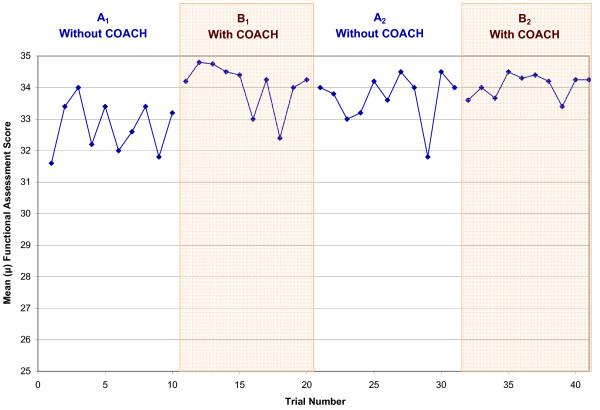
Six older adults with moderate-to-severe dementia participated in this study. Handwashing was chosen as the target ADL. A single subject research design was used with two alternating baseline (COACH not used) and intervention (COACH used) phases. The data were analyzed to investigate the impact of COACH on the participants' independence and caregiver burden as well as COACH's overall performance for the activity of handwashing.
RESULTS
Participants with moderate-level dementia were able to complete an average of 11% more handwashing steps independently and required 60% fewer interactions with a human caregiver when COACH was in use. Four of the participants achieved complete or very close to complete independence. Interestingly, participants' MMSE scores did not appear to robustly coincide with handwashing performance and/or responsiveness to COACH; other idiosyncrasies of each individual seem to play a stronger role. While the majority (78%) of COACH's actions were considered clinically correct, areas for improvement were identified.
CONCLUSION
The COACH system shows promise as a tool to help support older adults with moderate-levels of dementia and their caregivers. These findings reinforce the need for flexibility and dynamic personalization in devices designed to assist older adults with dementia. After addressing identified improvements, the authors plan to run clinical trials with a sample of community-dwelling older adults and caregivers.
背景
许多患有痴呆症的老年人在完成日常生活活动(ADL)时需要护理人员的持续协助。本研究考察了一种旨在通过日常生活活动帮助痴呆症患者并减轻护理人员负担的计算机化设备的功效。该设备名为COACH,它利用人工智能通过音频和/或音频 - 视频提示,自主引导患有痴呆症的老年人完成日常生活活动。
方法
六名患有中度至重度痴呆症的老年人参与了本研究。洗手被选为目标日常生活活动。采用单受试者研究设计,包括两个交替的基线(未使用COACH)和干预(使用COACH)阶段。对数据进行分析,以研究COACH对参与者独立性和护理人员负担的影响,以及COACH在洗手活动中的整体表现。
结果
在使用COACH时,患有中度痴呆症的参与者能够独立完成的洗手步骤平均多11%,与护理人员的互动需求减少60%。四名参与者实现了完全或非常接近完全独立。有趣的是,参与者的简易精神状态检查表(MMSE)分数似乎与洗手表现和/或对COACH的反应没有强烈的一致性;每个个体的其他特质似乎起到了更强的作用。虽然COACH的大多数(78%)行为被认为在临床上是正确的,但仍发现了需要改进的方面。
结论
COACH系统有望成为帮助支持中度痴呆症老年人及其护理人员的工具。这些发现强化了在设计用于协助痴呆症老年人的设备中需要灵活性和动态个性化的需求。在解决已确定的改进问题后,作者计划对社区居住的老年人和护理人员样本进行临床试验。


 Zotero 插件