Rohrbeck Astrid, Neukirchen Judith, Rosskopf Michael, Pardillos Guillermo G, Geddert Helene, Schwalen Andreas, Gabbert Helmut E, von Haeseler Arndt, Pitschke Gerald, Schott Matthias, Kronenwett Ralf, Haas Rainer, Rohr Ulrich-Peter
Department of Hematology, Oncology and Clinical Immunology, Heinrich-Heine-University Duesseldorf, Duesseldorf, Germany.
J Transl Med. 2008 Nov 7;6:69. doi: 10.1186/1479-5876-6-69.
We examined gene expression profiles of tumor cells from 29 untreated patients with lung cancer (10 adenocarcinomas (AC), 10 squamous cell carcinomas (SCC), and 9 small cell lung cancer (SCLC)) in comparison to 5 samples of normal lung tissue (NT). The European and American methodological quality guidelines for microarray experiments were followed, including the stipulated use of laser capture microdissection for separation and purification of the lung cancer tumor cells from surrounding tissue.
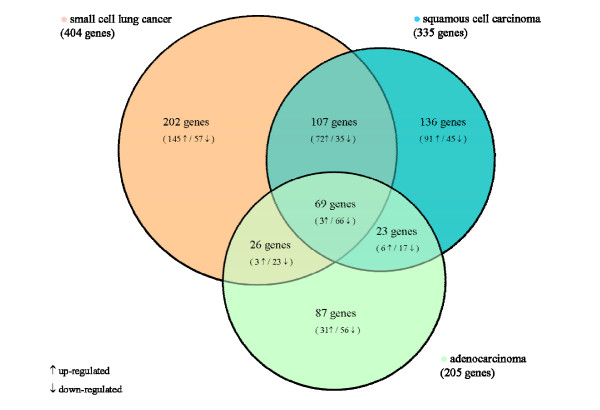
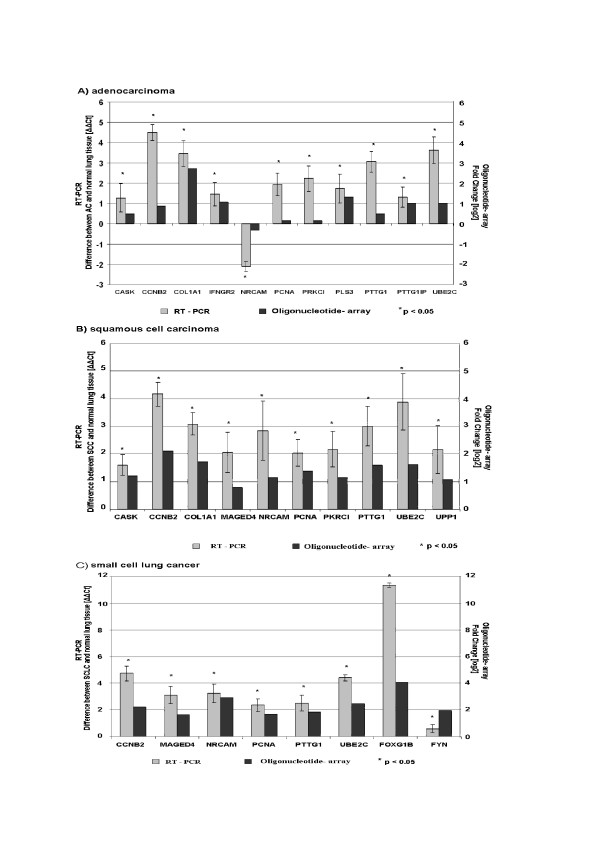
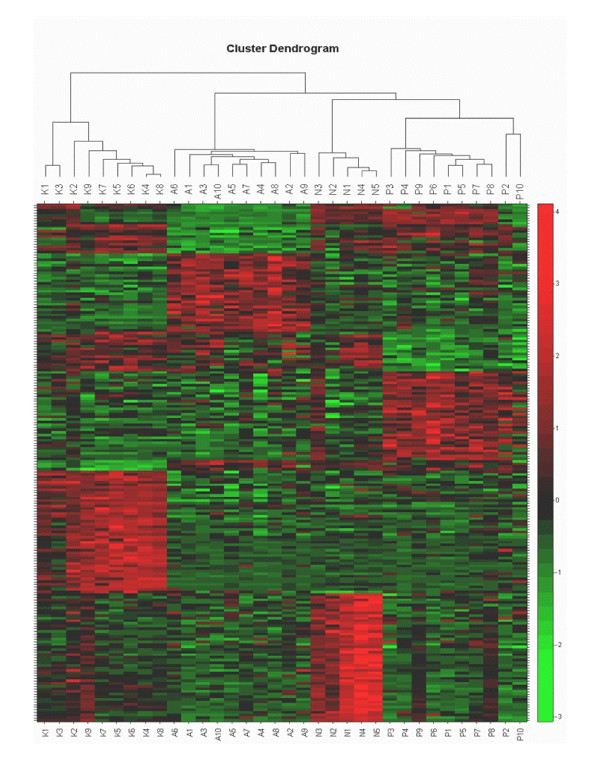
Based on differentially expressed genes, different lung cancer samples could be distinguished from each other and from normal lung tissue using hierarchical clustering. Comparing AC, SCC and SCLC with NT, we found 205, 335 and 404 genes, respectively, that were at least 2-fold differentially expressed (estimated false discovery rate: < 2.6%). Different lung cancer subtypes had distinct molecular phenotypes, which also reflected their biological characteristics. Differentially expressed genes in human lung tumors which may be of relevance in the respective lung cancer subtypes were corroborated by quantitative real-time PCR. Genetic programming (GP) was performed to construct a classifier for distinguishing between AC, SCC, SCLC, and NT. Forty genes, that could be used to correctly classify the tumor or NT samples, have been identified. In addition, all samples from an independent test set of 13 further tumors (AC or SCC) were also correctly classified.
The data from this research identified potential candidate genes which could be used as the basis for the development of diagnostic tools and lung tumor type-specific targeted therapies.
我们检测了29例未经治疗的肺癌患者(10例腺癌(AC)、10例鳞状细胞癌(SCC)和9例小细胞肺癌(SCLC))肿瘤细胞的基因表达谱,并与5份正常肺组织(NT)样本进行比较。遵循了欧美微阵列实验的方法学质量指南,包括规定使用激光捕获显微切割技术从周围组织中分离和纯化肺癌肿瘤细胞。
基于差异表达基因,通过层次聚类可以区分不同的肺癌样本以及它们与正常肺组织的差异。将AC、SCC和SCLC与NT进行比较,我们分别发现了205、335和404个基因,其表达差异至少为2倍(估计错误发现率:<2.6%)。不同的肺癌亚型具有独特的分子表型,这也反映了它们的生物学特征。通过定量实时PCR证实了人类肺肿瘤中可能与各自肺癌亚型相关的差异表达基因。进行了遗传编程(GP)以构建区分AC、SCC、SCLC和NT的分类器。已经鉴定出40个可用于正确分类肿瘤或NT样本的基因。此外,来自13个其他肿瘤(AC或SCC)的独立测试集的所有样本也被正确分类。
本研究的数据确定了潜在的候选基因,这些基因可作为开发诊断工具和肺癌类型特异性靶向治疗的基础。