Simon Dawn M, Zimmerly Steven
Department of Biological Sciences, University of Calgary, Calgary, Alberta, Canada.
Nucleic Acids Res. 2008 Dec;36(22):7219-29. doi: 10.1093/nar/gkn867. Epub 2008 Nov 12.
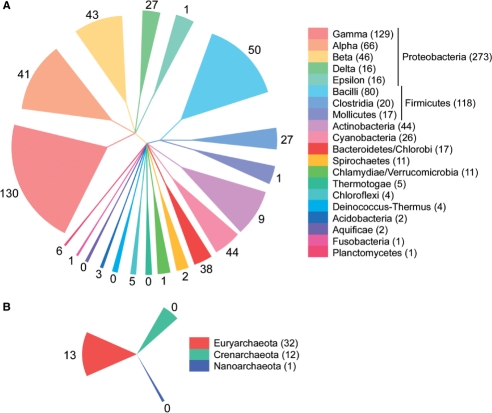
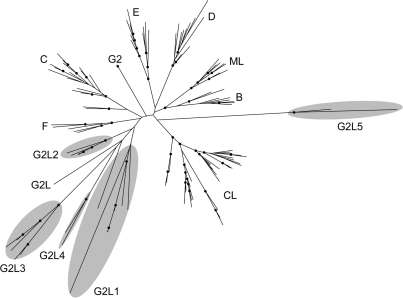
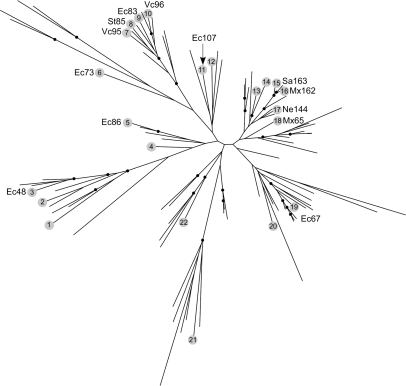
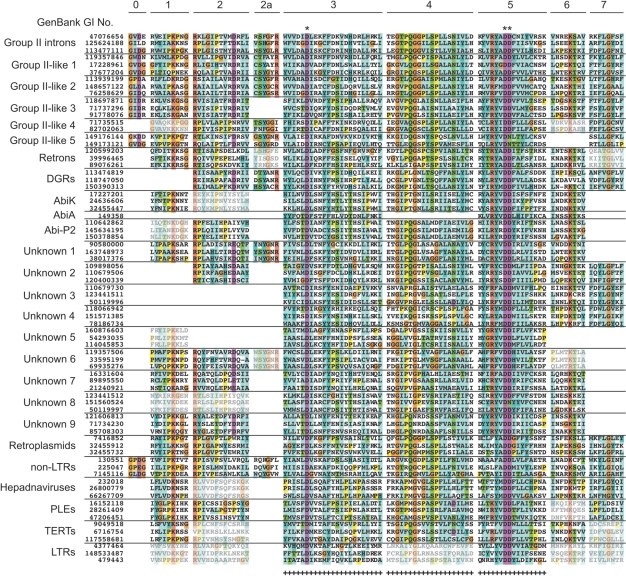
Retroelements are usually considered to be eukaryotic elements because of the large number and variety in eukaryotic genomes. By comparison, reverse transcriptases (RTs) are rare in bacteria, with only three characterized classes: retrons, group II introns and diversity-generating retroelements (DGRs). Here, we present the results of a bioinformatic survey that aims to define the landscape of RTs across eubacterial, archaeal and phage genomes. We identify and categorize 1021 RTs, of which the majority are group II introns (73%). Surprisingly, a plethora of novel RTs are found that do not belong to characterized classes. The RTs have 11 domain architectures and are classified into 20 groupings based on sequence similarity, phylogenetic analyses and open reading frame domain structures. Interestingly, group II introns are the only bacterial RTs to exhibit clear evidence for independent mobility, while five other groups have putative functions in defense against phage infection or promotion of phage infection. These examples suggest that additional beneficial functions will be discovered among uncharacterized RTs. The study lays the groundwork for experimental characterization of these highly diverse sequences and has implications for the evolution of retroelements.
由于真核生物基因组中反转录元件数量众多且种类多样,它们通常被认为是真核生物元件。相比之下,反转录酶(RTs)在细菌中很罕见,只有三个已被鉴定的类别:反转录子、II类内含子和多样性产生反转元件(DGRs)。在这里,我们展示了一项生物信息学调查的结果,该调查旨在确定真细菌、古细菌和噬菌体基因组中RTs的全貌。我们识别并分类了1021个RTs,其中大多数是II类内含子(73%)。令人惊讶的是,发现了大量不属于已鉴定类别的新型RTs。这些RTs具有11种结构域架构,并根据序列相似性、系统发育分析和开放阅读框结构域结构分为20个类别。有趣的是,II类内含子是唯一有明确证据表明具有独立移动性的细菌RTs,而其他五个类别在抵御噬菌体感染或促进噬菌体感染方面具有推定功能。这些例子表明,在未鉴定的RTs中还会发现其他有益功能。该研究为这些高度多样化序列的实验表征奠定了基础,并对反转录元件的进化具有启示意义。