Lee Ji-Hyun, Song Mi-Young, Song Eun-Kyung, Kim Eun-Kyung, Moon Woo Sung, Han Myung-Kwan, Park Jin-Woo, Kwon Kang-Beom, Park Byung-Hyun
Department of Biochemistry, Medical School and Diabetes Research Center, Chonbuk National University, Jeonju, Jeonbuk, Korea.
Diabetes. 2009 Feb;58(2):344-51. doi: 10.2337/db07-1795. Epub 2008 Nov 13.
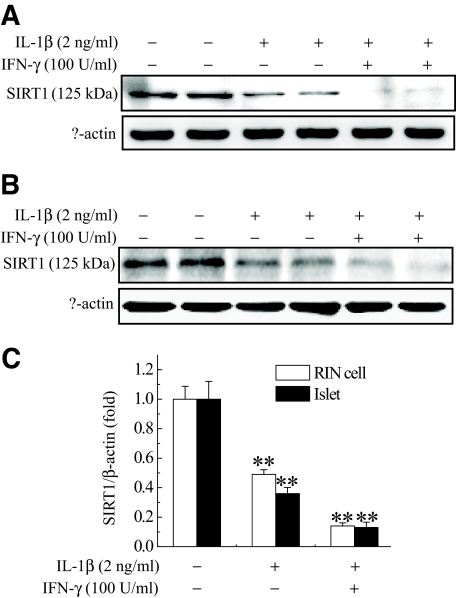
SIRT1, a class III histone/protein deacetylase, is known to interfere with the nuclear factor-kappaB (NF-kappaB) signaling pathway and thereby has an anti-inflammatory function. Because of the central role of NF-kappaB in cytokine-mediated pancreatic beta-cell damage, we postulated that SIRT1 might work in pancreatic beta-cell damage models.
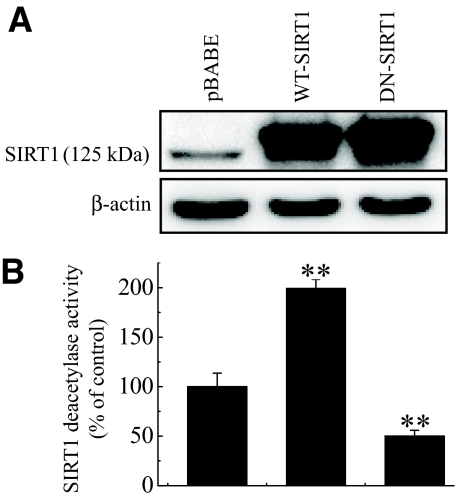
RINm5F (RIN) cells or isolated rat islets were treated with interleukin-1beta and interferon-gamma. SIRT1 was activated by resveratrol, a pharmacological activator, or ectopic overexpression. The underlying mechanisms of SIRT1 against cytokine toxicity were further explored.
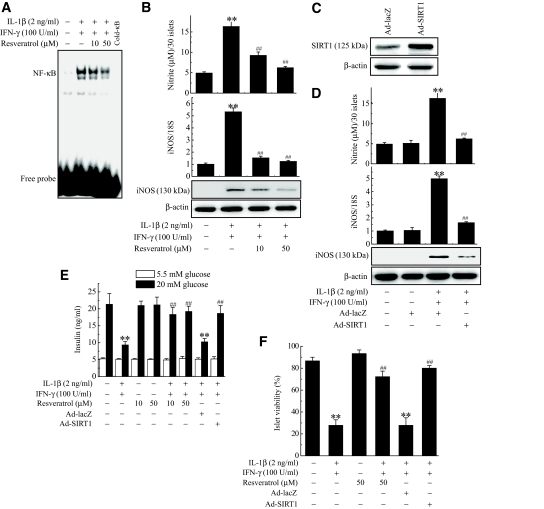
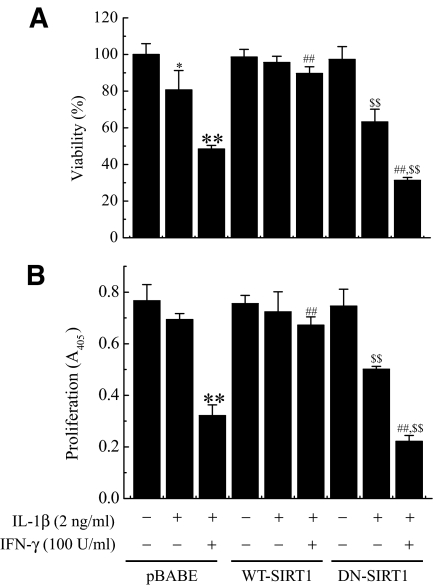
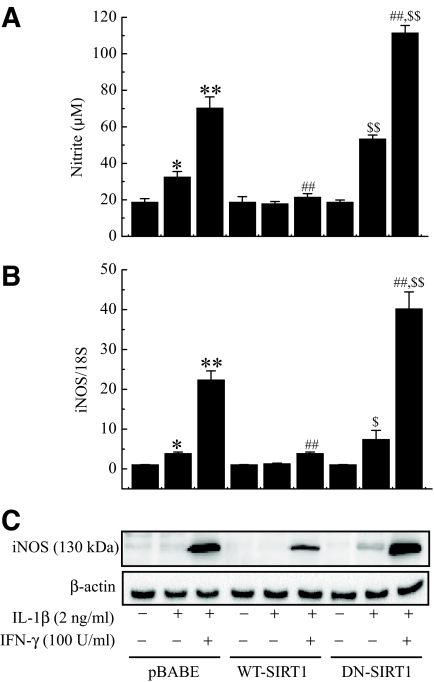
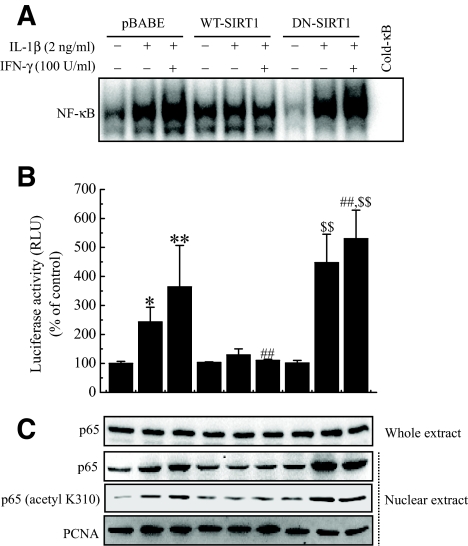
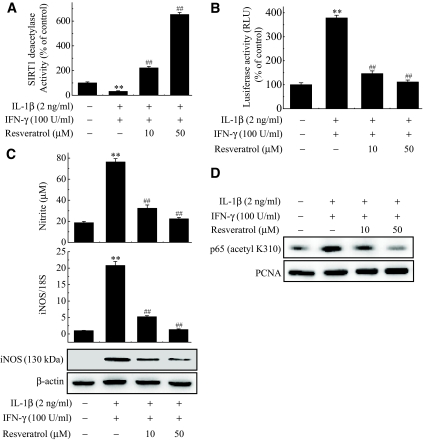
Treatment of RIN cells with cytokines induced cell damage, and this damage was well correlated with the expression of the inducible form of nitric oxide (NO) synthase (iNOS) and NO production. However, SIRT1 overexpression completely prevented cytokine-mediated cytotoxicity, NO production, and iNOS expression. The molecular mechanism by which SIRT1 inhibits iNOS expression appeared to involve the inhibition of the NF-kappaB signaling pathway through deacetylation of p65. In addition, SIRT1 activation by either resveratrol or adenoviral-directed overexpression of SIRT1 could prevent cytokine toxicity and maintain normal insulin-secreting responses to glucose in isolated rat islets.
This study will provide valuable information not only into the mechanisms underlying beta-cell destruction but also into the regulation of SIRT1 as a possible target to attenuate cytokine-induced beta-cell damage.
沉默调节蛋白1(SIRT1)是一种III类组蛋白/蛋白质去乙酰化酶,已知其可干扰核因子-κB(NF-κB)信号通路,从而具有抗炎功能。由于NF-κB在细胞因子介导的胰腺β细胞损伤中起核心作用,我们推测SIRT1可能在胰腺β细胞损伤模型中发挥作用。
用白细胞介素-1β和干扰素-γ处理RINm5F(RIN)细胞或分离的大鼠胰岛。通过药理学激活剂白藜芦醇或异位过表达激活SIRT1。进一步探究SIRT1抵抗细胞因子毒性的潜在机制。
用细胞因子处理RIN细胞会诱导细胞损伤,这种损伤与诱导型一氧化氮(NO)合酶(iNOS)的表达及NO生成密切相关。然而,SIRT1过表达完全阻止了细胞因子介导的细胞毒性、NO生成及iNOS表达。SIRT1抑制iNOS表达的分子机制似乎涉及通过使p65去乙酰化来抑制NF-κB信号通路。此外,白藜芦醇或腺病毒介导的SIRT1过表达激活SIRT1可预防细胞因子毒性,并维持分离的大鼠胰岛对葡萄糖的正常胰岛素分泌反应。
本研究不仅将为β细胞破坏的潜在机制提供有价值的信息,还将为作为减轻细胞因子诱导的β细胞损伤的可能靶点的SIRT1的调节提供有价值的信息。