• 文献检索
  • 文档翻译
  • 深度研究
  • 学术资讯
  • Suppr Zotero 插件Zotero 插件
  • 邀请有礼
  • 套餐&价格
  • 历史记录
应用&插件
Suppr Zotero 插件Zotero 插件浏览器插件Mac 客户端Windows 客户端微信小程序
定价
高级版会员购买积分包购买API积分包
服务
文献检索文档翻译深度研究API 文档MCP 服务
关于我们
关于 Suppr公司介绍联系我们用户协议隐私条款
关注我们

Suppr 超能文献

核心技术专利:CN118964589B侵权必究
粤ICP备2023148730 号-1Suppr @ 2026

文献检索

告别复杂PubMed语法,用中文像聊天一样搜索,搜遍4000万医学文献。AI智能推荐,让科研检索更轻松。

立即免费搜索

文件翻译

保留排版,准确专业,支持PDF/Word/PPT等文件格式,支持 12+语言互译。

免费翻译文档

深度研究

AI帮你快速写综述,25分钟生成高质量综述,智能提取关键信息,辅助科研写作。

立即免费体验

与动作抑制丧失相关的运动忽视。

Motor neglect associated with loss of action inhibition.

作者信息

Coulthard E, Rudd A, Husain M

机构信息

Institute of Neurology and National Hospital for Neurology and Neurosurgery, 17 Queen Square, London WC1N3AR, UK.

出版信息

J Neurol Neurosurg Psychiatry. 2008 Dec;79(12):1401-4. doi: 10.1136/jnnp.2007.140715.

DOI:10.1136/jnnp.2007.140715
PMID:19010953
原文链接:https://pmc.ncbi.nlm.nih.gov/articles/PMC2602747/
Abstract

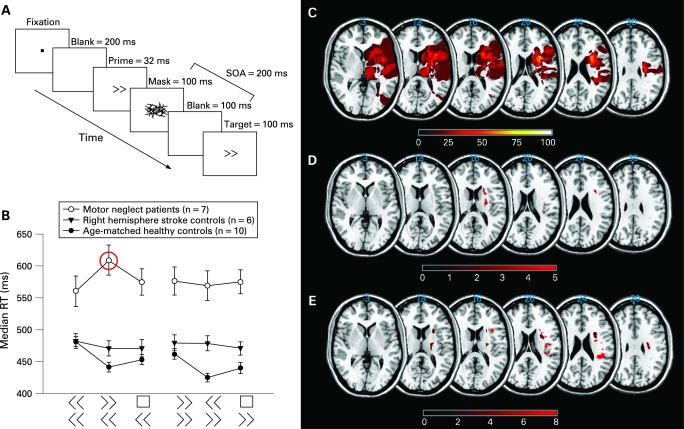
Motor neglect, underuse of one side of the body not explained by weakness or sensory impairment, is a common consequence of stroke that is surprisingly little understood. Behavioural and neuroanatomical hallmarks of the disorder are investigated. Using a masked prime task, it was shown that when patients with left motor neglect plan to move their left hand, irrelevant right limb motor programmes intrude, causing delay. Lesion analysis reveals that such asymmetry of motor programming occurs after infarcts of the right putamen and motor association areas. This demonstration of failure to inhibit ipsilesional limb motor plans suggests potential benefit from interventions that might act to restore balance in action planning.

摘要

肢体运动忽视,即身体一侧未因无力或感觉障碍而出现的使用不足,是中风的常见后果,但令人惊讶的是,人们对此了解甚少。本文对该疾病的行为和神经解剖学特征进行了研究。通过一项掩蔽启动任务发现,当患有左侧肢体运动忽视的患者计划移动其左手时,无关的右侧肢体运动程序会侵入,导致动作延迟。病灶分析表明,这种运动编程的不对称发生在右侧壳核和运动联合区梗死之后。这种无法抑制同侧肢体运动计划的表现表明,可能从有助于恢复动作计划平衡的干预措施中获益。
https://cdn.ncbi.nlm.nih.gov/pmc/blobs/e525/2602747/98f990c8e6d9/JNN-79-12-1401-f01.jpg

相似文献

1
Motor neglect associated with loss of action inhibition.与动作抑制丧失相关的运动忽视。
J Neurol Neurosurg Psychiatry. 2008 Dec;79(12):1401-4. doi: 10.1136/jnnp.2007.140715.
2
How many forms of perseveration? Evidence from cancellation tasks in right hemisphere patients.有多少种持续状态?来自右脑损伤患者删除任务的证据。
Neuropsychologia. 2013 Dec;51(14):2960-75. doi: 10.1016/j.neuropsychologia.2013.10.023. Epub 2013 Nov 4.
3
The effects of competition and motor reprogramming on visuomotor selection in unilateral neglect.竞争和运动重新编程对单侧忽视中视觉运动选择的影响。
Exp Brain Res. 1998 May;120(2):243-56. doi: 10.1007/s002210050398.
4
The impact of unilateral brain damage on anticipatory grip force scaling when lifting everyday objects.单侧脑损伤对举起日常物品时预期握力缩放的影响。
Neuropsychologia. 2014 Aug;61:222-34. doi: 10.1016/j.neuropsychologia.2014.06.026. Epub 2014 Jun 28.
5
The ipsilesional attention bias in right-hemisphere stroke patients as revealed by a realistic visual search task: Neuroanatomical correlates and functional relevance.通过逼真视觉搜索任务揭示的右半球中风患者的患侧注意偏向:神经解剖学关联及功能相关性
Neuropsychology. 2018 Oct;32(7):850-865. doi: 10.1037/neu0000493.
6
Anosognosia, neglect, extinction and lesion site predict impairment of daily living after right-hemispheric stroke.病感失认症、忽视、遗忘和病变部位预测右半球卒中后日常生活能力受损。
Cortex. 2013 Jul-Aug;49(7):1782-9. doi: 10.1016/j.cortex.2012.12.011. Epub 2012 Dec 19.
7
Lesion Sites Associated with Allocentric and Egocentric Visuospatial Neglect in Acute Stroke.急性卒中中与异我中心和自我中心视觉空间忽视相关的病灶部位
Brain Connect. 2015 Sep;5(7):413-22. doi: 10.1089/brain.2014.0316. Epub 2015 Mar 6.
8
Lesion location alters brain activation in chronically impaired stroke survivors.病变位置会改变慢性中风受损幸存者的大脑激活情况。
Neuroimage. 2004 Mar;21(3):924-35. doi: 10.1016/j.neuroimage.2003.10.026.
9
Motor-intentional disorders in right hemisphere stroke.右半球卒中的运动意向障碍
Cogn Behav Neurol. 2009 Dec;22(4):242-8. doi: 10.1097/WNN.0b013e3181b7f251.
10
Arm use after left or right hemiparesis is influenced by hand preference.左或右偏瘫后的上肢使用受利手影响。
Stroke. 2009 Feb;40(2):545-50. doi: 10.1161/STROKEAHA.108.528497. Epub 2008 Dec 24.

引用本文的文献

1
Joint impact on attention, alertness and inhibition of lesions at a frontal white matter crossroad.额叶白质交叉处病变对注意力、警觉性和抑制的联合影响。
Brain. 2023 Apr 19;146(4):1467-1482. doi: 10.1093/brain/awac359.
2
Decoding the neural dynamics of free choice in humans.解码人类自由选择的神经动力学。
PLoS Biol. 2020 Dec 10;18(12):e3000864. doi: 10.1371/journal.pbio.3000864. eCollection 2020 Dec.
3
Bimanual non-congruent actions in motor neglect syndrome: a combined behavioral/fMRI study.运动忽视综合征中的双手非对称动作:一项行为/fMRI联合研究。

本文引用的文献

1
Human medial frontal cortex mediates unconscious inhibition of voluntary action.人类内侧前额叶皮质介导对自主行动的无意识抑制。
Neuron. 2007 Jun 7;54(5):697-711. doi: 10.1016/j.neuron.2007.05.016.
2
Effect of constraint-induced movement therapy on upper extremity function 3 to 9 months after stroke: the EXCITE randomized clinical trial.强制性运动疗法对卒中后3至9个月上肢功能的影响:EXCITE随机临床试验
JAMA. 2006 Nov 1;296(17):2095-104. doi: 10.1001/jama.296.17.2095.
3
Motor neglect: implications for movement and rehabilitation following stroke.
Front Hum Neurosci. 2015 Oct 6;9:541. doi: 10.3389/fnhum.2015.00541. eCollection 2015.
4
Hearing and music in unilateral spatial neglect neuro-rehabilitation.单侧空间忽视神经康复中的听觉与音乐
Front Psychol. 2014 Dec 23;5:1503. doi: 10.3389/fpsyg.2014.01503. eCollection 2014.
5
Damage to the medial motor system in stroke patients with motor neglect.脑卒中后运动忽视患者的内侧运动系统损伤。
Front Hum Neurosci. 2014 Jun 11;8:408. doi: 10.3389/fnhum.2014.00408. eCollection 2014.
6
Presence of Motor-Intentional Aiming Deficit Predicts Functional Improvement of Spatial Neglect With Prism Adaptation.运动意向性瞄准缺陷的存在可预测棱镜适应对空间忽视的功能改善。
Neurorehabil Neural Repair. 2014 Jun;28(5):483-93. doi: 10.1177/1545968313516872. Epub 2013 Dec 27.
7
Motor extinction: a deficit of attention or intention?运动遗忘:注意力还是意图的缺失?
Front Hum Neurosci. 2013 Oct 16;7:644. doi: 10.3389/fnhum.2013.00644. eCollection 2013.
8
Multi-input/output alarming system for patients with inattention caused by higher cortical function disorder.多输入/输出报警系统,用于治疗因皮质功能障碍导致的注意力不集中的患者。
Biomed Eng Online. 2013 Oct 12;12:104. doi: 10.1186/1475-925X-12-104.
9
Evidence for a role of a cortico-subcortical network for automatic and unconscious motor inhibition of manual responses.有证据表明,皮质-皮质下网络在自动和无意识的手动反应抑制中起作用。
PLoS One. 2012;7(10):e48007. doi: 10.1371/journal.pone.0048007. Epub 2012 Oct 24.
10
Dissociating the role of prefrontal and premotor cortices in controlling inhibitory mechanisms during motor preparation.在运动准备过程中控制抑制机制时,前额叶和运动前皮质的作用分离。
J Neurosci. 2012 Jan 18;32(3):806-16. doi: 10.1523/JNEUROSCI.4299-12.2012.
运动忽视:对中风后运动及康复的影响
Disabil Rehabil. 2006;28(13-14):857-64. doi: 10.1080/09638280500535025.
4
Quantitative assessment of recovery from motor hemineglect in acute stroke patients.
Cerebrovasc Dis. 2006;21(5-6):307-14. doi: 10.1159/000091535. Epub 2006 Feb 14.
5
Don't think twice, it's all right--contralesional dependency for bimanual prehension movements.别再犹豫,一切都好——双侧协调抓握运动的对侧依赖性
Neuropsychologia. 2005;43(11):1547-58. doi: 10.1016/j.neuropsychologia.2005.02.001.
6
Independent effects of endogenous and exogenous spatial cueing: inhibition of return at endogenously attended target locations.内源性和外源性空间线索的独立作用:内源性注意目标位置上的返回抑制。
Exp Brain Res. 2004 Dec;159(4):447-57. doi: 10.1007/s00221-004-1963-5. Epub 2004 Jul 9.
7
The basal ganglia and inhibitory mechanisms in response selection: evidence from subliminal priming of motor responses in Parkinson's disease.基底神经节与反应选择中的抑制机制:来自帕金森病运动反应阈下启动的证据。
Brain. 2004 Feb;127(Pt 2):330-9. doi: 10.1093/brain/awh043. Epub 2003 Nov 25.
8
Facilitatory and inhibitory effects of masked prime stimuli on motor activation and behavioural performance.掩蔽启动刺激对运动激活和行为表现的促进和抑制作用。
Acta Psychol (Amst). 1999 Apr;101(2-3):293-313. doi: 10.1016/s0001-6918(99)00009-8.
9
The motor syndrome associated with exaggerated inhibition within the primary motor cortex of patients with hemiparetic.
Brain. 1997 Apr;120 ( Pt 4):605-19. doi: 10.1093/brain/120.4.605.
10
Directional bias of initial visual exploration. A symptom of neglect in Parkinson's disease.
Brain. 1996 Feb;119 ( Pt 1):79-87. doi: 10.1093/brain/119.1.79.