Hu Diane, Marcucio Ralph S
Department of Orthopaedic Surgery, University of California at San Francisco, San Francisco, CA, USA.
Dev Biol. 2009 Jan 1;325(1):200-10. doi: 10.1016/j.ydbio.2008.10.026. Epub 2008 Oct 31.
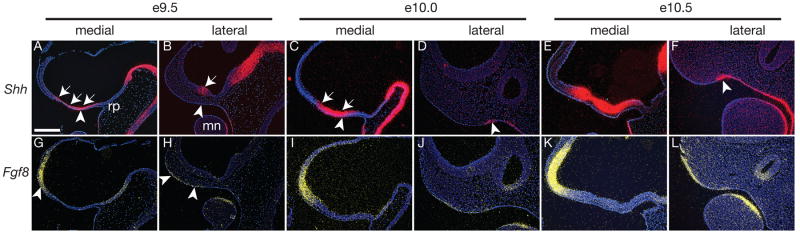
The faces of birds and mammals exhibit remarkable morphologic diversity, but how variation arises is not well-understood. We have previously demonstrated that a region of facial ectoderm, which we named the frontonasal ectodermal zone (FEZ), regulates proximo-distal extension and dorso-ventral polarity of the upper jaw in birds. In this work, we examined the equivalent ectoderm in murine embryos and determined that the FEZ is conserved in mice. However, our results revealed that fundamental differences in the organization and constituents of the FEZ in mice and chicks may underlie the distinct growth characteristics that distinguish mammalian and avian embryos during the earliest stages of development. Finally, current models suggest that neural crest cells regulate size and shape of the upper jaw, and that signaling by Bone morphogenetic proteins (Bmps) within avian neural crest helps direct this process. Here we show that Bmp expression patterns in neural crest cells are regulated in part by signals from the FEZ. The results of our work reconcile how a conserved signaling center that patterns growth of developing face may generate morphologic diversity among different animals. Subtle changes in the organization of gene expression patterns in the FEZ could underlie morphologic variation observed among and within species, and at extremes, variation could produce disease phenotypes.
鸟类和哺乳动物的面部呈现出显著的形态多样性,但这种变异是如何产生的却尚未得到充分理解。我们之前已经证明,面部外胚层的一个区域,我们将其命名为额鼻外胚层区域(FEZ),在鸟类中调节上颌的近远侧延伸和背腹极性。在这项研究中,我们检查了小鼠胚胎中的等效外胚层,并确定FEZ在小鼠中是保守的。然而,我们的结果表明,小鼠和小鸡FEZ在组织和成分上的根本差异可能是在发育的最早阶段区分哺乳动物和鸟类胚胎不同生长特征的基础。最后,目前的模型表明神经嵴细胞调节上颌的大小和形状,并且鸟类神经嵴内的骨形态发生蛋白(Bmps)信号传导有助于指导这一过程。在这里我们表明,神经嵴细胞中的Bmp表达模式部分受FEZ信号的调节。我们的研究结果解释了一个保守的信号中心如何在发育中的面部形成模式并在不同动物之间产生形态多样性。FEZ中基因表达模式组织的细微变化可能是物种间和物种内观察到的形态变异的基础,在极端情况下,变异可能产生疾病表型。