Unidad de Investigación en Economía de la Salud, Instituto Mexicano del Seguro Social, Mexico, D,F, Mexico.
Cost Eff Resour Alloc. 2008 Nov 12;6:21. doi: 10.1186/1478-7547-6-21.
Osteoarthritis (OA) is one of the main causes of disability worldwide, especially in persons >55 years of age. Currently, controversy remains about the best therapeutic alternative for this disease when evaluated from a cost-effectiveness viewpoint. For Social Security Institutions in developing countries, it is very important to assess what drugs may decrease the subsequent use of medical care resources, considering their adverse events that are known to have a significant increase in medical care costs of patients with OA. Three treatment alternatives were compared: celecoxib (200 mg twice daily), non-selective NSAIDs (naproxen, 500 mg twice daily; diclofenac, 100 mg twice daily; and piroxicam, 20 mg/day) and acetaminophen, 1000 mg twice daily. The aim of this study was to identify the most cost-effective first-choice pharmacological treatment for the control of joint pain secondary to OA in patients treated at the Instituto Mexicano del Seguro Social (IMSS).
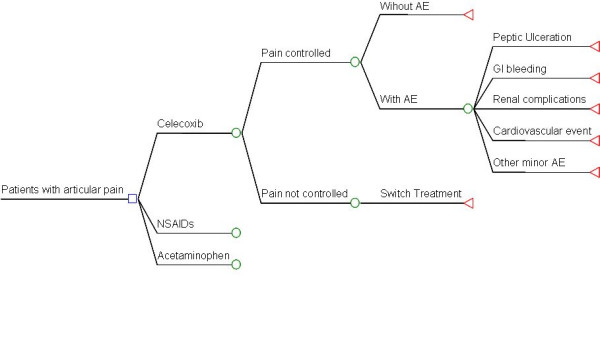
A cost-effectiveness assessment was carried out. A systematic review of the literature was performed to obtain transition probabilities. In order to evaluate analysis robustness, one-way and probabilistic sensitivity analyses were conducted. Estimations were done for a 6-month period.
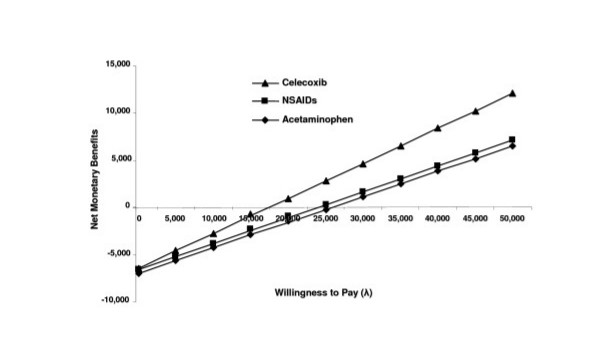
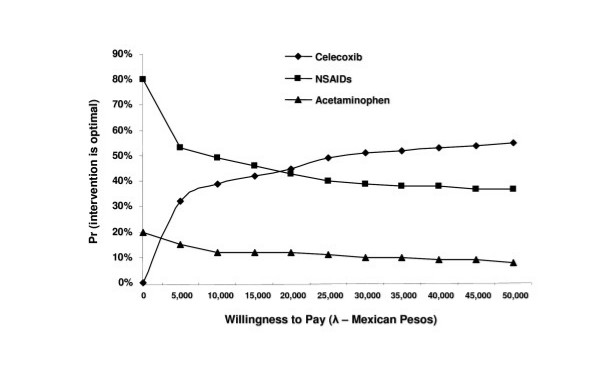
Treatment demonstrating the best cost-effectiveness results [lowest cost-effectiveness ratio $17.5 pesos/patient ($1.75 USD)] was celecoxib. According to the one-way sensitivity analysis, celecoxib would need to markedly decrease its effectiveness in order for it to not be the optimal treatment option. In the probabilistic analysis, both in the construction of the acceptability curves and in the estimation of net economic benefits, the most cost-effective option was celecoxib.
From a Mexican institutional perspective and probably in other Social Security Institutions in similar developing countries, the most cost-effective option for treatment of knee and/or hip OA would be celecoxib.
骨关节炎(OA)是全球主要的致残原因之一,尤其是在 >55 岁的人群中。目前,从成本效益的角度评估这种疾病的最佳治疗选择仍存在争议。对于发展中国家的社会保障机构来说,评估哪些药物可能会减少后续医疗资源的使用非常重要,因为众所周知,OA 患者的不良事件会显著增加医疗费用。比较了三种治疗选择:塞来昔布(200mg,每日两次)、非选择性 NSAIDs(萘普生,500mg,每日两次;双氯芬酸,100mg,每日两次;和吡罗昔康,20mg/天)和醋氨酚,1000mg,每日两次。本研究旨在确定 IMSS 治疗的 OA 患者关节疼痛控制的最具成本效益的一线药物治疗选择。
进行了成本效益评估。对文献进行了系统回顾以获得转移概率。为了评估分析的稳健性,进行了单因素和概率敏感性分析。估计期为 6 个月。
显示最佳成本效益结果的治疗方法[最低成本效益比 17.5 比索/患者(1.75 美元)]是塞来昔布。根据单因素敏感性分析,塞来昔布需要显著降低其疗效,才能使其不是最佳治疗选择。在概率分析中,无论是在可接受性曲线的构建还是在净经济效益的估计中,最具成本效益的选择都是塞来昔布。
从墨西哥机构的角度来看,并且可能在其他类似发展中国家的社会保障机构中,膝关节和/或髋关节 OA 的治疗最具成本效益的选择是塞来昔布。