Fradet Laetitia, Lee Gyusung, Dounskaia Natalia
Movement Control and Biomechanics Laboratory, Arizona State University, Tempe, AZ 85287, USA.
J Neuroeng Rehabil. 2008 Nov 13;5:28. doi: 10.1186/1743-0003-5-28.
Slowness is a well-recognized feature of movements in aging. One of the possible reasons for slowness suggested by previous research is production of corrective submovements that compensate for shortened primary submovement to the target. Here, we re-examine this traditional interpretation and argue that the majority of submovements in older adults may be a consequence rather than the cause of slowness.
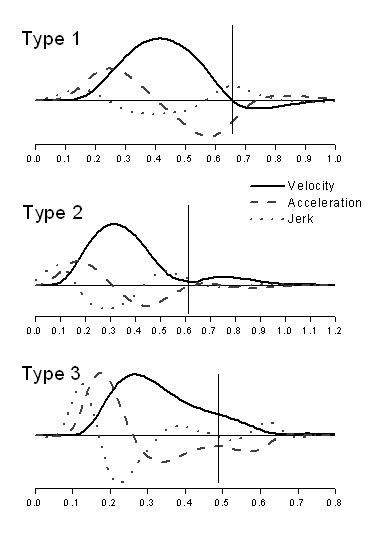
Pointing movements in young and older adults were recorded. Conditions for submovement emergence were manipulated by using small and large targets and three movement modes: discrete (required stopping on the target), reciprocal (required reversal on the target), and passing (required crossing the target and stopping after that). Movements were parsed into a primary and secondary submovement based on zero-crossings of velocity (type 1 submovements), acceleration (type 2 submovements), and jerk (type 3 submovements). In the passing mode, secondary submovements were analyzed only after crossing the target to exclude that they were accuracy adjustments.
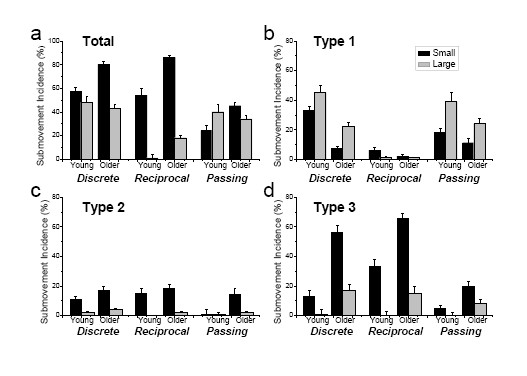
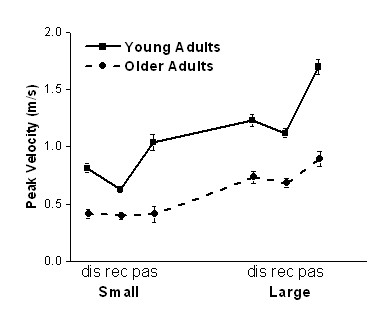
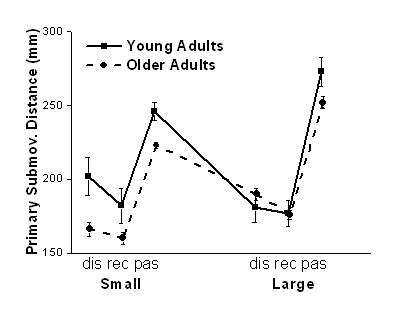
Consistent with previous research, the primary submovement was shortened and total secondary submovement incidence was increased in older adults. However, comparisons across conditions suggested that many submovements were non-corrective in both groups. Type 1 submovements were non-corrective because they were more frequent for large than small targets. They predominantly emerged due to arm stabilization and energy dissipation during motion termination in the discrete and passing mode. Although type 2 and 3 submovements were more frequent for small than large targets, this trend was also observed in the passing mode, suggesting that many of these submovements were non-corrective. Rather, they could have been velocity fluctuations associated predominantly with low speed of movements to small targets.
The results question the traditional interpretation of frequent submovements in older adults as corrective adjustments. Rather, the increased incidence of submovements in older adults is directly related to low movement speed observed in aging, whereas the relationship between submovement incidence and target size is a result of speed-accuracy trade-off. Aging-related declines in muscular control that may contribute to the disproportional increases in submovement incidence during slow movements of older adults are discussed.
动作迟缓是衰老过程中运动的一个公认特征。先前研究提出的动作迟缓的可能原因之一是产生纠正性子动作,以补偿向目标的主要子动作缩短。在此,我们重新审视这一传统解释,并认为老年人中的大多数子动作可能是动作迟缓的结果而非原因。
记录年轻人和老年人的指向动作。通过使用大小不同的目标和三种运动模式来操纵子动作出现的条件:离散模式(要求在目标上停止)、往复模式(要求在目标上反转)和通过模式(要求穿过目标并在之后停止)。根据速度(1型子动作)、加速度(2型子动作)和加加速度(3型子动作)的过零点,将动作解析为主要子动作和次要子动作。在通过模式中,仅在穿过目标后分析次要子动作,以排除它们是精度调整的可能性。
与先前研究一致,老年人的主要子动作缩短,次要子动作的总发生率增加。然而,不同条件之间的比较表明,两组中的许多子动作都是非纠正性的。1型子动作是非纠正性的,因为它们在大目标上比在小目标上更频繁。它们主要是由于离散模式和通过模式中运动终止期间手臂的稳定和能量耗散而出现的。尽管2型和3型子动作在小目标上比在大目标上更频繁,但在通过模式中也观察到了这种趋势,这表明这些子动作中的许多都是非纠正性的。相反,它们可能主要是与向小目标运动的低速相关的速度波动。
结果对将老年人频繁出现的子动作传统解释为纠正性调整提出了质疑。相反?老年人子动作发生率的增加与衰老过程中观察到的低运动速度直接相关,而子动作发生率与目标大小之间的关系是速度-精度权衡的结果。讨论了与衰老相关的肌肉控制下降,这可能导致老年人缓慢运动期间子动作发生率不成比例地增加。