Feirtag J M, Petzel J P, Pasalodos E, Baldwin K A, McKay L L
Department of Food Science and Nutrition, University of Minnesota, St. Paul 55108.
Appl Environ Microbiol. 1991 Feb;57(2):539-48. doi: 10.1128/aem.57.2.539-548.1991.
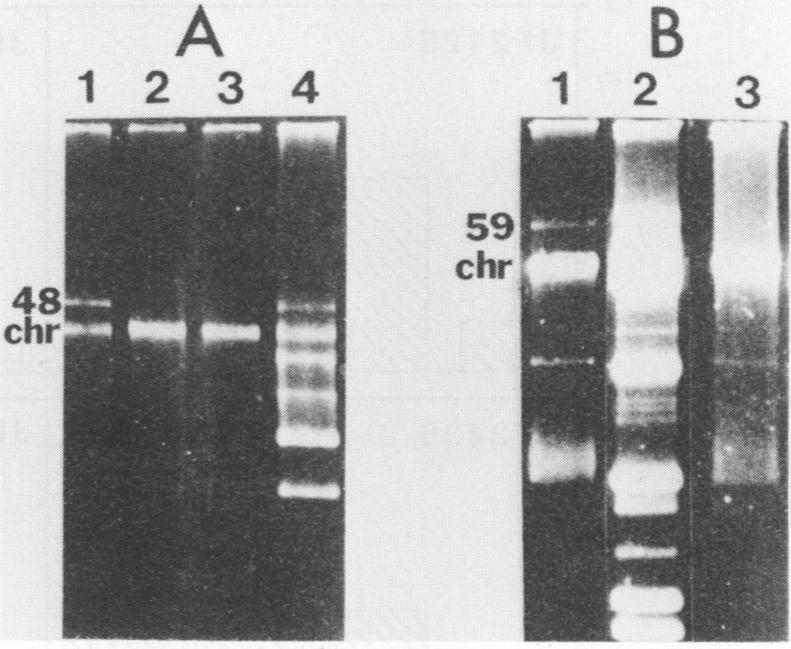
Evidence is presented that lactose-fermenting ability (Lac+) in Lactococcus lactis subsp. cremoris AM1, SK11, and ML1 is associated with plasmid DNA, even though these strains are difficult to cure of Lac plasmids. When the Lac plasmids from these strains were introduced into L. lactis subsp. lactis LM0230, they appeared to replicate in a thermosensitive manner; inheritance of the plasmid was less efficient at 32 to 40 degrees C than at 22 degrees C. The stability of the L. lactis subsp. cremoris Lac plasmids in lactococci appeared to be a combination of both host and plasmid functions. Stabilized variants were isolated by growing the cultures at 32 to 40 degrees C; these variants contained the Lac plasmids integrated into the L. lactis subsp. lactis LM0230 chromosome. In addition, the presence of the L. lactis subsp. cremoris Lac plasmids in L. lactis subsp. lactis resulted in a temperature-sensitive growth response; growth of L. lactis subsp. lactis transformants was significantly inhibited at 38 to 40 degrees C, thereby resembling some L. lactis subsp. cremoris strains with respect to temperature sensitivity of growth.
有证据表明,乳酸乳球菌乳脂亚种AM1、SK11和ML1中的乳糖发酵能力(Lac+)与质粒DNA相关,尽管这些菌株难以消除Lac质粒。当将来自这些菌株的Lac质粒导入乳酸乳球菌乳酸亚种LM0230时,它们似乎以热敏方式复制;在32至40摄氏度下,质粒的遗传效率低于22摄氏度。乳酸乳球菌乳脂亚种Lac质粒在乳球菌中的稳定性似乎是宿主和质粒功能的结合。通过在32至40摄氏度下培养培养物分离出稳定变体;这些变体含有整合到乳酸乳球菌乳酸亚种LM0230染色体中的Lac质粒。此外,乳酸乳球菌乳脂亚种Lac质粒在乳酸乳球菌乳酸亚种中的存在导致温度敏感的生长反应;乳酸乳球菌乳酸亚种转化体在38至40摄氏度下的生长受到显著抑制,从而在生长温度敏感性方面类似于一些乳酸乳球菌乳脂亚种菌株。