Briere Tina Marie, Tailor Ramesh, Tolani Naresh, Prado Karl, Lane Richard, Woo Shiao, Ha Chul, Gillin Michael T, Beddar A Sam
Department of Radiation Physics, The University of Texas M.D. Anderson Cancer Center, Houston, Texas, U.S.A.
Division of Radiation Oncology, and Division of Radiation Oncology, The University of Texas M.D. Anderson Cancer Center, Houston, Texas, U.S.A.
J Appl Clin Med Phys. 2008 Nov 3;9(4):200-205. doi: 10.1120/jacmp.v9i4.2787.
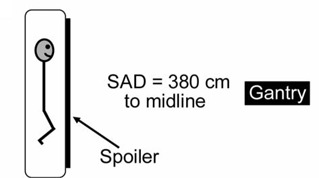
We studied the usefulness of a new type of solid-state detector, the OneDose single-use MOSFET (metal oxide semiconductor field effect transistor) dosimeter, for entrance dose measurements for total body irradiation (TBI). The factory calibration factors supplied by the manufacturer are applicable to conventional radiotherapy beam arrangements and therefore may not be expected to be valid for TBI dosimetry because of the large field sizes and extended source-to-axis distances used. OneDose detectors were placed under a 1-cm thick bolus at the head, neck, and umbilicus of 9 patients undergoing TBI procedures. Thermoluminescent dosimeters (TLDs) were placed beside the detectors. We found that the OneDose readings differed from the TLD readings by 4.6% at the head, 1.7% at the neck, and 3.9% at the umbilicus, with corresponding standard deviations of 3.9%, 2.2%, and 2.7%. For all patient measurements, 95% of the OneDose readings fell within 3.3% +/- 6.0% of the TLD readings. Anthropomorphic phantom measurements showed differences of -0.1% at the neck and -1.2% midway between the phantom's carina and umbilicus. Our results suggest that these detectors could be used for TBI quality assurance monitoring, although TLDs should remain the standard when critical dose measurements are performed. If OneDose detectors are to be used for TBI, the use of more than one at each location is strongly recommended. Because the detectors are designed for single use, they cannot be individually calibrated. However, to obtain institution-specific correction factors for better applicability to TBI dosimetry, measurements of several detectors taken from a particular lot could also be obtained in phantom with the TBI geometry configurations used for patient treatment.
我们研究了一种新型固态探测器——OneDose一次性使用金属氧化物半导体场效应晶体管(MOSFET)剂量仪,用于全身照射(TBI)的入射剂量测量。制造商提供的工厂校准因子适用于传统放射治疗束的布置,因此由于TBI剂量测定中使用的大野尺寸和延长的源轴距,预计这些校准因子对TBI剂量测定无效。将OneDose探测器置于9例接受TBI治疗患者的头部、颈部和脐部下方1厘米厚的组织等效填充物下。热释光剂量仪(TLD)置于探测器旁边。我们发现,OneDose读数与TLD读数相比,在头部相差4.6%,在颈部相差1.7%,在脐部相差3.9%,相应的标准差分别为3.9%、2.2%和2.7%。对于所有患者测量,95%的OneDose读数落在TLD读数的3.3%±6.0%范围内。人体模型测量显示,在颈部相差-0.1%,在人体模型隆突与脐部中间相差-1.2%。我们的结果表明,这些探测器可用于TBI质量保证监测,不过在进行关键剂量测量时,TLD仍应作为标准。如果要将OneDose探测器用于TBI,强烈建议在每个位置使用多个探测器。由于这些探测器设计为一次性使用,因此无法进行单独校准。然而,为了获得更适用于TBI剂量测定的机构特定校正因子,也可以在用于患者治疗的TBI几何配置的人体模型中,对从特定批次中取出的多个探测器进行测量。