Akazili James, Adjuik Martin, Jehu-Appiah Caroline, Zere Eyob
Navrongo Health Research Centre, P,O, Box 114, Navrongo, Upper East Region, Ghana.
BMC Int Health Hum Rights. 2008 Nov 20;8:11. doi: 10.1186/1472-698X-8-11.
Data Envelopment Analysis (DEA) has been used to analyze the efficiency of the health sector in the developed world for sometime now. However, in developing economies and particularly in Africa only a few studies have applied DEA in measuring the efficiency of their health care systems.
This study uses the DEA method, to calculate the technical efficiency of 89 randomly sampled health centers in Ghana. The aim was to determine the degree of efficiency of health centers and recommend performance targets for the inefficient facilities.
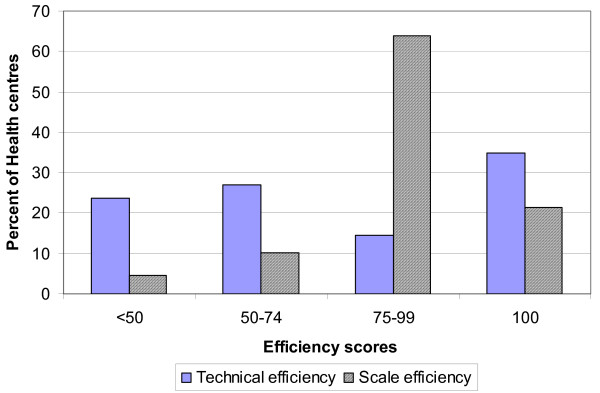
The findings showed that 65% of health centers were technically inefficient and so were using resources that they did not actually need.
The results broadly point to grave inefficiency in the health care delivery system of public health centers and that significant amounts of resources could be saved if measures were put in place to curb the waste.
数据包络分析(DEA)已经用于分析发达国家卫生部门的效率有一段时间了。然而,在发展中经济体,特别是在非洲,只有少数研究应用数据包络分析来衡量其医疗保健系统的效率。
本研究使用数据包络分析方法,计算加纳89个随机抽样的卫生中心的技术效率。目的是确定卫生中心的效率程度,并为效率低下的机构推荐绩效目标。
研究结果表明,65%的卫生中心技术效率低下,因此正在使用它们实际上并不需要的资源。
结果大致表明,公共卫生中心的医疗服务提供系统存在严重的低效率,如果采取措施遏制浪费,可节省大量资源。