Seitz Aaron R, Watanabe Takeo
Department of Psychology, University of California Riverside, Riverside, California, United States of America.
PLoS One. 2008;3(11):e3792. doi: 10.1371/journal.pone.0003792. Epub 2008 Nov 24.
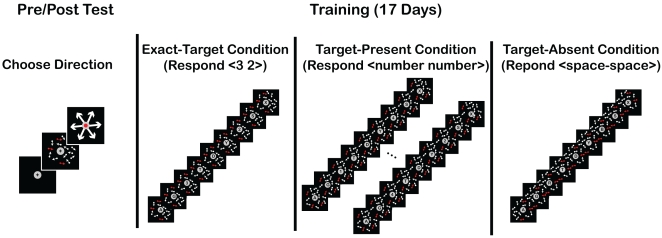
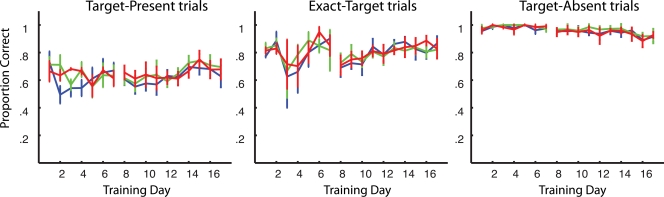
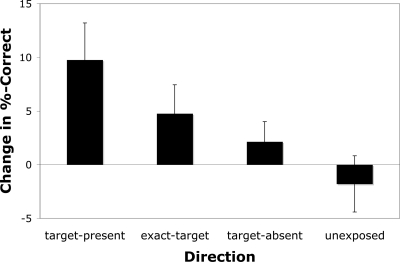
In the present study we address the question of whether the learning of task-irrelevant stimuli found in the paradigm of task-irrelevant learning (TIPL) [1]-[9] is truly task irrelevant. To test the hypothesis that associations that are beneficial to task-performance may develop between the task-relevant and task-irrelevant stimuli, or the task-responses and the task-irrelevant stimuli, we designed a new procedure in which correlations between the presentation of task-irrelevant motion stimuli and the identity of task-targets or task-responses were manipulated. We found no evidence for associations developing between the learned (task-irrelevant) motion stimuli and the targets or responses to the letter identification task used during training. Furthermore, the conditions that had the greatest correlations between stimulus and response showed the least amount of TIPL. On the other hand, TIPL was found in conditions of greatest response uncertainty and with the greatest processing requirements for the task-relevant stimuli. This is in line with our previously published model that suggests that task-irrelevant stimuli benefit from the spill-over of learning signals that are released due to processing of task-relevant stimuli.
在本研究中,我们探讨了在任务无关学习(TIPL)范式[1]-[9]中发现的对任务无关刺激的学习是否真的与任务无关这一问题。为了检验以下假设,即任务相关刺激与任务无关刺激之间,或者任务反应与任务无关刺激之间可能会形成对任务表现有益的关联,我们设计了一种新程序,在该程序中,对任务无关运动刺激的呈现与任务目标或任务反应的特征之间的相关性进行了操控。我们没有发现证据表明在学习到的(任务无关的)运动刺激与训练期间使用的字母识别任务的目标或反应之间形成了关联。此外,刺激与反应之间相关性最大的条件下,任务无关学习的量最少。另一方面,在反应不确定性最大且对任务相关刺激的加工要求最高的条件下发现了任务无关学习。这与我们之前发表的模型一致,该模型表明任务无关刺激受益于因任务相关刺激的加工而释放的学习信号的溢出。