Wittkowski Helmut, Frosch Michael, Wulffraat Nico, Goldbach-Mansky Raphaela, Kallinich Tilmann, Kuemmerle-Deschner Jasmin, Frühwald Michael C, Dassmann Sandra, Pham Tuyet-Hang, Roth Johannes, Foell Dirk
University Hospital Muenster, Muenster, Germany.
Arthritis Rheum. 2008 Dec;58(12):3924-31. doi: 10.1002/art.24137.
Fever of unknown origin (FUO) in children presents a diagnostic challenge. The differential diagnosis includes systemic-onset juvenile idiopathic arthritis (JIA), an autoinflammatory syndrome associated with activation of phagocytic cells that, at presentation, is difficult to differentiate from severe systemic infections. The aim of this study was to investigate whether serum concentrations of the phagocytic proinflammatory protein S100A12 may help in deciding whether to treat patients with FUO with antibiotics or immunosuppressive agents.
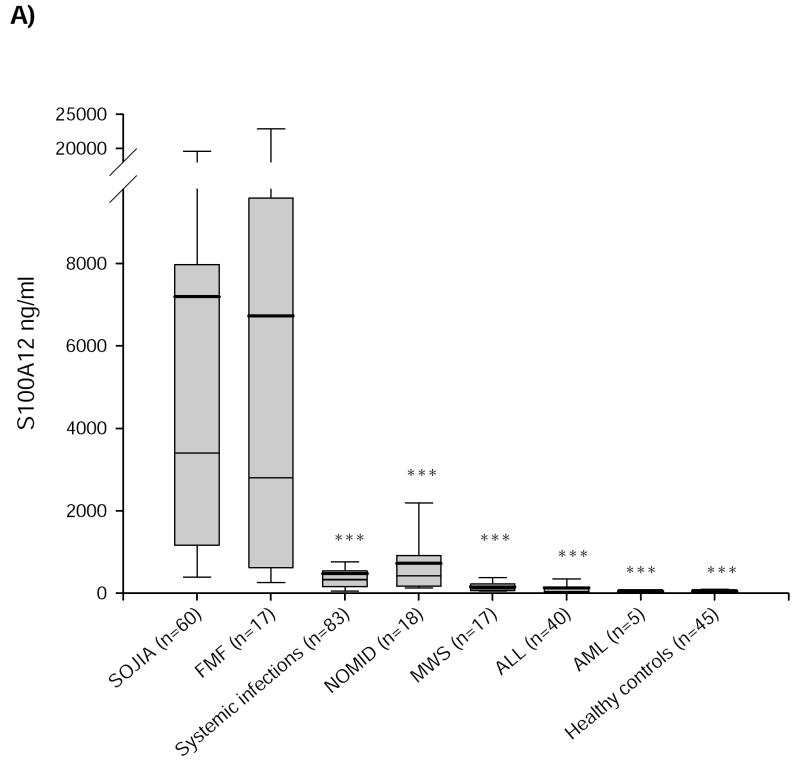
Serum samples were obtained from 45 healthy control subjects and from 240 patients (60 with systemic-onset JIA, 17 with familial Mediterranean fever [FMF], 18 with neonatal-onset multisystem inflammatory disease [NOMID], 17 with Muckle-Wells syndrome [MWS], 40 with acute lymphoblastic leukemia [ALL], 5 with acute myeloblastic leukemia [AML], and 83 with systemic infections). All samples were collected at the time of presentation, before the initiation of any treatment, and concentrations of S100A12 were determined by enzyme-linked immunosorbent assay.
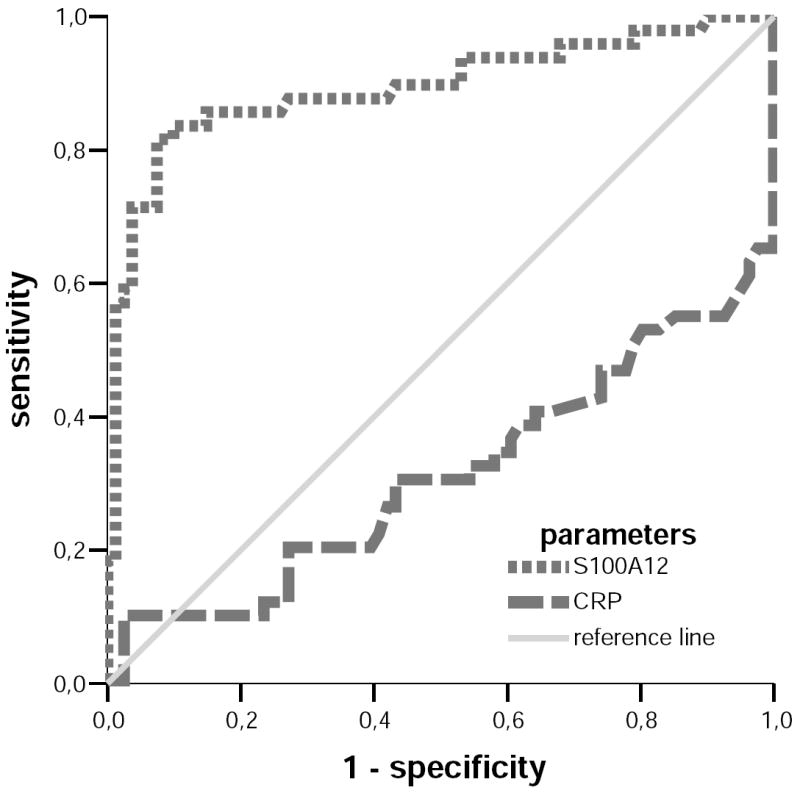
The mean +/- 95% confidence interval serum levels of S100A12 were as follows: in patients with JIA, 7,190 +/- 2,690 ng/ml; in patients with FMF, 6,720 +/- 4,960 ng/ml; in patients with NOMID, 720 +/- 450 ng/ml; in patients with MWS, 150 +/- 60 ng/ml; in patients with infections, 470 +/- 160 ng/ml; in patients with ALL, 130 +/- 80 ng/ml; in patients with AML, 45 +/- 60 ng/ml; in healthy control subjects, 50 +/- 10 ng/ml. The sensitivity and specificity of S100A12 to distinguish between systemic-onset JIA and infections were 66% and 94%, respectively.
S100A12, a marker of granulocyte activation, is highly overexpressed in patients with systemic-onset JIA or FMF, which may point to as-yet unknown common inflammatory mechanisms in these diseases. The measurement of S100A12 serum levels may provide a valuable diagnostic tool in the evaluation of FUO.
儿童不明原因发热(FUO)是一个诊断难题。鉴别诊断包括全身型幼年特发性关节炎(JIA),这是一种与吞噬细胞激活相关的自身炎症综合征,在疾病表现时,它很难与严重的全身感染相区分。本研究的目的是调查吞噬细胞促炎蛋白S100A12的血清浓度是否有助于决定对FUO患者使用抗生素还是免疫抑制剂进行治疗。
从45名健康对照者和240名患者(60名全身型JIA患者、17名家族性地中海热[FMF]患者、18名新生儿期多系统炎症性疾病[NOMID]患者、17名穆-韦综合征[MWS]患者、40名急性淋巴细胞白血病[ALL]患者、5名急性髓细胞白血病[AML]患者和83名全身感染患者)获取血清样本。所有样本均在就诊时、开始任何治疗之前采集,并通过酶联免疫吸附测定法测定S100A12的浓度。
S100A12的平均±95%置信区间血清水平如下:JIA患者为7190±2690 ng/ml;FMF患者为6720±4960 ng/ml;NOMID患者为720±450 ng/ml;MWS患者为150±60 ng/ml;感染患者为470±160 ng/ml;ALL患者为130±80 ng/ml;AML患者为45±60 ng/ml;健康对照者为50±10 ng/ml。S100A12区分全身型JIA和感染的敏感性和特异性分别为66%和94%。
S100A12作为粒细胞激活的标志物,在全身型JIA或FMF患者中高度过表达,这可能提示这些疾病中尚未明确的共同炎症机制。测定S100A12血清水平可能为FUO的评估提供一种有价值的诊断工具。