Kirpich Irina A, Solovieva Natalia V, Leikhter Svetlana N, Shidakova Natalia A, Lebedeva Oxsana V, Sidorov Pavel I, Bazhukova Tatjana A, Soloviev Andrej G, Barve Shirish S, McClain Craig J, Cave Matt
Department of Biochemistry, Northern State Medical University, 161020, Arkhangelsk, Russia.
Alcohol. 2008 Dec;42(8):675-82. doi: 10.1016/j.alcohol.2008.08.006.
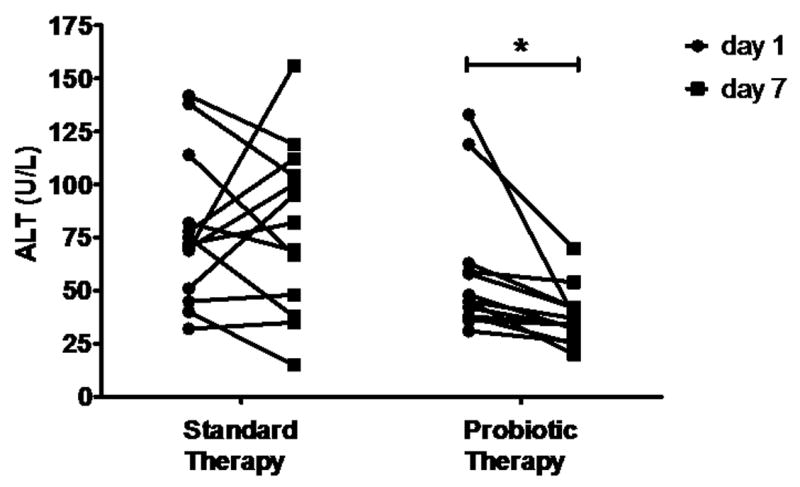
The effects of chronic alcohol consumption on the bowel flora and the potential therapeutic role of probiotics in alcohol-induced liver injury have not previously been evaluated. In this study, 66 adult Russian males admitted to a psychiatric hospital with a diagnosis of alcoholic psychosis were enrolled in a prospective, randomized, clinical trial to study the effects of alcohol and probiotics on the bowel flora and alcohol-induced liver injury. Patients were randomized to receive 5 days of Bifidobacterium bifidum and Lactobacillus plantarum 8PA3 versus standard therapy alone (abstinence plus vitamins). Stool cultures and liver enzymes were performed at baseline and again after therapy. Results were compared between groups and with 24 healthy, matched controls who did not consume alcohol. Compared to healthy controls, alcoholic patients had significantly reduced numbers of bifidobacteria (6.3 vs. 7.5 log colony-forming unit [CFU]/g), lactobacilli (3.15 vs. 4.59 log CFU/g), and enterococci (4.43 vs. 5.5 log CFU/g). The mean baseline alanine aminotransferase (ALT), aspartate aminotransferase (AST), and gamma-glutamyl transpeptidase (GGT) activities were significantly elevated in the alcoholic group compared to the healthy control group (AST: 104.1 vs. 29.15 U/L; ALT: 50.49 vs. 22.96 U/L; GGT 161.5 vs. 51.88 U/L), indicating that these patients did have mild alcohol-induced liver injury. After 5 days of probiotic therapy, alcoholic patients had significantly increased numbers of both bifidobacteria (7.9 vs. 6.81 log CFU/g) and lactobacilli (4.2 vs. 3.2 log CFU/g) compared to the standard therapy arm. Despite similar values at study initiation, patients treated with probiotics had significantly lower AST and ALT activity at the end of treatment than those treated with standard therapy alone (AST: 54.67 vs. 76.43 U/L; ALT 36.69 vs. 51.26 U/L). In a subgroup of 26 subjects with well-characterized mild alcoholic hepatitis (defined as AST and ALT greater than 30 U/L with AST-to-ALT ratio greater than one), probiotic therapy was associated with a significant end of treatment reduction in ALT, AST, GGT, lactate dehydrogenase, and total bilirubin. In this subgroup, there was a significant end of treatment mean ALT reduction in the probiotic arm versus the standard therapy arm. In conclusion, patients with alcohol-induced liver injury have altered bowel flora compared to healthy controls. Short-term oral supplementation with B. bifidum and L. plantarum 8PA3 was associated with restoration of the bowel flora and greater improvement in alcohol-induced liver injury than standard therapy alone.
长期饮酒对肠道菌群的影响以及益生菌在酒精性肝损伤中的潜在治疗作用此前尚未得到评估。在本研究中,66名因酒精性精神病入住精神病院的成年俄罗斯男性被纳入一项前瞻性、随机临床试验,以研究酒精和益生菌对肠道菌群及酒精性肝损伤的影响。患者被随机分为两组,一组接受5天的双歧双歧杆菌和植物乳杆菌8PA3治疗,另一组仅接受标准治疗(戒酒加维生素)。在基线时以及治疗后再次进行粪便培养和肝酶检测。将两组结果与24名不饮酒的健康匹配对照进行比较。与健康对照相比,酒精性患者的双歧杆菌数量(6.3对7.5 log菌落形成单位[CFU]/g)、乳酸杆菌数量(3.15对4.59 log CFU/g)和肠球菌数量(4.43对5.5 log CFU/g)显著减少。与健康对照组相比,酒精性组的平均基线丙氨酸转氨酶(ALT)、天冬氨酸转氨酶(AST)和γ-谷氨酰转肽酶(GGT)活性显著升高(AST:104.1对29.15 U/L;ALT:50.49对22.96 U/L;GGT 161.5对51.88 U/L),表明这些患者确实存在轻度酒精性肝损伤。益生菌治疗5天后,与标准治疗组相比,酒精性患者的双歧杆菌数量(7.9对6.81 log CFU/g)和乳酸杆菌数量(4.2对3.2 log CFU/g)均显著增加。尽管在研究开始时数值相似,但接受益生菌治疗的患者在治疗结束时的AST和ALT活性显著低于仅接受标准治疗的患者(AST:54.67对76.43 U/L;ALT 36.69对51.26 U/L)。在26名特征明确的轻度酒精性肝炎患者亚组中(定义为AST和ALT大于30 U/L且AST与ALT比值大于1),益生菌治疗与治疗结束时ALT、AST、GGT、乳酸脱氢酶和总胆红素的显著降低相关。在该亚组中,益生菌组与标准治疗组相比,治疗结束时平均ALT有显著降低。总之,与健康对照相比,酒精性肝损伤患者的肠道菌群发生了改变。短期口服双歧双歧杆菌和植物乳杆菌8PA3与肠道菌群的恢复以及比单独标准治疗更大程度地改善酒精性肝损伤相关。