Dai Pu, Yuan Yongyi, Huang Deliang, Zhu Xiuhui, Yu Fei, Kang Dongyang, Yuan Huijun, Wu Bailin, Han Dongyi, Wong Lee-Jun C
Department of Otolaryngology and Genetic Testing Center for Deafness, Chinese PLA General Hospital, Beijing, PR China.
J Transl Med. 2008 Nov 30;6:74. doi: 10.1186/1479-5876-6-74.
The molecular etiology of hearing impairment in Chinese has not been thoroughly investigated. Study of GJB2 gene revealed that 30.4% of the patients with hearing loss in Inner Mongolia carried GJB2 mutations. The SLC26A4 gene mutations and relevant phenotype are analyzed in this study.
One hundred and thirty-five deaf patients were included. The coding exons of SLC26A4 gene were sequence analyzed in 111 patients, not including 22 patients carrying bi-allelic GJB2 mutations or one patient carrying a known GJB2 dominant mutation as well as one patient with mtDNA 1555A>G mutation. All patients with SLC26A4 mutations or variants were subjected to high resolution temporal bone CT scan and those with confirmed enlarged vestibular aqueduct and/or other inner ear malformation were then given further ultrasound scan of thyroid and thyroid hormone assays.
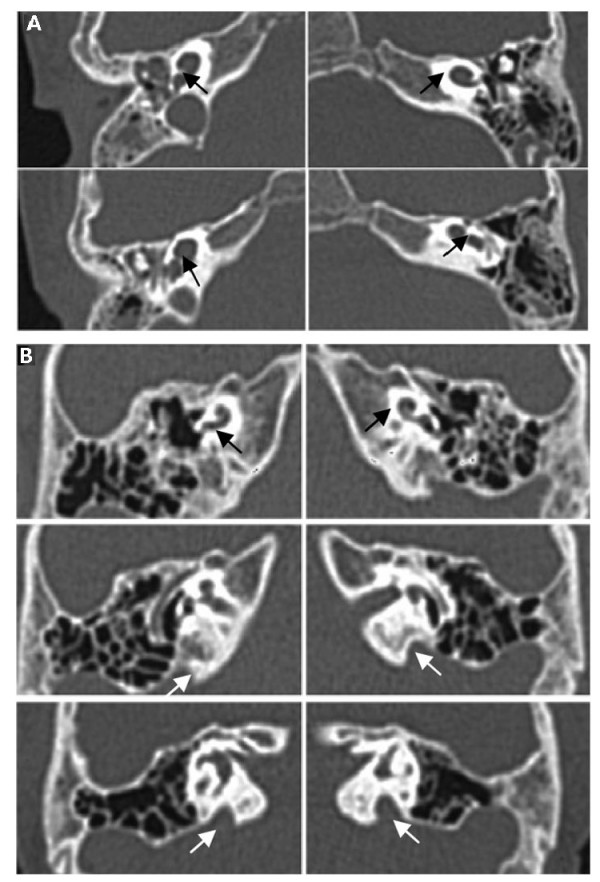
Twenty-six patients (19.26%, 26/135) were found carrying SLC26A4 mutation. Among them, 17 patients with bi-allelic SLC26A4 mutations were all confirmed to have EVA or other inner ear malformation by CT scan. Nine patients were heterozygous for one SLC26A4 mutation, including 3 confirmed to be EVA or EVA and Mondini dysplasia by CT scan. The most common mutation, IVS7-2A>G, accounted for 58.14% (25/43) of all SLC26A4 mutant alleles. The shape and function of thyroid were confirmed to be normal by thyroid ultrasound scan and thyroid hormone assays in 19 of the 20 patients with EVA or other inner ear malformation except one who had cystoid change in the right side of thyroid. No Pendred syndrome was diagnosed.
In Inner Mongolia, China, mutations in SLC26A4 gene account for about 12.6% (17/135) of the patients with hearing loss. Together with GJB2 (23/135), SLC26A4 are the two most commonly mutated genes causing deafness in this region. Pendred syndrome is not detected in this deaf population. We established a new strategy that detects SLC26A4 mutations prior to the temporal bone CT scan to find EVA and inner ear malformation patients. This model has a unique advantage in epidemiologic study of large deaf population.
中国听力障碍的分子病因尚未得到充分研究。对GJB2基因的研究表明,内蒙古30.4%的听力损失患者携带GJB2突变。本研究对SLC26A4基因突变及相关表型进行分析。
纳入135例耳聋患者。对111例患者进行SLC26A4基因编码外显子序列分析,不包括22例携带双等位基因GJB2突变的患者、1例携带已知GJB2显性突变的患者以及1例线粒体DNA 1555A>G突变的患者。所有携带SLC26A4突变或变异的患者均接受高分辨率颞骨CT扫描,对确诊为前庭导水管扩大和/或其他内耳畸形的患者进一步进行甲状腺超声检查和甲状腺激素检测。
发现26例患者(19.26%,26/135)携带SLC26A4突变。其中,17例携带双等位基因SLC26A4突变的患者经CT扫描均确诊为EVA或其他内耳畸形。9例患者为SLC26A4单突变杂合子,其中3例经CT扫描确诊为EVA或EVA合并Mondini发育异常。最常见的突变IVS7-2A>G占所有SLC26A4突变等位基因的58.14%(25/43)。20例EVA或其他内耳畸形患者中,除1例右侧甲状腺有囊样改变外,其余19例经甲状腺超声检查和甲状腺激素检测证实甲状腺形态和功能正常。未诊断出Pendred综合征。
在中国内蒙古地区,SLC26A4基因突变约占听力损失患者的12.6%(17/135)。与GJB2基因(23/135)一起,SLC26A4是该地区导致耳聋的两个最常见突变基因。在该耳聋人群中未检测到Pendred综合征。我们建立了一种新策略,在颞骨CT扫描前检测SLC26A4突变,以发现EVA和内耳畸形患者。该模式在大规模耳聋人群的流行病学研究中具有独特优势。