Valente Maria Anete S, Faria Jerusa A Q A, Soares-Ramos Juliana R L, Reis Pedro A B, Pinheiro Guilherme L, Piovesan Newton D, Morais Angélica T, Menezes Carlos C, Cano Marco A O, Fietto Luciano G, Loureiro Marcelo E, Aragão Francisco J L, Fontes Elizabeth P B
Departamento de Bioquímica e Biologia Molecular, BIOAGRO, Universidade Federal de Viçosa, Avenida PH Rolfs s/n, 36571.000 Viçosa, MG, Brazil.
J Exp Bot. 2009;60(2):533-46. doi: 10.1093/jxb/ern296. Epub 2008 Dec 3.
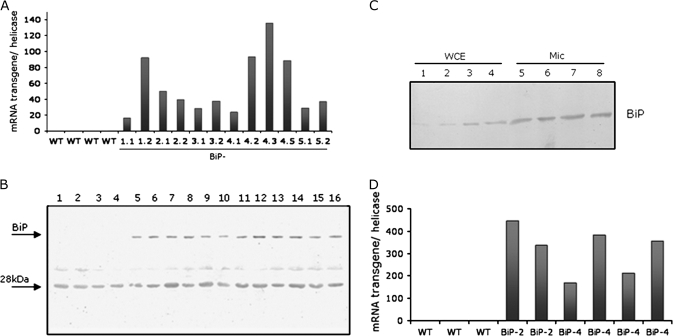
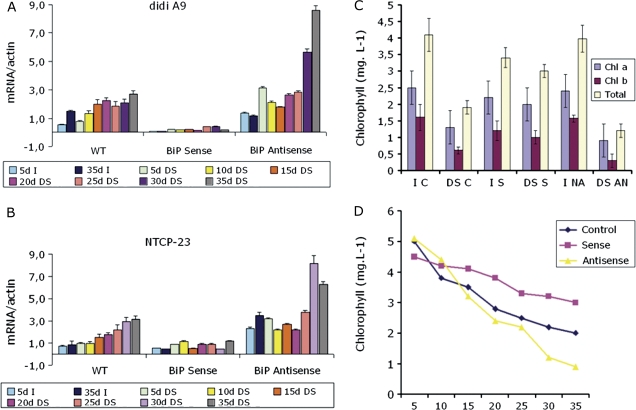
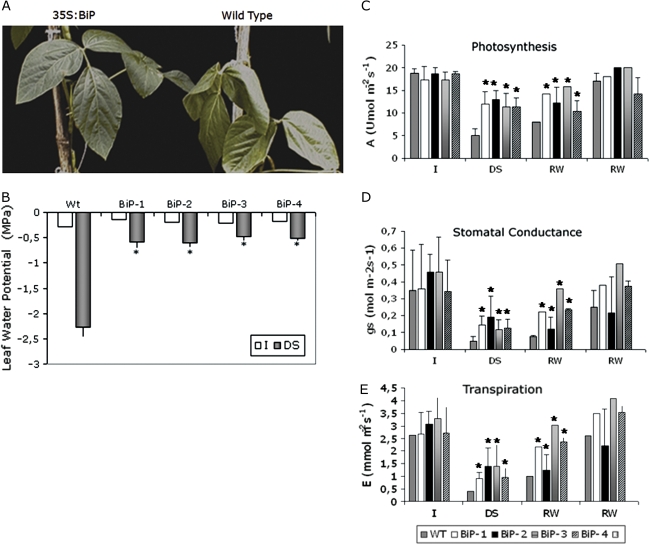
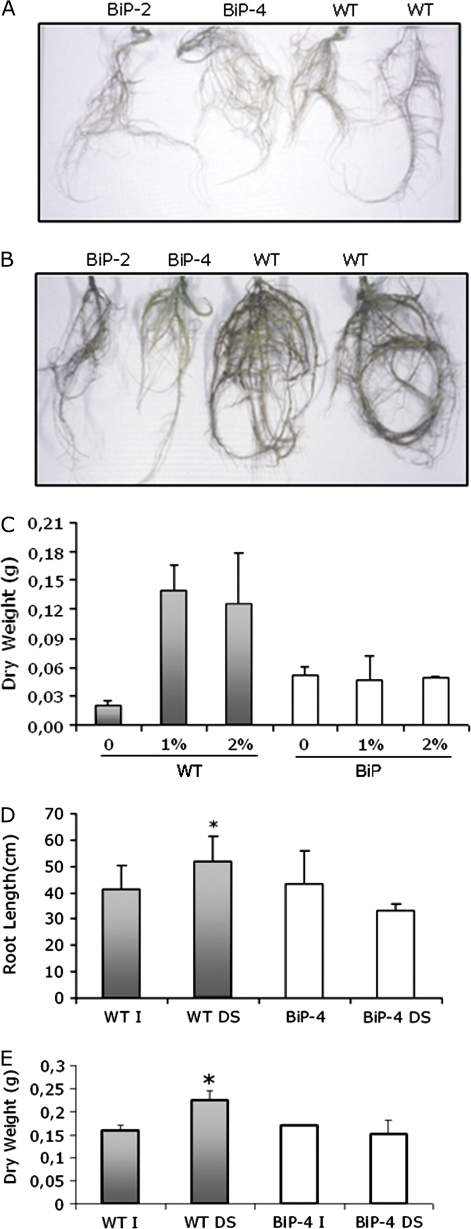
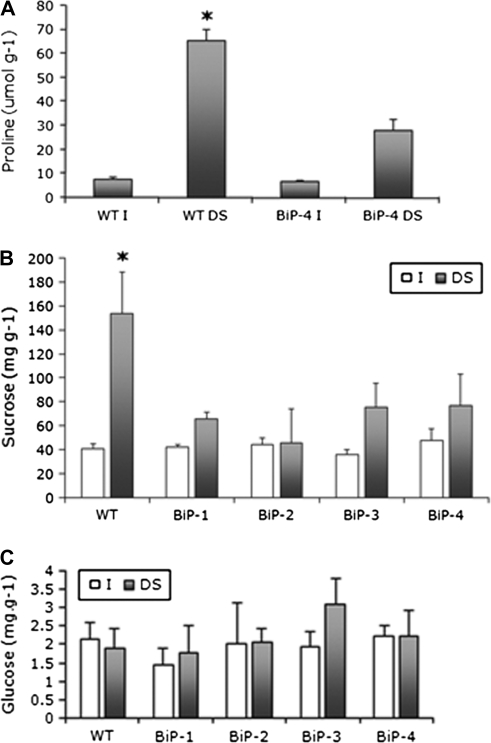
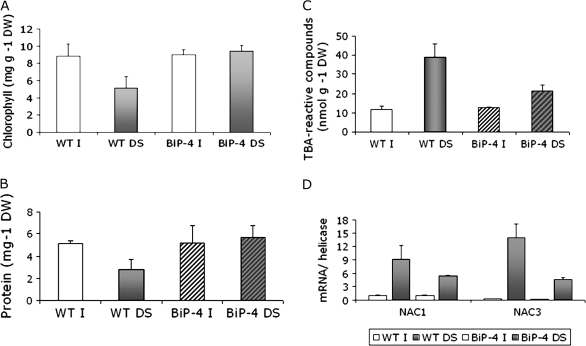
The ER-resident molecular chaperone BiP (binding protein) was overexpressed in soybean. When plants growing in soil were exposed to drought (by reducing or completely withholding watering) the wild-type lines showed a large decrease in leaf water potential and leaf wilting, but the leaves in the transgenic lines did not wilt and exhibited only a small decrease in water potential. During exposure to drought the stomata of the transgenic lines did not close as much as in the wild type, and the rates of photosynthesis and transpiration became less inhibited than in the wild type. These parameters of drought resistance in the BiP overexpressing lines were not associated with a higher level of the osmolytes proline, sucrose, and glucose. It was also not associated with the typical drought-induced increase in root dry weight. Rather, at the end of the drought period, the BiP overexpressing lines had a lower level of the osmolytes and root weight than the wild type. The mRNA abundance of several typical drought-induced genes [NAC2, a seed maturation protein (SMP), a glutathione-S-transferase (GST), antiquitin, and protein disulphide isomerase 3 (PDI-3)] increased in the drought-stressed wild-type plants. Compared with the wild type, the increase in mRNA abundance of these genes was less (in some genes much less) in the BiP overexpressing lines that were exposed to drought. The effect of drought on leaf senescence was investigated in soybean and tobacco. It had previously been reported that tobacco BiP overexpression or repression reduced or accentuated the effects of drought. BiP overexpressing tobacco and soybean showed delayed leaf senescence during drought. BiP antisense tobacco plants, conversely, showed advanced leaf senescence. It is concluded that BiP overexpression confers resistance to drought, through an as yet unknown mechanism that is related to ER functioning. The delay in leaf senescence by BiP overexpression might relate to the absence of the response to drought.
内质网驻留分子伴侣BiP(结合蛋白)在大豆中过表达。当种植在土壤中的植株遭受干旱(通过减少或完全停止浇水)时,野生型品系的叶片水势大幅下降且叶片萎蔫,但转基因品系的叶片没有萎蔫,仅表现出水势小幅下降。在干旱期间,转基因品系的气孔不像野生型那样关闭程度大,光合作用和蒸腾作用速率受到的抑制也比野生型小。这些过表达BiP品系的抗旱参数与渗透调节物质脯氨酸、蔗糖和葡萄糖的较高水平无关。它也与干旱诱导的典型根系干重增加无关。相反,在干旱期结束时,过表达BiP的品系的渗透调节物质水平和根重比野生型低。几种典型干旱诱导基因[NAC2、一种种子成熟蛋白(SMP)、一种谷胱甘肽-S-转移酶(GST)、抗泛素蛋白和蛋白二硫键异构酶3(PDI-3)]的mRNA丰度在干旱胁迫的野生型植株中增加。与野生型相比,在遭受干旱的过表达BiP品系中,这些基因的mRNA丰度增加较少(在某些基因中少得多)。在大豆和烟草中研究了干旱对叶片衰老的影响。此前有报道称,烟草中BiP的过表达或抑制会减轻或加剧干旱的影响。过表达BiP的烟草和大豆在干旱期间叶片衰老延迟。相反,BiP反义烟草植株叶片衰老提前。得出的结论是,BiP的过表达通过一种与内质网功能相关的未知机制赋予抗旱性。BiP过表达导致的叶片衰老延迟可能与缺乏对干旱的响应有关。