Tveitå Einar Kristian, Ekeberg Ole Marius, Juel Niels Gunnar, Bautz-Holter Erik
Department of Physical Medicine and Rehabilitation, Ullevål University Hospital, University of Oslo, Oslo, Norway.
BMC Musculoskelet Disord. 2008 Dec 3;9:161. doi: 10.1186/1471-2474-9-161.
Instruments designed to measure the subjective impact of painful shoulder conditions have become essential in shoulder research. The Shoulder Pain and Disability Index (SPADI) is one of the most extensively used scales of this type. The objective of this study was to investigate reproducibility and responsiveness of the SPADI in patients with adhesive capsulitis.
SPADI test-retest reproducibility was estimated by the "intraclass correlation coefficient" (ICC) and the "smallest detectable difference" (SDD). Responsiveness was assessed by exploring baseline and follow-up data recorded in a recently reported clinical trial regarding hydrodilatation and corticosteroid injections in 76 patients with adhesive capsulitis. "Standardized response mean" (SRM) and "reliable change proportion" (RCP) for SPADI were compared with corresponding figures for shoulder range-of-motion (ROM). The relationship between SPADI and ROM change scores was investigated through correlation and linear regression analyses.
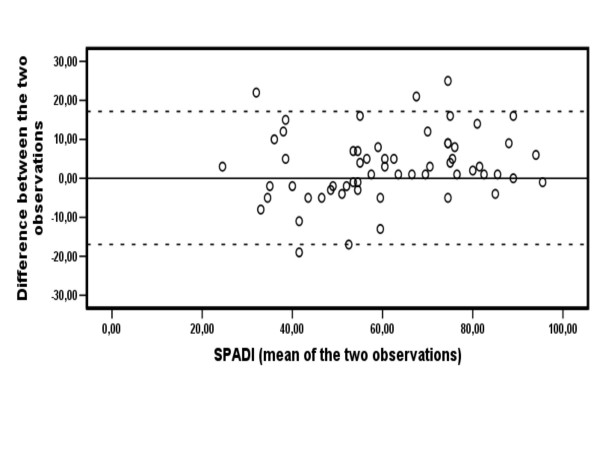
Results for test-retest reproducibility indicated a smallest detectable difference of 17 points on the 0-100 scale, and an intraclass correlation coefficient of 0.89. The SPADI was generally more responsive than ROM. Weak to moderately strong associations were identified between SPADI and ROM change scores. According to the regression model, the three variables baseline SPADI, baseline active ROM and change in active ROM together explained 60% of the variance in SPADI improvement.
This study supports the use of SPADI as an outcome measure in similar settings.
旨在测量肩部疼痛状况主观影响的工具在肩部研究中已变得至关重要。肩痛和功能障碍指数(SPADI)是这类使用最广泛的量表之一。本研究的目的是调查SPADI在粘连性肩关节囊炎患者中的可重复性和反应性。
通过“组内相关系数”(ICC)和“最小可检测差异”(SDD)评估SPADI的重测可重复性。通过探索最近报道的一项关于76例粘连性肩关节囊炎患者进行液压扩张和皮质类固醇注射的临床试验中记录的基线和随访数据来评估反应性。将SPADI的“标准化反应均值”(SRM)和“可靠变化比例”(RCP)与肩关节活动范围(ROM)的相应数据进行比较。通过相关性和线性回归分析研究SPADI与ROM变化分数之间的关系。
重测可重复性结果表明,在0 - 100分的量表上最小可检测差异为17分,组内相关系数为0.89。SPADI通常比ROM更具反应性。在SPADI与ROM变化分数之间发现了弱至中等强度的关联。根据回归模型,基线SPADI、基线主动ROM和主动ROM变化这三个变量共同解释了SPADI改善差异的60%。
本研究支持在类似情况下使用SPADI作为结局指标。