Cole T J, Stanojevic S, Stocks J, Coates A L, Hankinson J L, Wade A M
MRC Centre of Epidemiology for Child Health, UCL Institute of Child Health, London WC1N 1EH, U.K.
Stat Med. 2009 Feb 28;28(5):880-98. doi: 10.1002/sim.3504.
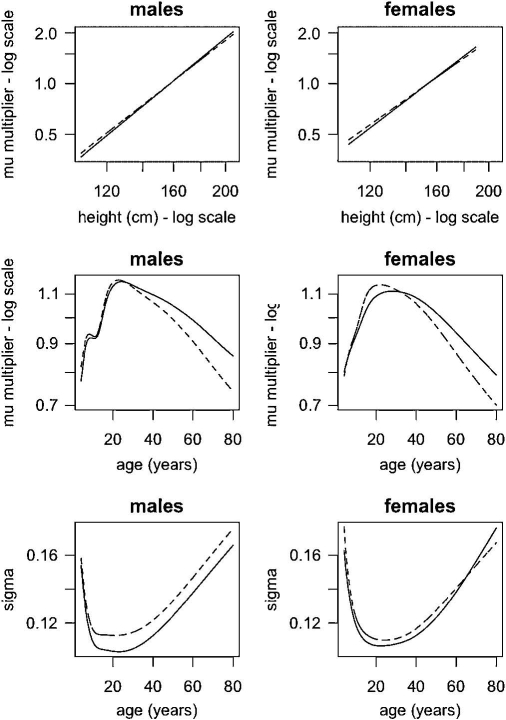
Age-related reference ranges are useful for assessing growth in children. The LMS method is a popular technique for constructing growth charts that model the age-changing distribution of the measurement in terms of the median, coefficient of variation and skewness. Here the methodology is extended to references that depend on body size as well as age, by exploiting the flexibility of the generalised additive models for location, scale and shape (GAMLSS) technique. GAMLSS offers general linear predictors for each moment parameter and a choice of error distributions, which can handle kurtosis as well as skewness. A key question with such references is the nature of the age-size adjustment, additive or multiplicative, which is explored by comparing the identity link and log link for the median predictor.There are several measurements whose reference ranges depend on both body size and age. As an example, models are developed here for the first four moments of the lung function variables forced expiratory volume in 1 s (FEV(1)), forced vital capacity (FVC) and FEV(1)/FVC in terms of height and age, in a data set of 3598 children and adults aged 4 to 80 years. The results show a strong multiplicative association between spirometry, height and age, with a large and nonlinear age effect across the age range. Variability also depends nonlinearly on age and to a lesser extent on height. FEV(1) and FVC are close to normally distributed, while FEV(1)/FVC is appreciably skew to the left. GAMLSS is a powerful technique for the construction of such references, which should be useful in clinical medicine.
与年龄相关的参考范围对于评估儿童生长情况很有用。LMS方法是构建生长图表的一种常用技术,该方法根据中位数、变异系数和偏度对测量值随年龄变化的分布进行建模。在此,通过利用广义相加模型在位置、尺度和形状(GAMLSS)技术的灵活性,将该方法扩展到依赖于身体大小以及年龄的参考范围。GAMLSS为每个矩参数提供广义线性预测器,并提供误差分布的选择,它可以处理峰度以及偏度。对于此类参考范围的一个关键问题是年龄 - 大小调整的性质,即加法还是乘法,通过比较中位数预测器的恒等链接和对数链接来进行探究。有几种测量的参考范围既取决于身体大小又取决于年龄。例如,在此针对3598名年龄在4至80岁的儿童和成人的数据集中,根据身高和年龄建立了肺功能变量第1秒用力呼气量(FEV(1))、用力肺活量(FVC)和FEV(1)/FVC前四个矩的模型。结果表明,肺量计测量值、身高和年龄之间存在很强的乘法关联,在整个年龄范围内年龄效应大且呈非线性。变异性也非线性地取决于年龄,在较小程度上取决于身高。FEV(1)和FVC接近正态分布,而FEV(1)/FVC明显向左偏斜。GAMLSS是构建此类参考范围的一种强大技术,在临床医学中应会很有用。