Ostrowski Elizabeth A, Katoh Mariko, Shaulsky Gad, Queller David C, Strassmann Joan E
Department of Ecology and Evolutionary Biology, Rice University, Houston, Texas, USA.
PLoS Biol. 2008 Nov 25;6(11):e287. doi: 10.1371/journal.pbio.0060287.
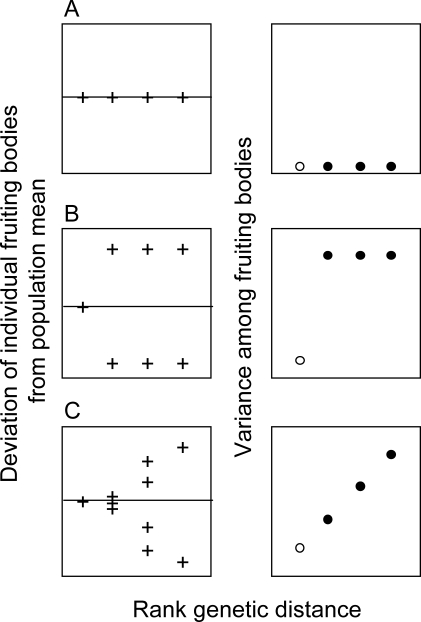
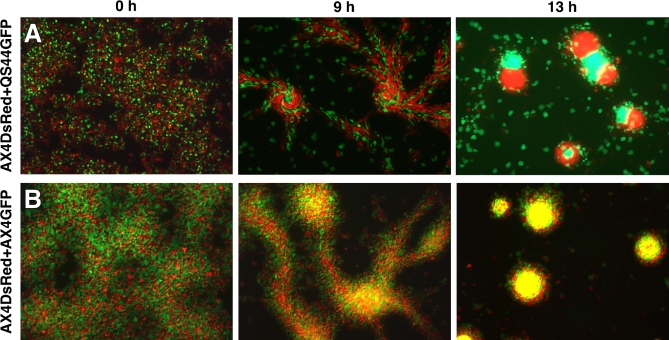
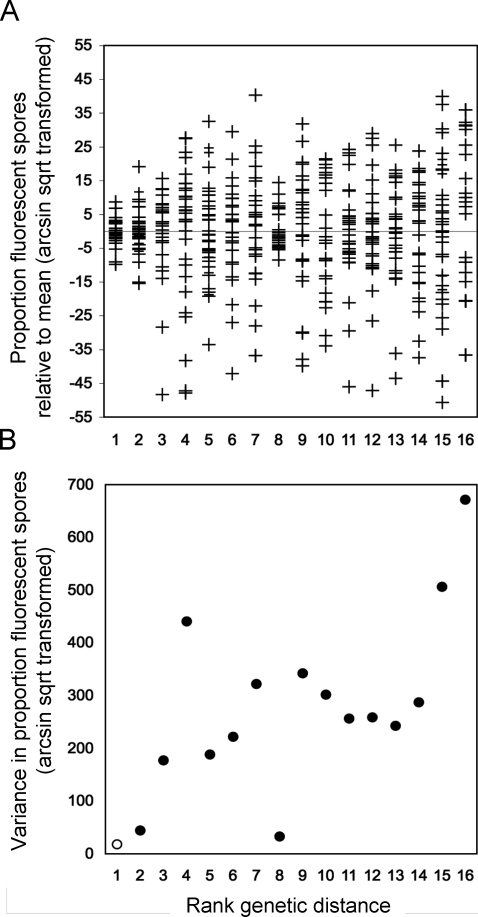
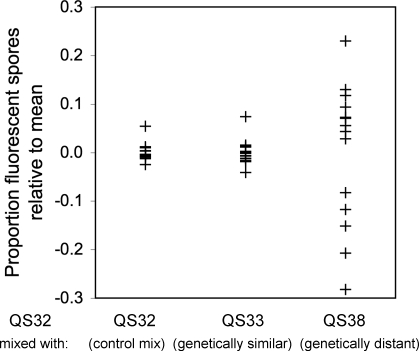
In the social amoeba Dictyostelium discoideum, thousands of cells aggregate upon starvation to form a multicellular fruiting body, and approximately 20% of them die to form a stalk that benefits the others. The aggregative nature of multicellular development makes the cells vulnerable to exploitation by cheaters, and the potential for cheating is indeed high. Cells might avoid being victimized if they can discriminate among individuals and avoid those that are genetically different. We tested how widely social amoebae cooperate by mixing isolates from different localities that cover most of their natural range. We show here that different isolates partially exclude one another during aggregation, and there is a positive relationship between the extent of this exclusion and the genetic distance between strains. Our findings demonstrate that D. discoideum cells co-aggregate more with genetically similar than dissimilar individuals, suggesting the existence of a mechanism that discerns the degree of genetic similarity between individuals in this social microorganism.
在社会性变形虫盘基网柄菌中,数千个细胞在饥饿时聚集形成一个多细胞子实体,其中约20%的细胞死亡形成柄,从而使其他细胞受益。多细胞发育的聚集特性使细胞容易受到作弊者的利用,而且作弊的可能性确实很高。如果细胞能够区分个体并避开那些基因不同的个体,它们可能会避免成为受害者。我们通过混合来自覆盖其大部分自然分布范围的不同地点的分离株,测试了社会性变形虫的合作范围有多广。我们在此表明,不同的分离株在聚集过程中会部分地相互排斥,并且这种排斥程度与菌株之间的遗传距离呈正相关。我们的研究结果表明,盘基网柄菌细胞与基因相似的个体比与基因不同的个体更倾向于共同聚集,这表明在这种社会性微生物中存在一种能够识别个体间遗传相似程度的机制。