Ma Minmin, Ma Yuping, Yi Xueming, Guo Ruibing, Zhu Wusheng, Fan Xinying, Xu Gelin, Frey William H, Liu Xinfeng
Department of Neurology, Jinling Hospital, Nanjing University School of Medicine, 305# East Zhongshan Road, Nanjing 21002, Jiangsu Province, PR China.
BMC Neurosci. 2008 Dec 10;9:117. doi: 10.1186/1471-2202-9-117.
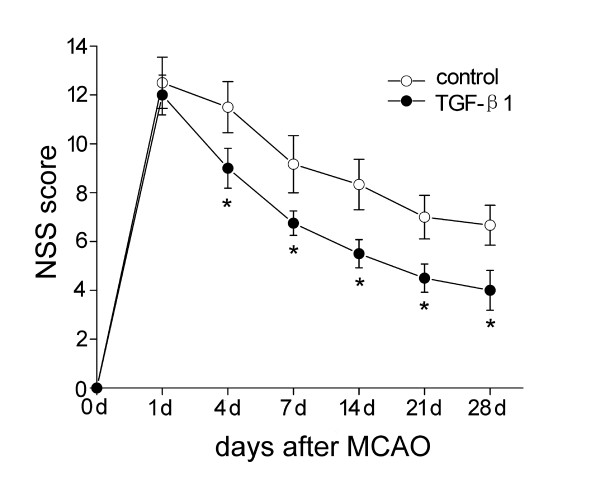
The effect of neurotrophic factors in enhancing stroke-induced neurogenesis in the adult subventricular zone (SVZ) is limited by their poor blood-brain barrier (BBB) permeability.Intranasal administration is a noninvasive and valid method for delivery of neuropeptides into the brain, to bypass the BBB. We investigated the effect of treatment with intranasal transforming growth factor-beta1 (TGF-beta1) on neurogenesis in the adult mouse SVZ following focal ischemia. The modified Neurological Severity Scores (NSS) test was used to evaluate neurological function, and infarct volumes were determined from hematoxylin-stained sections. Terminal deoxynucleotidyl transferase-mediated dUTP nick end labeling (TUNEL) labeling was performed at 7 days after middle cerebral artery occlusion (MCAO). Immunohistochemistry was used to detect bromodeoxyuridine (BrdU) and neuron- or glia-specific markers for identifying neurogenesis in the SVZ at 7, 14, 21, 28 days after MCAO.
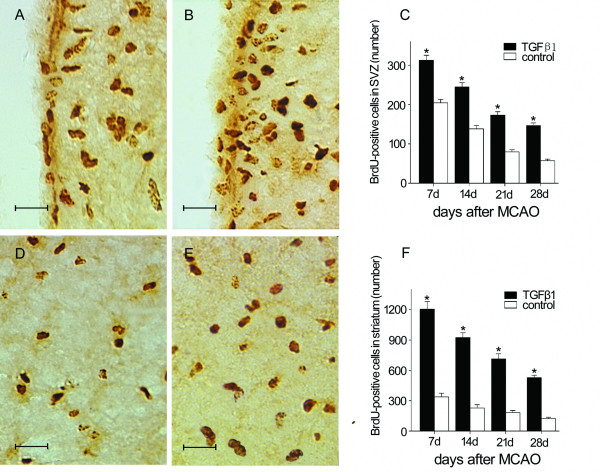
Intranasal treatment of TGF-beta1 shows significant improvement in neurological function and reduction of infarct volume compared with control animals. TGF-beta1 treated mice had significantly less TUNEL-positive cells in the ipsilateral striatum than that in control groups. The number of BrdU-incorporated cells in the SVZ and striatum was significantly increased in the TGF-beta1 treated group compared with control animals at each time point. In addition, numbers of BrdU- labeled cells coexpressed with the migrating neuroblast marker doublecortin (DCX) and the mature neuronal marker neuronal nuclei (NeuN) were significantly increased after intranasal delivery of TGF-beta1, while only a few BrdU labeled cells co-stained with glial fibrillary acidic protein (GFAP).
Intranasal administration of TGF-beta1 reduces infarct volume, improves functional recovery and enhances neurogenesis in mice after stroke. Intranasal TGF-beta1 may have therapeutic potential for cerebrovascular disorders.
神经营养因子增强成年脑室下区(SVZ)中风诱导神经发生的作用受到其血脑屏障(BBB)通透性差的限制。鼻内给药是一种将神经肽输送到大脑的非侵入性有效方法,可绕过血脑屏障。我们研究了鼻内给予转化生长因子-β1(TGF-β1)对成年小鼠局灶性缺血后SVZ神经发生的影响。采用改良的神经功能缺损评分(NSS)测试评估神经功能,并通过苏木精染色切片测定梗死体积。在大脑中动脉闭塞(MCAO)后7天进行末端脱氧核苷酸转移酶介导的dUTP缺口末端标记(TUNEL)标记。免疫组织化学用于检测溴脱氧尿苷(BrdU)以及神经元或神经胶质细胞特异性标志物,以鉴定MCAO后7、14、21、28天SVZ中的神经发生情况。
与对照动物相比,鼻内给予TGF-β1可显著改善神经功能并减小梗死体积。TGF-β1处理的小鼠同侧纹状体中TUNEL阳性细胞明显少于对照组。与对照动物相比,TGF-β1处理组在每个时间点SVZ和纹状体中掺入BrdU的细胞数量均显著增加。此外,鼻内给予TGF-β1后,与迁移的神经母细胞标志物双皮质素(DCX)和成熟神经元标志物神经元细胞核(NeuN)共表达的BrdU标记细胞数量显著增加,而仅有少数BrdU标记细胞与胶质纤维酸性蛋白(GFAP)共染色。
鼻内给予TGF-β1可减小小鼠中风后的梗死体积,改善功能恢复并增强神经发生。鼻内给予TGF-β1可能对脑血管疾病具有治疗潜力。