Luo Wenjie, Rodina Anna, Chiosis Gabriela
Laboratory of Molecular and Cellular Neuroscience, The Rockefeller University and Fisher Foundation for Alzheimer's Disease, New York, NY 10021, USA.
BMC Neurosci. 2008 Dec 3;9 Suppl 2(Suppl 2):S7. doi: 10.1186/1471-2202-9-S2-S7.
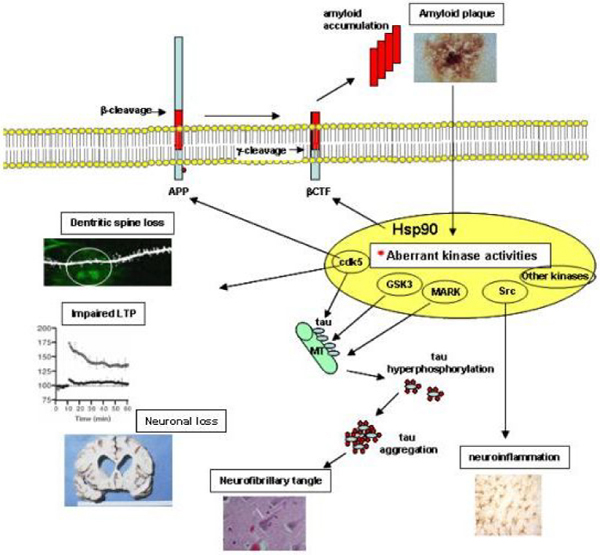
Both malignant transformation and neurodegeneration, as it occurs in Alzheimer's disease, are complex and lengthy multistep processes characterized by abnormal expression, post-translational modification, and processing of certain proteins. To maintain and allow the accumulation of these dysregulated processes, and to facilitate the step-wise evolution of the disease phenotype, cells must co-opt a compensatory regulatory mechanism. In cancer, this role has been attributed to heat shock protein 90 (Hsp90), a molecular chaperone that maintains the functional conformation of multiple proteins involved in cell-specific oncogenic processes. In this sense, at the phenotypic level, Hsp90 appears to serve as a biochemical buffer for the numerous cancer-specific lesions that are characteristic of diverse tumors. The current review proposes a similar role for Hsp90 in neurodegeneration. It will present experimentally demonstrated, but also hypothetical, roles that suggest Hsp90 can act as a regulator of pathogenic changes that lead to the neurodegenerative phenotype in Alzheimer's disease.
恶性转化和神经退行性变(如在阿尔茨海默病中发生的那样)都是复杂且漫长的多步骤过程,其特征是某些蛋白质的异常表达、翻译后修饰和加工。为了维持并允许这些失调过程的积累,并促进疾病表型的逐步演变,细胞必须采用一种补偿性调节机制。在癌症中,这一作用归因于热休克蛋白90(Hsp90),它是一种分子伴侣,可维持参与细胞特异性致癌过程的多种蛋白质的功能构象。从这个意义上说,在表型水平上,Hsp90似乎充当了多种肿瘤所特有的众多癌症特异性病变的生化缓冲剂。本综述提出Hsp90在神经退行性变中具有类似作用。它将介绍实验证明的以及假设的作用,这些作用表明Hsp90可以作为导致阿尔茨海默病神经退行性表型的致病变化的调节因子。