Viala-Danten Muriel, Martin Susan, Guillemin Isabelle, Hays Ron D
Mapi Values, 19 rue de Villette, 69003 Lyon, France.
Health Qual Life Outcomes. 2008 Dec 17;6:113. doi: 10.1186/1477-7525-6-113.
Sleep is an important element of functioning and well-being. The Medical Outcomes Study Sleep Scale (MOS-Sleep) includes 12 items assessing sleep disturbance, sleep adequacy, somnolence, quantity of sleep, snoring, and awakening short of breath or with a headache. A sleep problems index, grouping items from each of the former domains, is also available. This study evaluates the psychometric properties of MOS-Sleep Scale in a painful diabetic peripheral neuropathic population based on a clinical trial conducted in six countries.
Clinical data and health-related quality of life data were collected at baseline and after 12 weeks of follow-up. Overall, 396 patients were included in the analysis. Psychometric properties of the MOS-Sleep were assessed in the overall population and per country when the sample size was sufficient. Internal consistency reliability was assessed by Cronbach's alpha; the structure of the instrument was assessed by verifying item convergent and discriminant criteria; construct validity was evaluated by examining the relationships between MOS-Sleep scores and sleep interference and pain scores, and SF-36 scores; effect-sizes were used to assess the MOS-Sleep responsiveness. The study was conducted in compliance with United States Food and Drug Administration regulations for informed consent and protection of patient rights.
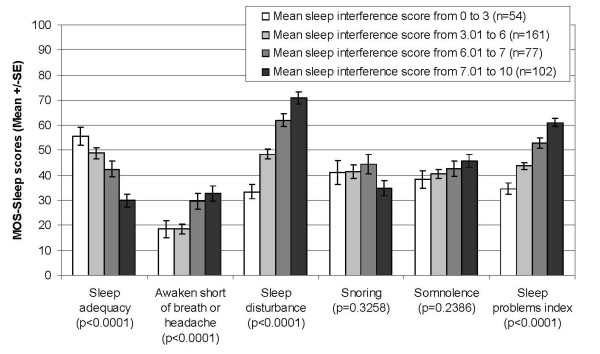
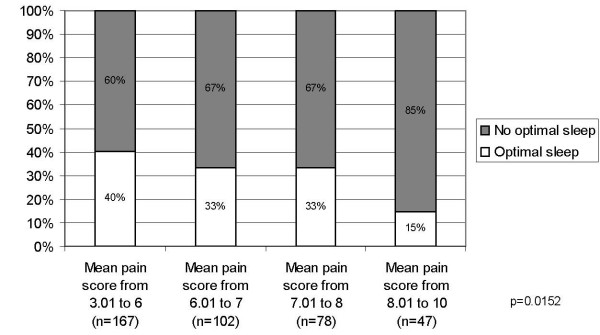
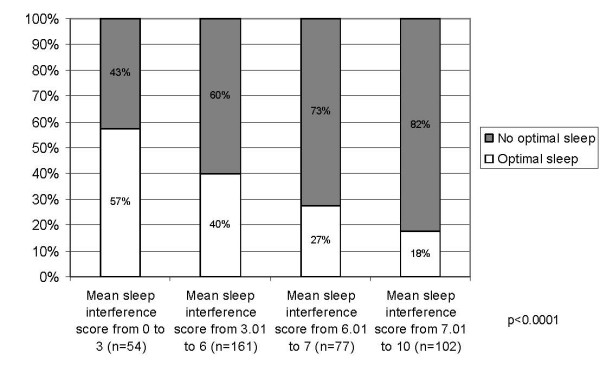
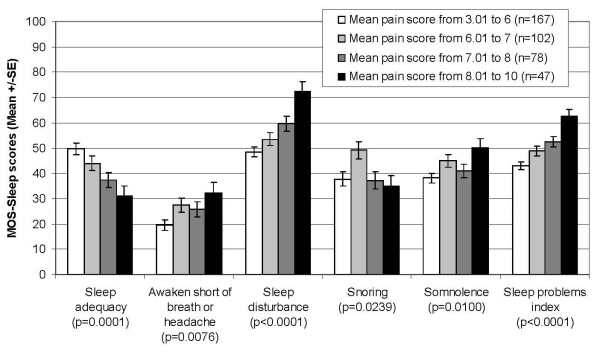
Cronbach's alpha ranged from 0.71 to 0.81 for the multi-item dimensions and the sleep problems index. Item convergent and discriminant criteria were satisfied with item-scale correlations for hypothesized dimensions higher than 0.40 and tending to exceed the correlations of items with other dimensions, respectively. Taken individually, German, Polish and English language versions had good internal consistency reliability and dimension structure. Construct validity was supported with lower sleep adequacy score and greater sleep problems index scores associated with measures of sleep interference and pain scores. In addition, correlations between the SF-36 scores and the MOS-Sleep scores were low to moderate, ranging from -0.28 to -0.53. Responsiveness was supported by effect sizes > 0.80 for patients who improved according to the mean sleep interference and pain scores and clinician and patient global impression of change (p < 0.0001).
The MOS-Sleep had good psychometric properties in this painful diabetic peripheral neuropathic population.
As this study was conducted from 2000 to 2002 (i.e., before the filing requirement came out), no trial registration number is available.
睡眠是身体机能和健康的重要组成部分。医学结局研究睡眠量表(MOS-睡眠量表)包含12个项目,用于评估睡眠障碍、睡眠充足度、嗜睡程度、睡眠时间、打鼾情况以及因呼吸急促或头痛而醒来的情况。此外,还有一个睡眠问题指数,它将上述各领域的项目进行了分组。本研究基于在六个国家开展的一项临床试验,评估了MOS-睡眠量表在疼痛性糖尿病周围神经病变人群中的心理测量学特性。
在基线期和随访12周后收集临床数据和与健康相关的生活质量数据。总体而言,396例患者纳入分析。当样本量足够时,在总体人群以及每个国家中评估MOS-睡眠量表的心理测量学特性。通过Cronbach's α评估内部一致性信度;通过验证项目收敛和判别标准来评估量表结构;通过检查MOS-睡眠量表得分与睡眠干扰、疼痛得分以及SF-36得分之间的关系来评估结构效度;使用效应量来评估MOS-睡眠量表的反应度。本研究遵循美国食品药品监督管理局关于知情同意和保护患者权利的规定进行。
多项目维度和睡眠问题指数的Cronbach's α范围为0.71至0.81。项目收敛和判别标准得到满足,假设维度的项目-量表相关性高于0.40,且各项目与其他维度的相关性倾向于更高。单独来看,德语、波兰语和英语版本具有良好的内部一致性信度和维度结构。较低的睡眠充足度得分以及较高的睡眠问题指数得分与睡眠干扰和疼痛得分相关,支持了结构效度。此外,SF-36得分与MOS-睡眠量表得分之间的相关性为低到中度,范围在-0.28至-0.53之间。对于根据平均睡眠干扰和疼痛得分以及临床医生和患者对变化的总体印象显示病情有所改善的患者,效应量>0.80支持了反应度(p<0.0001)。
在这个疼痛性糖尿病周围神经病变人群中,MOS-睡眠量表具有良好的心理测量学特性。
由于本研究于2000年至2002年进行(即提交要求出台之前),因此没有试验注册号。