Dansithong Warunee, Wolf Cordula M, Sarkar Partha, Paul Sharan, Chiang Andy, Holt Ian, Morris Glenn E, Branco Dorothy, Sherwood Megan C, Comai Lucio, Berul Charles I, Reddy Sita
Department of Biochemistry and Molecular Biology, Institute for Genetic Medicine, University of Southern California, Los Angeles, CA, USA.
PLoS One. 2008;3(12):e3968. doi: 10.1371/journal.pone.0003968. Epub 2008 Dec 18.
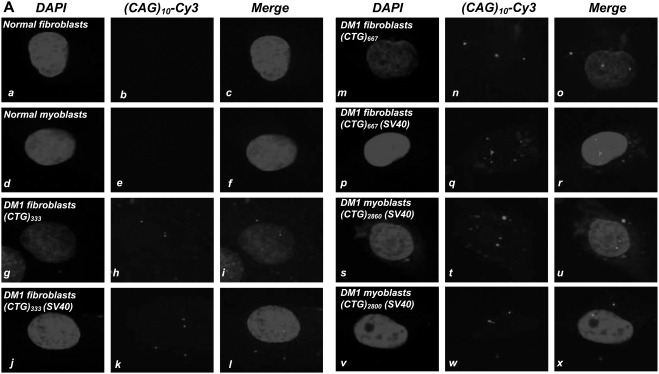
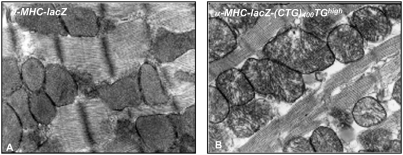
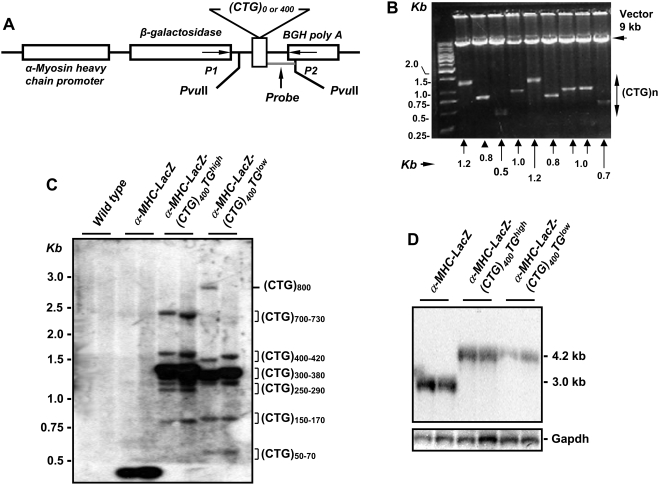
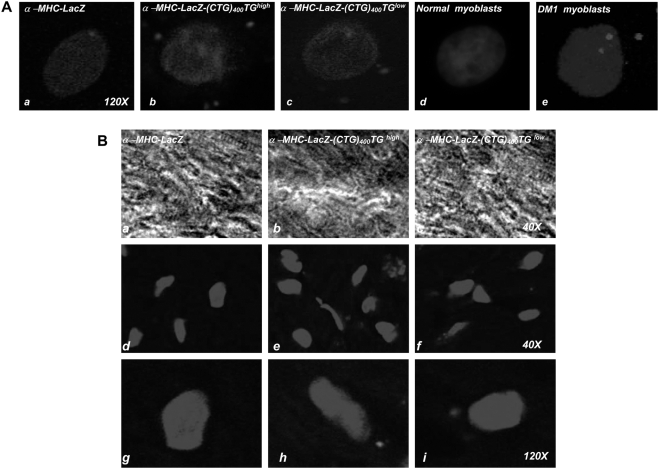
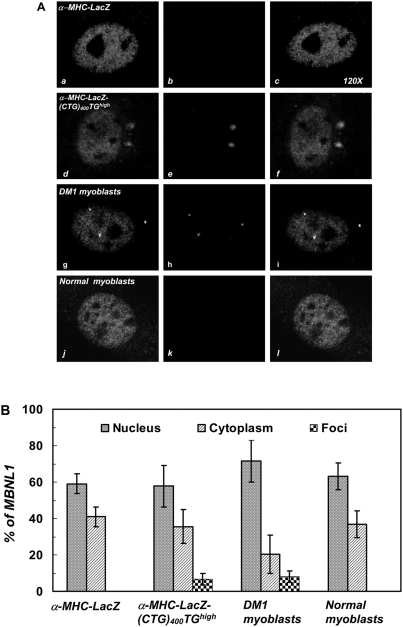
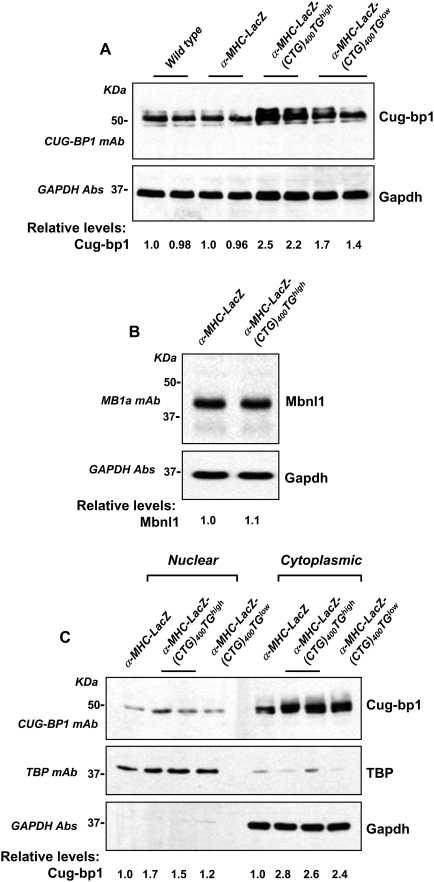
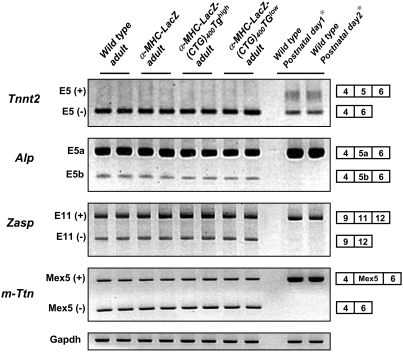
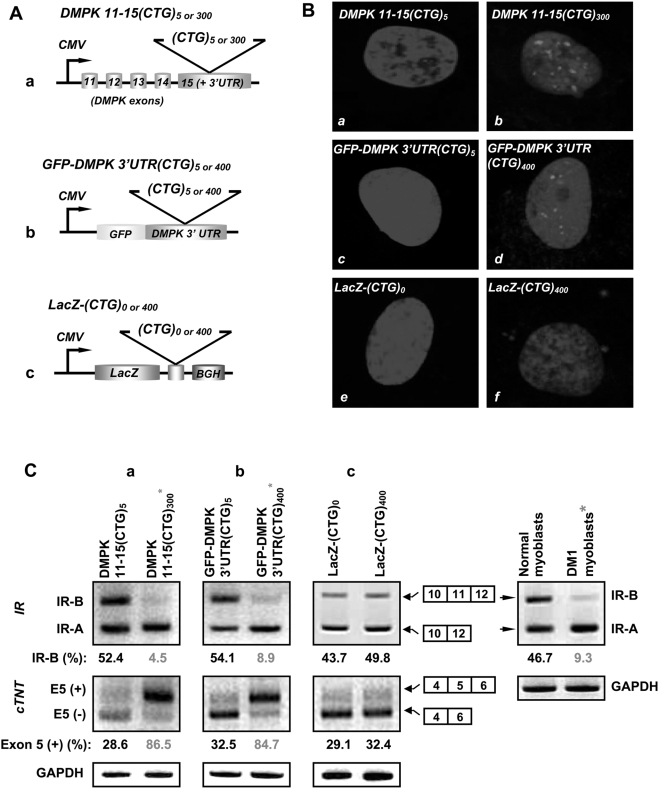
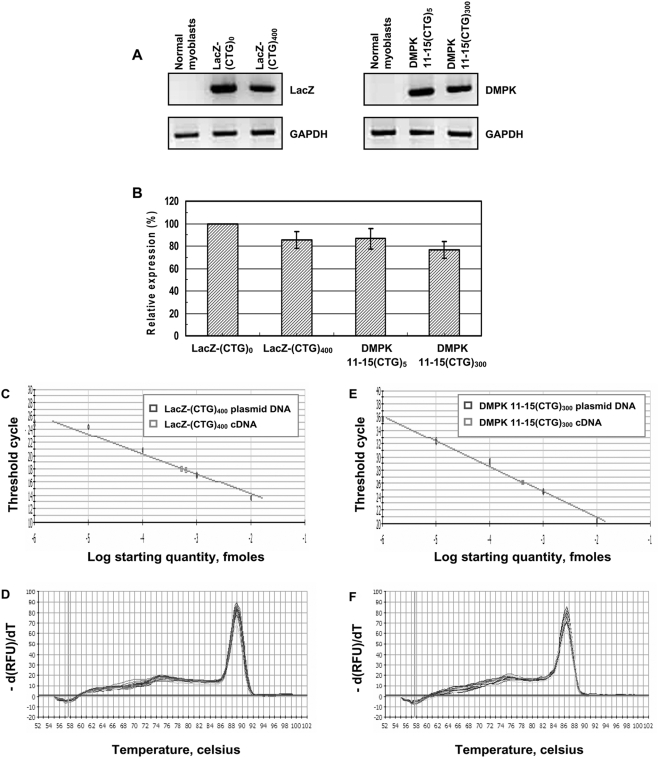
The genetic basis of myotonic dystrophy type I (DM1) is the expansion of a CTG tract located in the 3' untranslated region of DMPK. Expression of mutant RNAs encoding expanded CUG repeats plays a central role in the development of cardiac disease in DM1. Expanded CUG tracts form both nuclear and cytoplasmic aggregates, yet the relative significance of such aggregates in eliciting DM1 pathology is unclear. To test the pathophysiology of CUG repeat encoding RNAs, we developed and analyzed mice with cardiac-specific expression of a beta-galactosidase cassette in which a (CTG)(400) repeat tract was positioned 3' of the termination codon and 5' of the bovine growth hormone polyadenylation signal. In these animals CUG aggregates form exclusively in the cytoplasm of cardiac cells. A key pathological consequence of expanded CUG repeat RNA expression in DM1 is aberrant RNA splicing. Abnormal splicing results from the functional inactivation of MBNL1, which is hypothesized to occur due to MBNL1 sequestration in CUG foci or from elevated levels of CUG-BP1. We therefore tested the ability of cytoplasmic CUG foci to elicit these changes. Aggregation of CUG RNAs within the cytoplasm results both in Mbnl1 sequestration and in approximately a two fold increase in both nuclear and cytoplasmic Cug-bp1 levels. Significantly, despite these changes RNA splice defects were not observed and functional analysis revealed only subtle cardiac dysfunction, characterized by conduction defects that primarily manifest under anesthesia. Using a human myoblast culture system we show that this transgene, when expressed at similar levels to a second transgene, which encodes expanded CTG tracts and facilitates both nuclear focus formation and aberrant splicing, does not elicit aberrant splicing. Thus the lack of toxicity of cytoplasmic CUG foci does not appear to be a consequence of low expression levels. Our results therefore demonstrate that the cellular location of CUG RNA aggregates is an important variable that influences toxicity and support the hypothesis that small molecules that increase the rate of transport of the mutant DMPK RNA from the nucleus into the cytoplasm may significantly improve DM1 pathology.
I型强直性肌营养不良(DM1)的遗传基础是位于强直性肌营养不良蛋白激酶(DMPK)3'非翻译区的CTG序列的扩增。编码扩展CUG重复序列的突变RNA的表达在DM1心脏疾病的发展中起核心作用。扩展的CUG序列形成核内和胞质聚集体,但这些聚集体在引发DM1病理过程中的相对重要性尚不清楚。为了测试编码CUG重复序列的RNA的病理生理学,我们构建并分析了心脏特异性表达β-半乳糖苷酶盒的小鼠,其中一个(CTG)400重复序列位于终止密码子的3'端和牛生长激素聚腺苷酸化信号的5'端。在这些动物中,CUG聚集体仅在心肌细胞的细胞质中形成。DM1中扩展的CUG重复RNA表达的一个关键病理后果是异常的RNA剪接。异常剪接是由于肌肉盲样蛋白1(MBNL1)功能失活导致的,据推测这是由于MBNL1被隔离在CUG病灶中或由于CUG结合蛋白1(CUG-BP1)水平升高所致。因此,我们测试了细胞质CUG病灶引发这些变化的能力。细胞质内CUG RNA的聚集导致Mbnl1被隔离,并且核内和胞质Cug-bp1水平均增加约两倍。值得注意的是,尽管有这些变化,但未观察到RNA剪接缺陷,功能分析仅显示轻微的心脏功能障碍,其特征为传导缺陷,主要在麻醉下表现出来。使用人类成肌细胞培养系统,我们表明,当该转基因以与另一个编码扩展CTG序列并促进核内病灶形成和异常剪接的转基因相似的水平表达时,不会引发异常剪接。因此,细胞质CUG病灶缺乏毒性似乎不是低表达水平的结果。我们的结果因此证明,CUG RNA聚集体的细胞定位是影响毒性的一个重要变量,并支持这样的假设,即增加突变DMPK RNA从细胞核向细胞质转运速率的小分子可能会显著改善DM1的病理状况。