Rakvåg Trude T, Ross Joy R, Sato Hiroe, Skorpen Frank, Kaasa Stein, Klepstad Pål
Department of Cancer Research and Molecular Medicine, Faculty of Medicine, Norwegian University of Science and Technology (NTNU), Trondheim, Norway.
Mol Pain. 2008 Dec 18;4:64. doi: 10.1186/1744-8069-4-64.
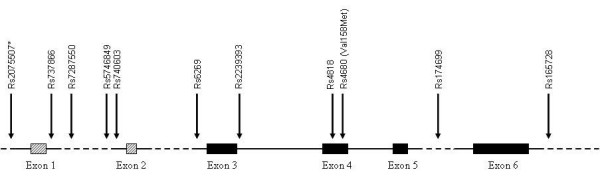
Genetic variation contributes to differences in pain sensitivity and response to different analgesics. Catecholamines are involved in the modulation of pain and are partly metabolized by the catechol-O-methyltransferase (COMT) enzyme. Genetic variability in the COMT gene may therefore contribute to differences in pain sensitivity and response to analgesics. It is shown that a polymorphism in the COMT gene, Rs4680 (Val158Met), influence pain sensitivity in human experimental pain and the efficacy for morphine in cancer pain treatment. In this study we wanted to investigate if variability in other regions in the COMT gene also contributes to interindividual variability in morphine efficacy.
We genotyped 11 single nucleotide polymorphisms (SNPs) throughout the COMT gene, and constructed haplotypes from these 11 SNPs, which were in Hardy-Weinberg equilibrium. We compared both genotypes and haplotypes against pharmacological, demographical and patient symptoms measurements in a Caucasian cancer patient cohort (n = 197) receiving oral morphine treatment for cancer pain. There were two frequent haplotypes (34.5% and 17.8%) in our cohort. Multivariate analyses showed that patients carrying the most frequent haplotype (34.5%) needed lower morphine doses than patients not carrying the haplotype, with a reduction factor of 0.71 (p = 0.005). On the allele level, carriers of alleles for six of the SNPs show weak associations in respect to morphine dose and the alleles associated with the lowest morphine doses constitute part of the most frequent haplotype.
This study suggests that genetic variability in the COMT gene influence the efficacy of morphine in cancer patients with pain, and that increased understanding of this variability is reached by expanding from analyses of single SNPs to haplotype construction and analyses.
基因变异导致疼痛敏感性及对不同镇痛药反应的差异。儿茶酚胺参与疼痛调节,部分由儿茶酚-O-甲基转移酶(COMT)代谢。因此,COMT基因的遗传变异性可能导致疼痛敏感性及镇痛药反应的差异。研究表明,COMT基因多态性Rs4680(Val158Met)影响人体实验性疼痛的疼痛敏感性及吗啡在癌症疼痛治疗中的疗效。在本研究中,我们想探究COMT基因其他区域的变异性是否也会导致吗啡疗效的个体间差异。
我们对COMT基因的11个单核苷酸多态性(SNP)进行基因分型,并根据这11个处于哈迪-温伯格平衡的SNP构建单倍型。我们在接受口服吗啡治疗癌症疼痛的白种人癌症患者队列(n = 197)中,将基因型和单倍型与药理学、人口统计学及患者症状测量结果进行比较。我们的队列中有两种常见单倍型(34.5%和17.8%)。多变量分析显示,携带最常见单倍型(34.5%)的患者所需吗啡剂量低于未携带该单倍型的患者,降低系数为0.71(p = 0.005)。在等位基因水平上,6个SNP的等位基因携带者在吗啡剂量方面显示出弱关联,与最低吗啡剂量相关的等位基因构成最常见单倍型的一部分。
本研究表明,COMT基因的遗传变异性影响癌症疼痛患者中吗啡的疗效,且通过从单个SNP分析扩展到单倍型构建及分析,能更好地理解这种变异性。