Sergeant Martin J, Li Jian-Jun, Fox Christine, Brookbank Nicola, Rea Dean, Bugg Timothy D H, Thompson Andrew J
Warwick HRI, University of Warwick, Wellesbourne CV35, 9EF, United Kingdom.
J Biol Chem. 2009 Feb 20;284(8):5257-64. doi: 10.1074/jbc.M805453200. Epub 2008 Dec 19.
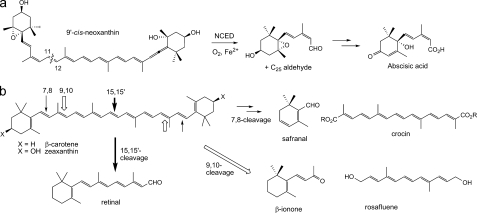
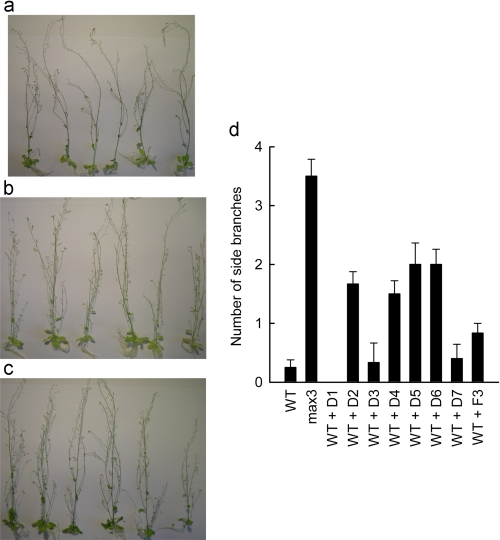
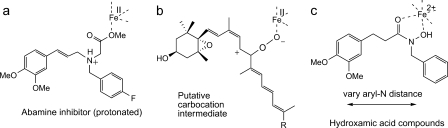
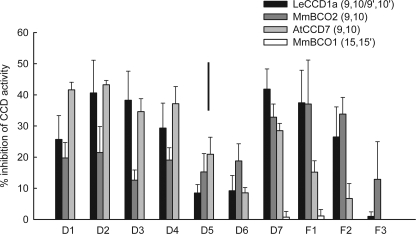
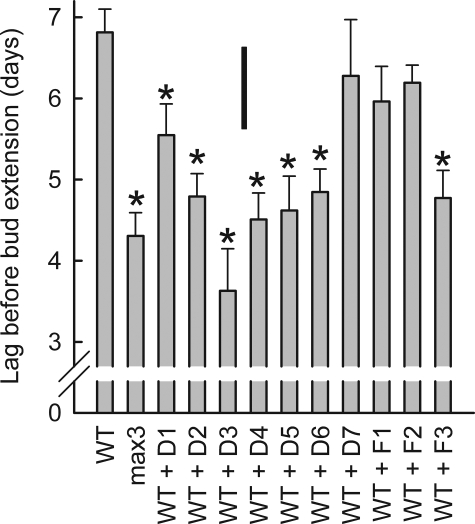
Members of the carotenoid cleavage dioxygenase family catalyze the oxidative cleavage of carotenoids at various chain positions, leading to the formation of a wide range of apocarotenoid signaling molecules. To explore the functions of this diverse enzyme family, we have used a chemical genetic approach to design selective inhibitors for different classes of carotenoid cleavage dioxygenase. A set of 18 arylalkyl-hydroxamic acids was synthesized in which the distance between an iron-chelating hydroxamic acid and an aromatic ring was varied; these compounds were screened as inhibitors of four different enzyme classes, either in vitro or in vivo. Potent inhibitors were found that selectively inhibited enzymes that cleave carotenoids at the 9,10 position; 50% inhibition was achieved at submicromolar concentrations. Application of certain inhibitors at 100 microm to Arabidopsis node explants or whole plants led to increased shoot branching, consistent with inhibition of 9,10-cleavage.
类胡萝卜素裂解双加氧酶家族的成员催化类胡萝卜素在不同链位置的氧化裂解,从而导致多种类胡萝卜素信号分子的形成。为了探索这个多样的酶家族的功能,我们采用了化学遗传学方法来设计针对不同类别的类胡萝卜素裂解双加氧酶的选择性抑制剂。合成了一组18种芳基烷基异羟肟酸,其中铁螯合异羟肟酸与芳环之间的距离有所变化;这些化合物在体外或体内作为四种不同酶类的抑制剂进行了筛选。发现了强效抑制剂,它们能选择性抑制在9,10位裂解类胡萝卜素的酶;在亚微摩尔浓度下可实现50%的抑制率。将某些抑制剂以100微摩尔的浓度应用于拟南芥节外植体或整株植物,导致枝条分枝增加,这与对9,10裂解的抑制一致。