Engebretsen Ingunn Marie Stadskleiv, Tylleskär Thorkild, Wamani Henry, Karamagi Charles, Tumwine James K
Centre for International Health, University of Bergen, Norway.
BMC Public Health. 2008 Dec 22;8:418. doi: 10.1186/1471-2458-8-418.
Child under-nutrition is a leading factor underlying child mortality and morbidity in Sub-Saharan Africa. Several studies from Uganda have reported impaired growth, but there have been few if any community-based infant anthropometric studies from Eastern Uganda. The aim of this study was to describe current infant growth patterns using WHO Child Growth Standards and to determine the extent to which these patterns are associated with infant feeding practices, equity dimensions, morbidity and use of primary health care for the infants.
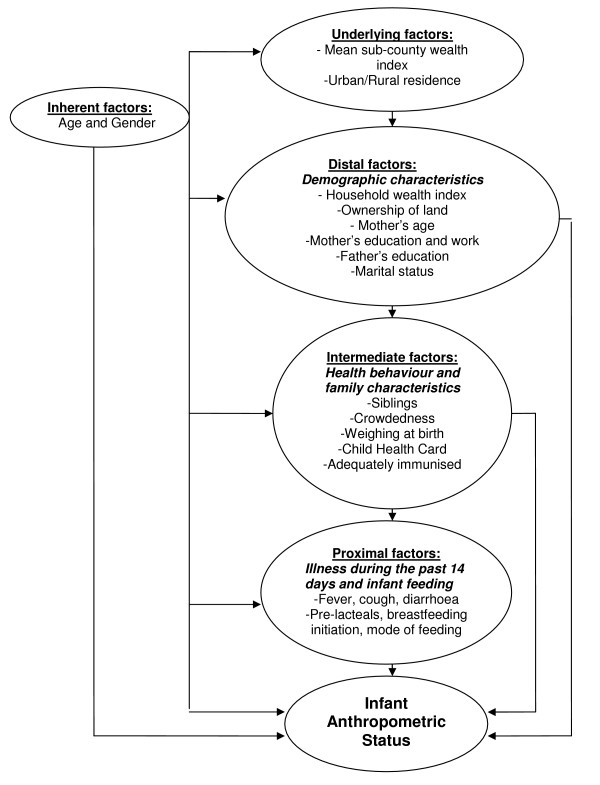
A cross-sectional survey of infant feeding practices, socio-economic characteristics and anthropometric measurements was conducted in Mbale District, Eastern Uganda in 2003; 723 mother-infant (0-11 months) pairs were analysed. Infant anthropometric status was assessed using z-scores for weight-for-length (WLZ), length-for-age (LAZ) and weight-for-age (WAZ). Dependent dichotomous variables were constructed using WLZ < -2 (wasting) and LAZ < -2 (stunting) as cut-off values. A conceptual hierarchical framework was used as the basis for controlling for the explanatory factors in multivariate analysis. Household wealth was assessed using principal components analysis.
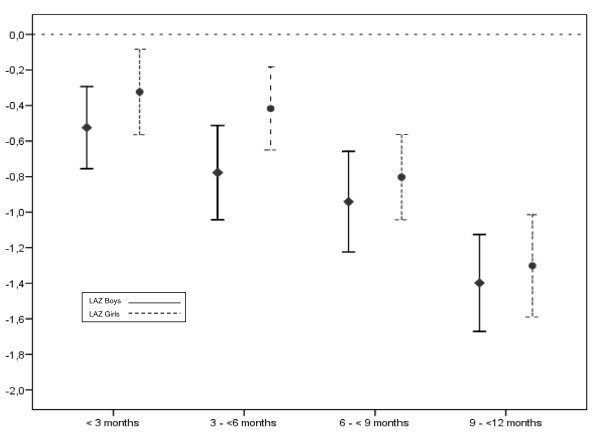
The prevalences of wasting and stunting were 4.2% and 16.7%, respectively. Diarrhoea during the previous 14 days was associated with wasting in the crude analysis, but no factors were significantly associated with wasting in the adjusted analysis. The adjusted analysis for stunting showed associations with age and gender. Stunting was more prevalent among boys than girls, 58.7% versus 41.3%. Having brothers and/or sisters was a protective factor against stunting (OR 0.4, 95% CI 0.2-0.8), but replacement or mixed feeding was not (OR 2.7, 95% CI 1.0-7.1). Lowest household wealth was the most prominent factor associated with stunting with a more than three-fold increase in odds ratio (OR 3.5, 95% CI 1.6-7.8). This pattern was also seen when the mean LAZ was investigated across household wealth categories: the adjusted mean difference between the top and the bottom wealth categories was 0.58 z-scores, p < 0.001. Those who had received pre-lacteal feeds had lower adjusted mean WLZ than those who had not: difference 0.20 z-scores, p = 0.023.
Sub-optimal infant feeding practices after birth, poor household wealth, age, gender and family size were associated with growth among Ugandan infants.
儿童营养不良是撒哈拉以南非洲地区儿童死亡率和发病率的主要潜在因素。乌干达的多项研究报告了生长发育受损情况,但来自乌干达东部的基于社区的婴儿人体测量学研究却寥寥无几。本研究的目的是使用世界卫生组织儿童生长标准描述当前婴儿的生长模式,并确定这些模式与婴儿喂养方式、公平维度、发病率以及婴儿对初级卫生保健的利用之间的关联程度。
2003年在乌干达东部的姆巴莱区对婴儿喂养方式、社会经济特征和人体测量进行了横断面调查;分析了723对母婴(0至11个月)。使用身长别体重(WLZ)、年龄别身长(LAZ)和年龄别体重(WAZ)的z评分评估婴儿的人体测量状况。以WLZ < -2(消瘦)和LAZ < -2(发育迟缓)为临界值构建相关二分变量。在多变量分析中,使用一个概念性层次框架作为控制解释因素的基础。采用主成分分析法评估家庭财富状况。
消瘦和发育迟缓的患病率分别为4.2%和16.7%。在粗分析中,前14天内腹泻与消瘦有关,但在调整分析中没有因素与消瘦显著相关。发育迟缓的调整分析显示与年龄和性别有关。发育迟缓在男孩中比女孩更普遍,分别为58.7%和41.3%。有兄弟姐妹是预防发育迟缓的保护因素(比值比0.4,95%置信区间0.2 - 0.8),但代乳品喂养或混合喂养则不是(比值比2.7,95%置信区间1.0 - 7.1)。家庭财富最低是与发育迟缓相关的最突出因素,比值比增加超过三倍(比值比3.5,95%置信区间1.6 - 7.8)。在按家庭财富类别调查平均LAZ时也观察到这种模式:最高和最低财富类别之间的调整后平均差异为0.58个z评分,p < 0.001。接受过初乳前喂养的婴儿调整后平均WLZ低于未接受过的婴儿:差异为0.20个z评分,p = 0.023。
乌干达婴儿出生后的喂养方式欠佳、家庭财富状况差、年龄、性别和家庭规模与生长发育有关。