
收缩储备对心脏再同步治疗急性反应的影响。
Impact of contractile reserve on acute response to cardiac resynchronization therapy.
作者信息
Moonen Marie, Senechal Mario, Cosyns Bernard, Melon Pierre, Nellessen Eric, Pierard Luc, Lancellotti Patrizio
机构信息
Department of Cardiology, CHU Sart Tilman, Liege, Belgium.
出版信息
Cardiovasc Ultrasound. 2008 Dec 31;6:65. doi: 10.1186/1476-7120-6-65.
BACKGROUND
Cardiac resynchronization therapy (CRT) provides benefit for congestive heart failure, but still 30% of patients failed to respond to such therapy. This lack of response may be due to the presence of significant amount of scar or fibrotic tissue at myocardial level. This study sought to investigate the potential impact of myocardial contractile reserve as assessed during exercise echocardiography on acute response following CRT implantation.
METHODS
Fifty-one consecutive patients with heart failure (LV ejection fraction 27% +/- 5%, 67% ischemic cardiomyopathy) underwent exercise Doppler echocardiography before CRT implantation to assess global contractile reserve (improvement in LV ejection fraction) and local contractile reserve in the region of the LV pacing lead (assessed by radial strain using speckle tracking analysis). Responders were defined by an increase in stroke volume > or = 15% after CRT.
RESULTS
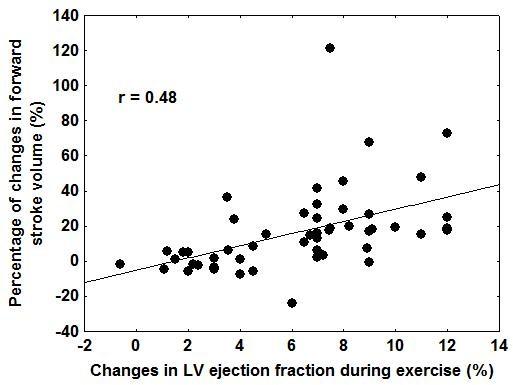
Compared with nonresponders, responders (25 patients) showed a greater exercise-induced increase in LV ejection fraction, a higher degree of mitral regurgitation and a significant extent of LV dyssynchrony. The presence of contractile reserve was directly related to the acute increase in stroke volume (r = 0.48, p < 0.001). Baseline myocardial deformation as well as contractile reserve in the LV pacing lead region was greater in responders during exercise than in nonresponders (p < 0.0001).
CONCLUSION
The present study showed that response to CRT largely depends not only on the extent of LV dyssynchrony and the severity of mitral regurgitation but also on the presence of contractile reserve.
背景
心脏再同步治疗(CRT)对充血性心力衰竭有益,但仍有30%的患者对此治疗无反应。这种无反应可能是由于心肌水平存在大量瘢痕或纤维化组织。本研究旨在探讨运动超声心动图评估的心肌收缩储备对CRT植入后急性反应的潜在影响。
方法
51例连续的心力衰竭患者(左心室射血分数27%±5%,67%为缺血性心肌病)在CRT植入前接受运动多普勒超声心动图检查,以评估整体收缩储备(左心室射血分数的改善)和左心室起搏导线区域的局部收缩储备(使用斑点追踪分析通过径向应变评估)。反应者定义为CRT后每搏输出量增加≥15%。
结果
与无反应者相比,反应者(25例患者)运动诱导的左心室射血分数增加更大,二尖瓣反流程度更高,左心室不同步程度更明显。收缩储备的存在与每搏输出量的急性增加直接相关(r = 0.48,p < 0.001)。运动期间,反应者的基线心肌变形以及左心室起搏导线区域的收缩储备均高于无反应者(p < 0.0001)。
结论
本研究表明,对CRT的反应很大程度上不仅取决于左心室不同步的程度和二尖瓣反流的严重程度,还取决于收缩储备的存在。



 Zotero 插件