Saito Yuhi, Kishida Koichi, Takata Kenji, Takahashi Hideyuki, Shimada Takeaki, Tanaka Kunisuke, Morita Shigeto, Satoh Shigeru, Masumura Takehiro
Laboratory of Genetic Engineering, Graduate School of Life and Environmental Sciences, Kyoto Prefectural University, Shimogamo, Kyoto 606-8522, Japan.
J Exp Bot. 2009;60(2):615-27. doi: 10.1093/jxb/ern311. Epub 2009 Jan 6.
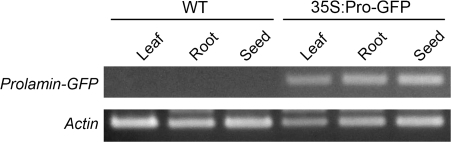
Prolamins, a group of rice (Oryza sativa) seed storage proteins, are synthesized on the rough endoplasmic reticulum (ER) and deposited in ER-derived type I protein bodies (PB-Is) in rice endosperm cells. The accumulation mechanism of prolamins, which do not possess the well-known ER retention signal, remains unclear. In order to elucidate whether the accumulation of prolamin in the ER requires seed-specific factors, the subcellular localization of the constitutively expressed green fluorescent protein fused to prolamin (prolamin-GFP) was examined in seeds, leaves, and roots of transgenic rice plants. The prolamin-GFP fusion proteins accumulated not only in the seeds but also in the leaves and roots. Microscopic observation of GFP fluorescence and immunocytochemical analysis revealed that prolamin-GFP fusion proteins specifically accumulated in PB-Is in the endosperm, whereas they were deposited in the electron-dense structures in the leaves and roots. The ER chaperone BiP was detected in the structures in the leaves and roots. The results show that the aggregation of prolamin-GFP fusion proteins does not depend on the tissues, suggesting that the prolamin-GFP fusion proteins accumulate in the ER by forming into aggregates. The findings bear out the importance of the assembly of prolamin molecules and the interaction of prolamin with BiP in the formation of ER-derived PBs.
醇溶蛋白是水稻种子中的一类贮藏蛋白,在糙面内质网上合成,并沉积在水稻胚乳细胞内质网衍生的I型蛋白体(PB-Is)中。醇溶蛋白不具有众所周知的内质网滞留信号,其积累机制尚不清楚。为了阐明醇溶蛋白在内质网中的积累是否需要种子特异性因子,对组成型表达的与醇溶蛋白融合的绿色荧光蛋白(醇溶蛋白-GFP)在转基因水稻植株的种子、叶片和根中的亚细胞定位进行了检测。醇溶蛋白-GFP融合蛋白不仅在种子中积累,也在叶片和根中积累。对GFP荧光的显微镜观察和免疫细胞化学分析表明,醇溶蛋白-GFP融合蛋白特异性地积累在胚乳的PB-Is中,但在叶片和根中则沉积在电子致密结构中。在内质网伴侣BiP在叶片和根的结构中被检测到。结果表明,醇溶蛋白-GFP融合蛋白的聚集不依赖于组织,这表明醇溶蛋白-GFP融合蛋白通过形成聚集体在内质网中积累。这些发现证实了醇溶蛋白分子组装以及醇溶蛋白与BiP在内质网衍生的蛋白体形成过程中的相互作用的重要性。