Burton T R, Gibson S B
Manitoba Institute of Cell Biology, 675 McDermot Avenue, Winnipeg, Manitoba, Canada.
Cell Death Differ. 2009 Apr;16(4):515-23. doi: 10.1038/cdd.2008.185. Epub 2009 Jan 9.
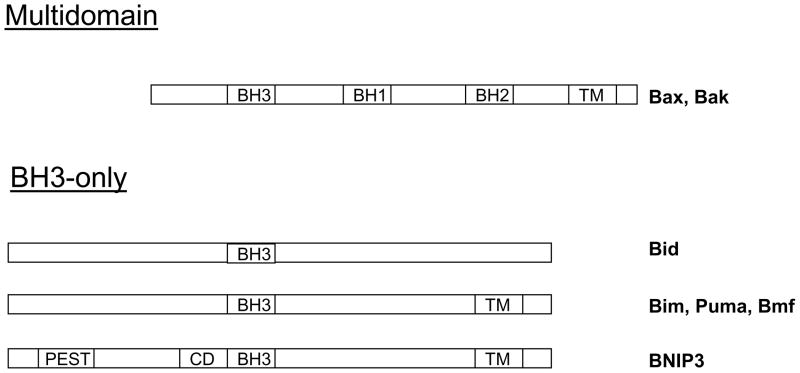
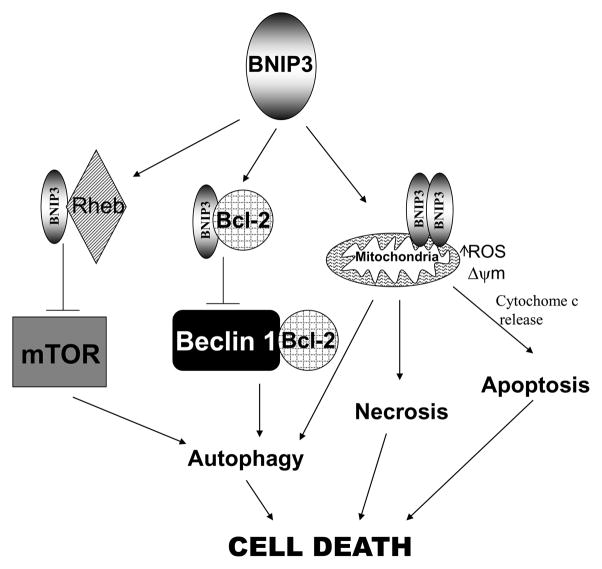
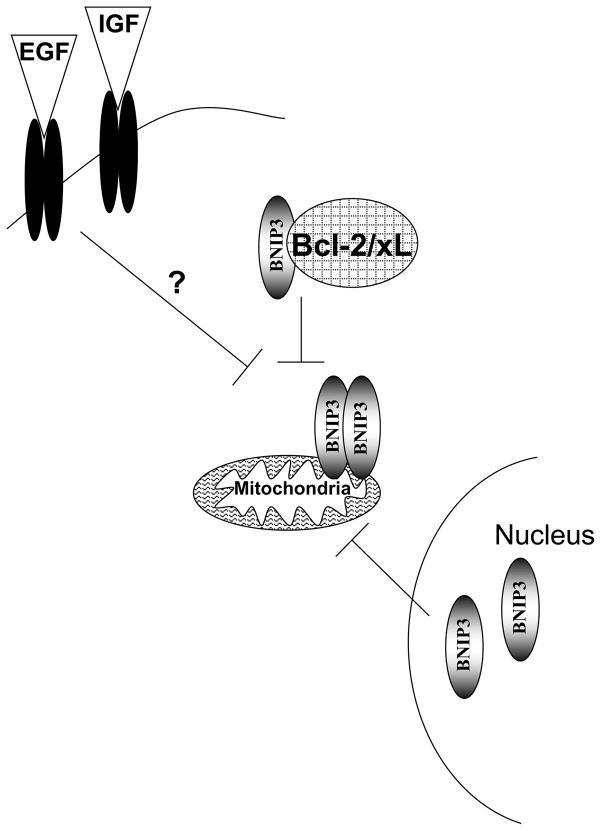
Bcl-2 nineteen-kilodalton interacting protein (BNIP3) is a BH-3-only Bcl-2 family member whose expression levels increase during stress such as hypoxia through hypoxia-inducing factor-1-dependent or -independent mechanisms. When BNIP3 expression is induced, it localizes to the mitochondria and triggers a loss of membrane potential, and an increase in the reactive oxygen species production, which often leads to cell death. Cells under normal growth conditions suppress BNIP3 expression through transcriptional repression. There is considerable debate in the literature regarding what type of cell death is induced by BNIP3. It has been observed that BNIP3 could induce necrosis, autophagy and/or apoptosis. In contrast, other studies indicate that BNIP3 could promote cell survival. Besides its cell death regulation, BNIP3 plays a key role in the pathogenicity of many diseases. In cardiac infarction, loss of BNIP3 expression has been shown to reduce the number of damaged cardiomyocytes after ischemia and reperfusion. BNIP3 expression also plays an important role in the deregulation of cell death in many cancers. In this review, we will discuss the different and often contradictory mechanisms of BNIP3 regulation of cell death and the role that BNIP3 may play in diseases.
Bcl-2十九千道尔顿相互作用蛋白(BNIP3)是仅含BH-3结构域的Bcl-2家族成员,其表达水平在诸如缺氧等应激过程中通过缺氧诱导因子-1依赖性或非依赖性机制升高。当BNIP3表达被诱导时,它定位于线粒体并引发膜电位丧失以及活性氧生成增加,这通常会导致细胞死亡。正常生长条件下的细胞通过转录抑制来抑制BNIP3表达。关于BNIP3诱导何种类型的细胞死亡,文献中存在相当多的争论。据观察,BNIP3可诱导坏死、自噬和/或凋亡。相反,其他研究表明BNIP3可促进细胞存活。除了其对细胞死亡的调节作用外,BNIP3在许多疾病的发病机制中也起着关键作用。在心肌梗死中,已表明BNIP3表达缺失可减少缺血再灌注后受损心肌细胞的数量。BNIP3表达在许多癌症的细胞死亡失调中也起着重要作用。在本综述中,我们将讨论BNIP3调节细胞死亡的不同且常常相互矛盾的机制以及BNIP3在疾病中可能发挥的作用。