Bandesh Khushdeep, Motakis Efthymios, Nargund Siddhi, Kursawe Romy, Selvam Vijay, Bhuiyan Redwan M, Eryilmaz Giray Naim, Krishnan Sai Nivedita, Spracklen Cassandra N, Ucar Duygu, Stitzel Michael L
The Jackson Laboratory for Genomic Medicine, 10 Discovery Drive, Farmington, CT 06032 USA.
Department of Genetics and Genome Sciences, UConn Health, Farmington, CT 06032 USA.
bioRxiv. 2025 Jan 22:2025.01.17.633590. doi: 10.1101/2025.01.17.633590.
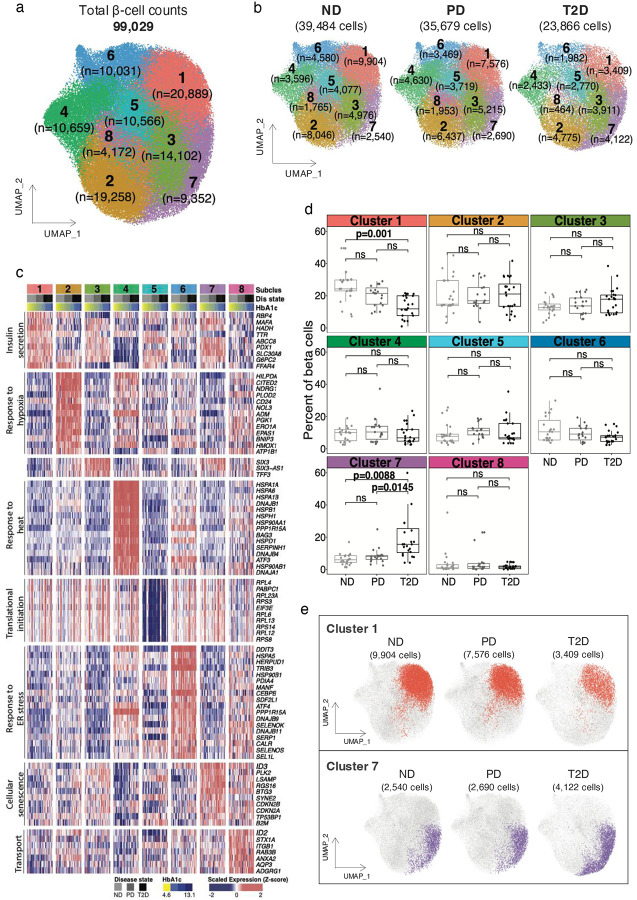
Pancreatic islets maintain glucose homeostasis through coordinated action of their constituent endocrine and affiliate cell types and are central to type 2 diabetes (T2D) genetics and pathophysiology. Our understanding of robust human islet cell type-specific alterations in T2D remains limited. Here, we report comprehensive single cell transcriptome profiling of 245,878 human islet cells from a 48-donor cohort spanning non-diabetic (ND), pre-diabetic (PD), and T2D states, identifying 14 distinct cell types detected in every donor from each glycemic state. Cohort analysis reveals ~25-30% loss of functional beta cell mass in T2D vs. ND or PD donors resulting from (1) reduced total beta cell numbers/proportions and (2) reciprocal loss of 'high function' and gain of senescent -cell subpopulations. We identify in T2D -cells 511 differentially expressed genes (DEGs), including new (66.5%) and validated genes (e.g., , , ), and significant neuronal transmission and vitamin A metabolism pathway alterations. Importantly, we demonstrate newly identified DEG roles in human -cell viability and/or insulin secretion and link 47 DEGs to diabetes-relevant phenotypes in knockout mice, implicating them as potential causal islet dysfunction genes. Additionally, we nominate as candidate T2D causal genes and therapeutic targets 27 DEGs for which T2D genetic risk variants (GWAS SNPs) and pathophysiology (T2D vs. ND) exert concordant expression effects. We provide this freely accessible atlas for data exploration, analysis, and hypothesis testing. Together, this study provides new genomic resources for and insights into T2D pathophysiology and human islet dysfunction.
胰岛通过其组成的内分泌细胞和附属细胞类型的协同作用维持葡萄糖稳态,并且在2型糖尿病(T2D)的遗传学和病理生理学中起着核心作用。我们对T2D中强大的人类胰岛细胞类型特异性改变的理解仍然有限。在这里,我们报告了来自一个涵盖非糖尿病(ND)、糖尿病前期(PD)和T2D状态的48名供体队列的245,878个人类胰岛细胞的综合单细胞转录组分析,确定了在每个血糖状态的每个供体中检测到的14种不同细胞类型。队列分析显示,与ND或PD供体相比,T2D供体中功能性β细胞质量损失约25-30%,这是由于(1)总β细胞数量/比例减少,以及(2)“高功能”β细胞亚群相互丧失和衰老β细胞亚群增加。我们在T2Dβ细胞中鉴定出511个差异表达基因(DEG),包括新基因(66.5%)和已验证的基因(如、、),以及显著的神经传递和维生素A代谢途径改变。重要的是,我们证明了新鉴定的DEG在人类β细胞活力和/或胰岛素分泌中的作用,并将47个DEG与基因敲除小鼠中的糖尿病相关表型联系起来,暗示它们是潜在的因果胰岛功能障碍基因。此外,我们提名2个DEG作为T2D因果基因和治疗靶点,T2D遗传风险变异(GWAS SNPs)和病理生理学(T2D与ND)对其发挥一致的表达影响。我们提供这个免费访问的图谱用于数据探索、分析和假设检验。总之,这项研究为T2D病理生理学和人类胰岛功能障碍提供了新的基因组资源和见解。