Heredia Dante J, Dickson Eamonn J, Bayguinov Peter O, Hennig Grant W, Smith Terence K
Department of Physiology & Cell Biology, University of Nevada School of Medicine, Reno, Nevada, USA.
Gastroenterology. 2009 Apr;136(4):1328-38. doi: 10.1053/j.gastro.2008.12.010. Epub 2008 Dec 10.
BACKGROUND & AIMS: The colonic migrating motor complex (CMMC) is a motor pattern that regulates the movement of fecal matter through a rhythmic sequence of electrical activity and/or contractions along the large bowel. CMMCs have largely been studied in empty preparations; we investigated whether local reflexes generated by a fecal pellet modify the CMMC to initiate propulsive activity.
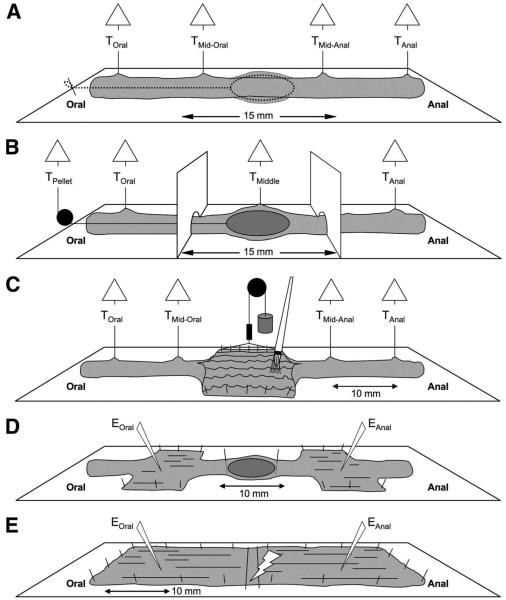
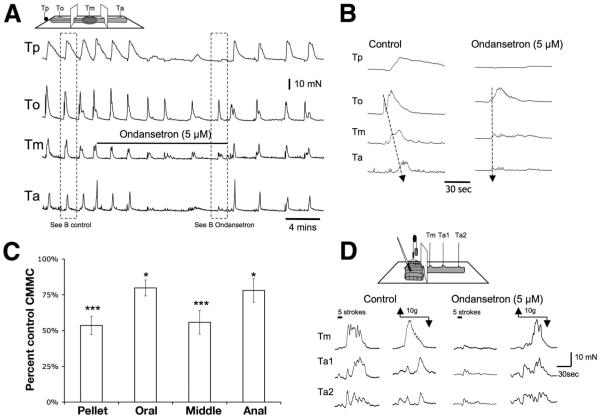
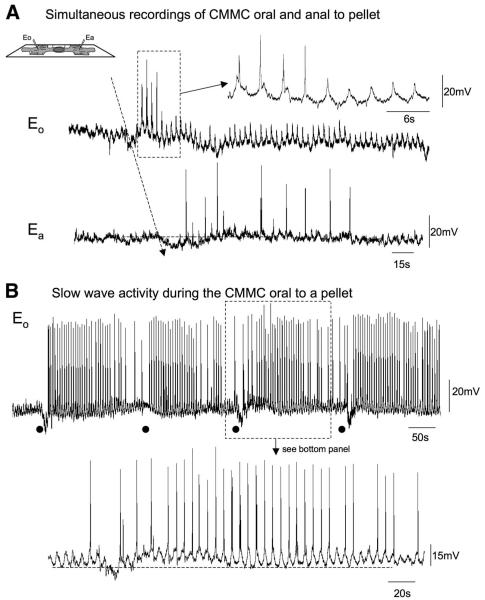
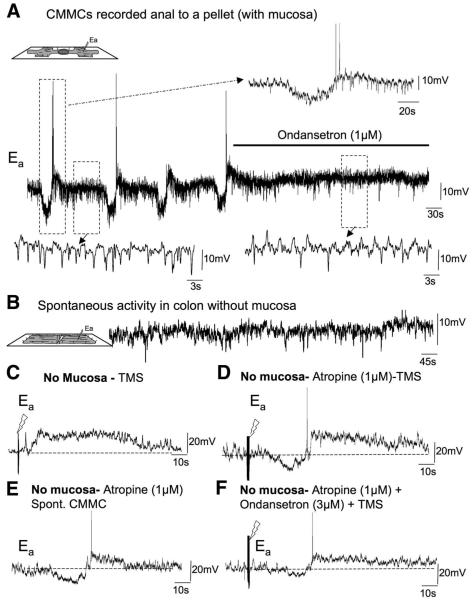
Recordings of CMMCs were made from the isolated murine large bowel, with or without a fecal pellet. Transducers were placed along the colon to record muscle tension and propulsive force on the pellet and microelectrodes were used to record electrical activity from either side of a fecal pellet, circular muscle cells oral and anal of a pellet, and in colons without the mucosa.
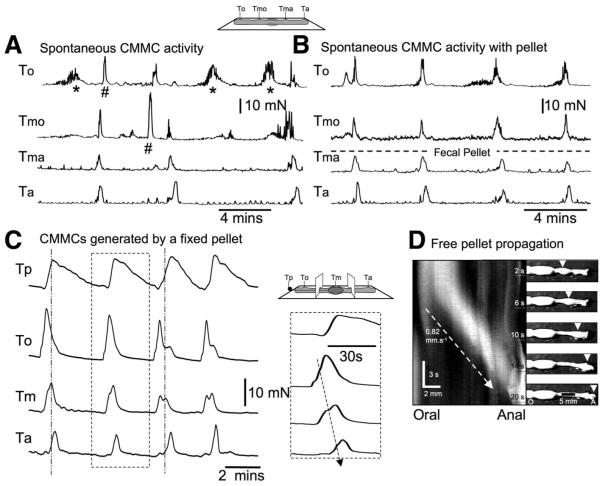
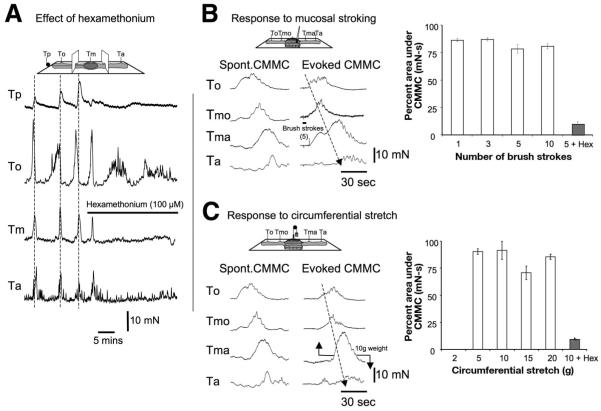
Spontaneous CMMCs propagated in both an oral or anal direction. When a pellet was inserted, CMMCs increased in frequency and propagated anally, exerting propulsive force on the pellet. The amplitude of slow waves increased during the CMMC. Localized mucosal stimulation/circumferential stretch evoked a CMMC, regardless of stimulus strength. The serotonin (5-hydroxytryptamine-3) receptor antagonist ondansetron reduced the amplitude of the CMMC, the propulsive force on the pellet, and the response to mucosal stroking, but increased the apparent conduction velocity of the CMMC. Removing the mucosa abolished spontaneous CMMCs, which still could be evoked by electrical stimulation.
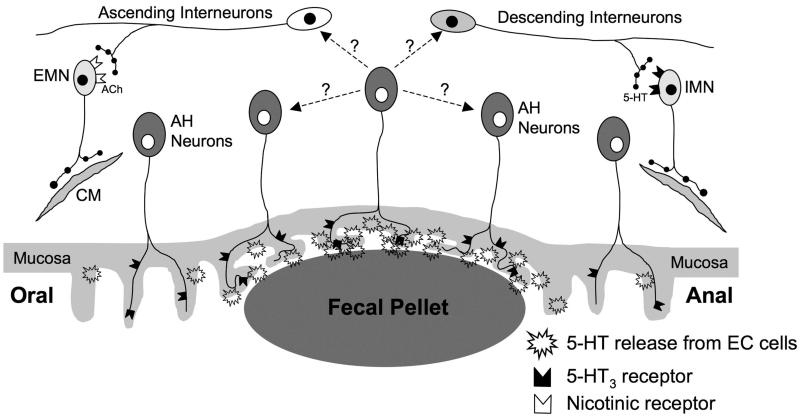
The fecal pellet activates local mucosal reflexes, which release serotonin (5-hydroxytryptamine) from enterochromaffin cells, and stretch reflexes that determine the site of origin and propagation of the CMMC, facilitating propulsion.
结肠移行性运动复合波(CMMC)是一种运动模式,通过沿大肠有节律的电活动序列和/或收缩来调节粪便的移动。CMMC主要是在肠腔空虚的标本中进行研究;我们调查了粪便颗粒产生的局部反射是否会改变CMMC以启动推进活动。
在有或没有粪便颗粒的情况下,从分离的小鼠大肠记录CMMC。沿着结肠放置传感器以记录肌肉张力和对粪便颗粒的推进力,并用微电极记录粪便颗粒两侧、颗粒口侧和肛侧的环形肌细胞以及无黏膜结肠中的电活动。
自发性CMMC沿口侧或肛侧传播。当插入一个粪便颗粒时,CMMC频率增加并向肛侧传播,对粪便颗粒施加推进力。在CMMC期间慢波振幅增加。局部黏膜刺激/环周牵张可诱发CMMC,与刺激强度无关。5-羟色胺(5-羟色胺-3)受体拮抗剂昂丹司琼降低了CMMC的振幅、对粪便颗粒的推进力以及对黏膜抚摸的反应,但增加了CMMC的表观传导速度。去除黏膜消除了自发性CMMC,但电刺激仍可诱发。
粪便颗粒激活局部黏膜反射,后者从肠嗜铬细胞释放5-羟色胺(5-羟色胺),以及牵张反射,这些反射决定了CMMC的起源部位和传播方向,促进推进。