Maestripieri Dario, Hoffman Christy L, Anderson George M, Carter C Sue, Higley James D
Department of Comparative Human Development, University of Chicago, 5730 S.Woodlawn Avenue, Chicago, IL 60637 USA.
Physiol Behav. 2009 Mar 23;96(4-5):613-9. doi: 10.1016/j.physbeh.2008.12.016. Epub 2008 Dec 31.
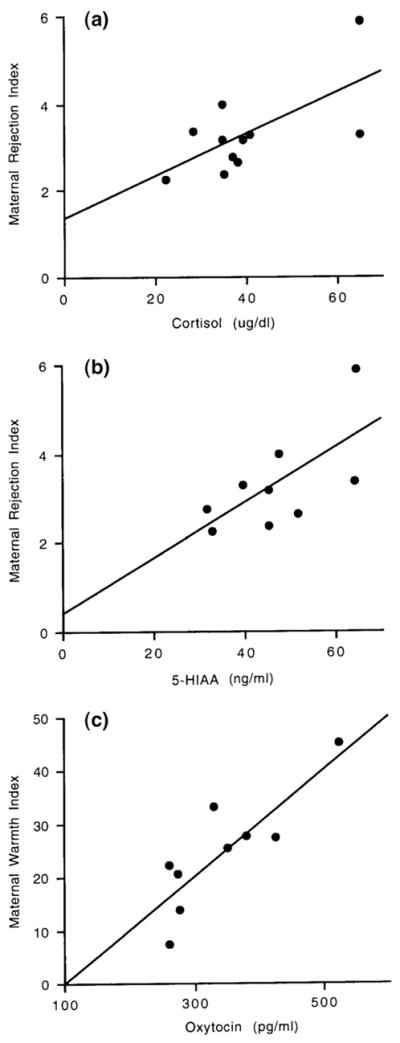
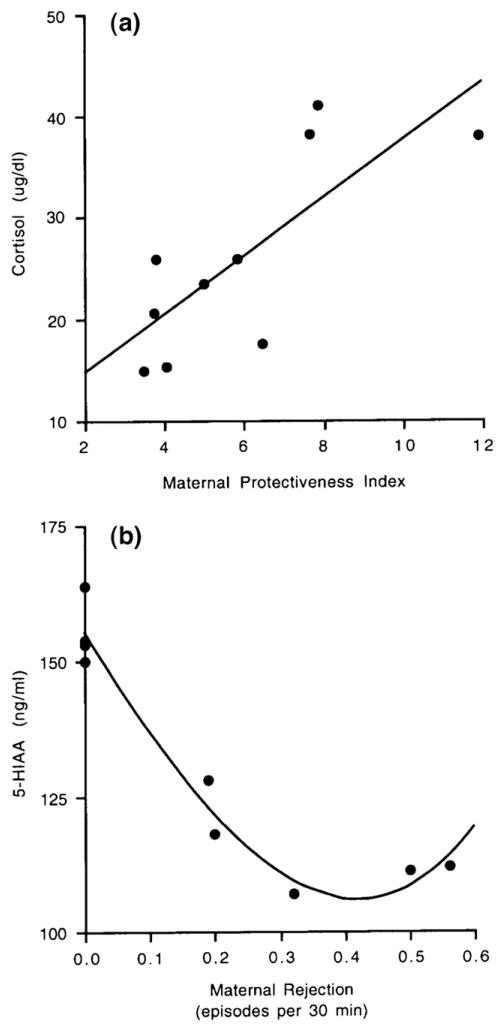
Studies of mother-infant relationships in nonhuman primates have increasingly attempted to understand the neuroendocrine bases of interindividual variation in mothering styles and the mechanisms through which early exposure to variable mothering styles affects infant behavioral development. In this study of free-ranging rhesus macaques on Cayo Santiago, Puerto Rico, we aimed to: 1) compare lactating and nonlactating females to investigate whether lactation is associated with changes in plasma cortisol, prolactin and oxytocin, as well as changes in CSF levels of serotonin and dopamine metabolites (5-HIAA and HVA); 2) examine the extent to which interindividual variation in maternal physiology is associated with variation in maternal behavior; 3) examine the extent to which interindividual variation in infant physiology and behavior is accounted for by variation in maternal physiology and behavior. Lactating females had higher plasma concentrations of cortisol, prolactin, and oxytocin but lower CSF concentrations of HVA than nonlactating females. Variation in maternal rejection behavior was positively correlated with variation in maternal plasma cortisol levels and in CSF 5-HIAA levels while variation in the time spent nursing and grooming was associated with maternal plasma oxytocin levels. Infants who were protected more by their mothers had higher cortisol levels than those who were protected less, while infants who were rejected more had lower CSF 5-HIAA than infants who were rejected less. Since exposure to high levels of maternal protectiveness and rejection is known to affect the offspring's behavior and responsiveness to the environment later in life, our results are consistent with the hypothesis that these effects are mediated by long-term changes in the activity of the offspring's HPA axis and brain serotonergic system.
对非人类灵长类动物母婴关系的研究越来越多地试图理解育儿方式个体差异的神经内分泌基础,以及早期接触不同育儿方式影响婴儿行为发展的机制。在这项对波多黎各圣地亚哥岛自由放养的恒河猴的研究中,我们旨在:1)比较哺乳期和非哺乳期雌性,以调查泌乳是否与血浆皮质醇、催乳素和催产素的变化以及脑脊液中血清素和多巴胺代谢物(5-羟吲哚乙酸和高香草酸)水平的变化有关;2)研究母体生理的个体差异与母体行为差异的关联程度;3)研究母体生理和行为的差异在多大程度上解释了婴儿生理和行为的个体差异。与非哺乳期雌性相比,哺乳期雌性的血浆皮质醇、催乳素和催产素浓度更高,但脑脊液中高香草酸浓度更低。母体拒绝行为的差异与母体血浆皮质醇水平和脑脊液5-羟吲哚乙酸水平的差异呈正相关,而哺乳和梳理毛发所花费时间的差异与母体血浆催产素水平有关。受到母亲更多保护的婴儿比受到较少保护的婴儿皮质醇水平更高,而受到更多拒绝的婴儿脑脊液中5-羟吲哚乙酸水平比受到较少拒绝的婴儿更低。由于已知暴露于高水平的母体保护和拒绝会影响后代日后的行为和对环境的反应能力,我们的结果与以下假设一致,即这些影响是由后代下丘脑-垂体-肾上腺轴和大脑血清素能系统活动的长期变化介导的。