Oyama Takuji, Oka Hayato, Mayanagi Kouta, Shirai Tsuyoshi, Matoba Kyoko, Fujikane Ryosuke, Ishino Yoshizumi, Morikawa Kosuke
The Takara Bio Endowed Division, Institute for Protein Research, Osaka University, Open Laboratories of Advanced Bioscience and Biotechnology (OLABB), 6-2-3 Furuedai, Suita, Osaka 565-0874, Japan.
BMC Struct Biol. 2009 Jan 22;9:2. doi: 10.1186/1472-6807-9-2.
Pyrococcus furiosus Hjm (PfuHjm) is a structure-specific DNA helicase that was originally identified by in vitro screening for Holliday junction migration activity. It belongs to helicase superfamily 2, and shares homology with the human DNA polymerase Theta (PolTheta), HEL308, and Drosophila Mus308 proteins, which are involved in DNA repair. Previous biochemical and genetic analyses revealed that PfuHjm preferentially binds to fork-related Y-structured DNAs and unwinds their double-stranded regions, suggesting that this helicase is a functional counterpart of the bacterial RecQ helicase, which is essential for genome maintenance. Elucidation of the DNA unwinding and translocation mechanisms by PfuHjm will require its three-dimensional structure at atomic resolution.
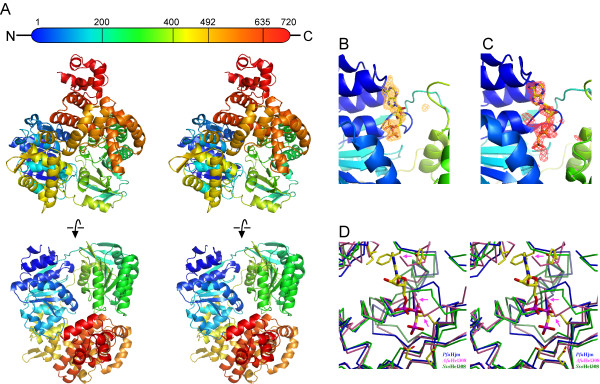
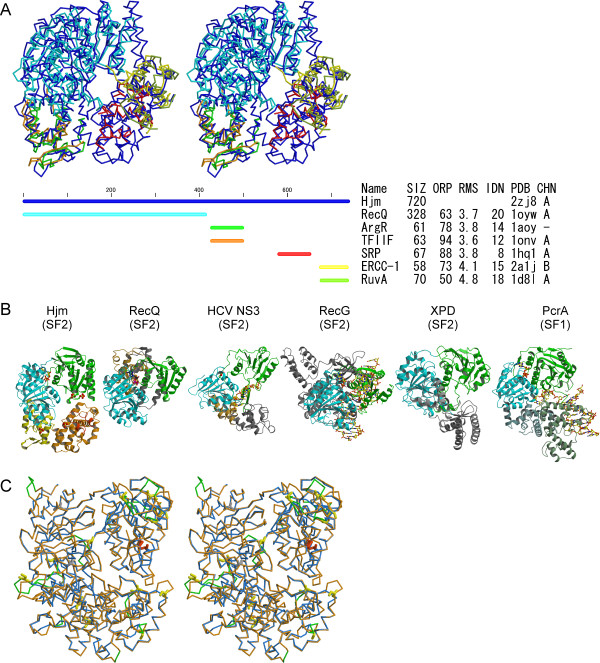
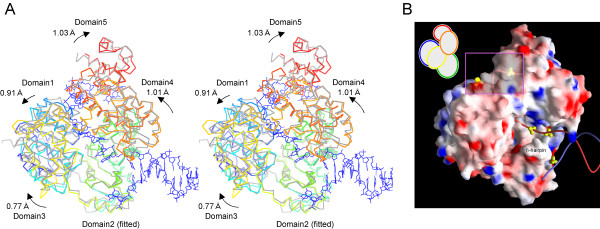
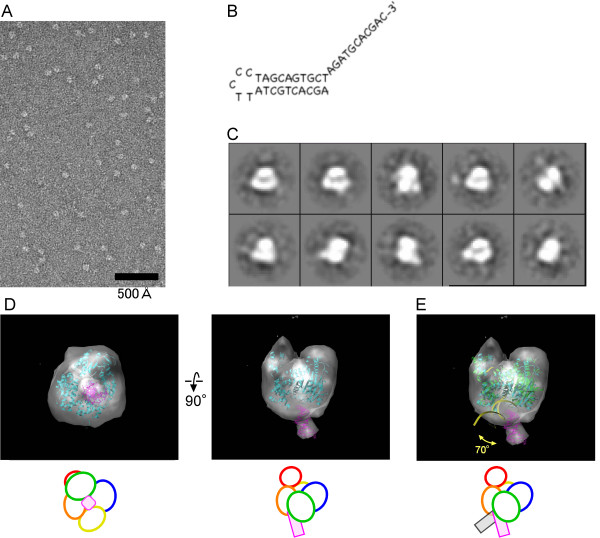
We determined the crystal structures of PfuHjm, in two apo-states and two nucleotide bound forms, at resolutions of 2.0-2.7 A. The overall structures and the local conformations around the nucleotide binding sites are almost the same, including the side-chain conformations, irrespective of the nucleotide-binding states. The architecture of Hjm was similar to that of Archaeoglobus fulgidus Hel308 complexed with DNA. An Hjm-DNA complex model, constructed by fitting the five domains of Hjm onto the corresponding Hel308 domains, indicated that the interaction of Hjm with DNA is similar to that of Hel308. Notably, sulphate ions bound to Hjm lie on the putative DNA binding surfaces. Electron microscopic analysis of an Hjm-DNA complex revealed substantial flexibility of the double stranded region of DNA, presumably due to particularly weak protein-DNA interactions. Our present structures allowed reasonable homology model building of the helicase region of human PolTheta, indicating the strong conformational conservation between archaea and eukarya.
The detailed comparison between our DNA-free PfuHjm structure and the structure of Hel308 complexed with DNA suggests similar DNA unwinding and translocation mechanisms, which could be generalized to all of the members in the same family. Structural comparison also implied a minor rearrangement of the five domains during DNA unwinding reaction. The unexpected small contact between the DNA duplex region and the enzyme appears to be advantageous for processive helicase activity.
嗜热栖热菌Hjm(PfuHjm)是一种结构特异性DNA解旋酶,最初通过体外筛选霍利迪连接体迁移活性而被鉴定。它属于解旋酶超家族2,与参与DNA修复的人类DNA聚合酶Theta(PolTheta)、HEL308和果蝇Mus308蛋白具有同源性。先前的生化和遗传分析表明,PfuHjm优先结合与叉相关的Y结构DNA并解开其双链区域,这表明这种解旋酶是细菌RecQ解旋酶的功能对应物,而RecQ解旋酶对基因组维持至关重要。要阐明PfuHjm的DNA解旋和转位机制,需要其原子分辨率的三维结构。
我们确定了处于两种无辅因子状态和两种核苷酸结合形式的PfuHjm的晶体结构,分辨率为2.0 - 2.7 Å。无论核苷酸结合状态如何,整体结构以及核苷酸结合位点周围的局部构象几乎相同,包括侧链构象。Hjm的结构与与DNA复合的嗜热栖热放线杆菌Hel308的结构相似。通过将Hjm的五个结构域拟合到相应的Hel308结构域构建的Hjm - DNA复合物模型表明,Hjm与DNA的相互作用与Hel308相似。值得注意的是,与Hjm结合的硫酸根离子位于假定的DNA结合表面上。对Hjm - DNA复合物的电子显微镜分析揭示了DNA双链区域的显著灵活性,这可能是由于蛋白质 - DNA相互作用特别弱所致。我们目前的结构允许对人类PolTheta的解旋酶区域进行合理的同源模型构建,表明古细菌和真核生物之间存在很强的构象保守性。
我们的无DNA的PfuHjm结构与与DNA复合的Hel308结构之间的详细比较表明,它们具有相似的DNA解旋和转位机制,这可能适用于同一家族的所有成员。结构比较还暗示在DNA解旋反应过程中五个结构域会发生轻微重排。DNA双链区域与酶之间意外的小接触似乎有利于进行性解旋酶活性。