Thies Sibylle B, Tresadern Phil A, Kenney Laurence P, Smith Joel, Howard David, Goulermas John Y, Smith Christine, Rigby Julie
Centre for Rehabilitation and Human Performance Research, University of Salford, Greater Manchester, UK.
J Neuroeng Rehabil. 2009 Jan 23;6:2. doi: 10.1186/1743-0003-6-2.
In the evaluation of upper limb impairment post stroke there remains a gap between detailed kinematic analyses with expensive motion capturing systems and common clinical assessment tests. In particular, although many clinical tests evaluate the performance of functional tasks, metrics to characterise upper limb kinematics are generally not applicable to such tasks and very limited in scope. This paper reports on a novel, user-friendly methodology that allows for the assessment of both signal magnitude and timing variability in upper limb movement trajectories during functional task performance. In order to demonstrate the technique, we report on a study in which the variability in timing and signal magnitude of data collected during the performance of two functional tasks is compared between a group of subjects with stroke and a group of individually matched control subjects.
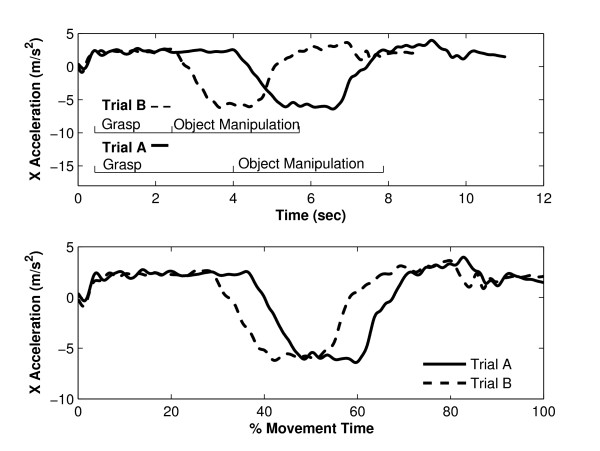
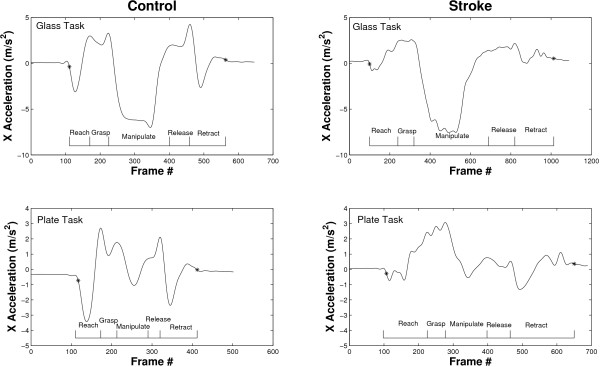
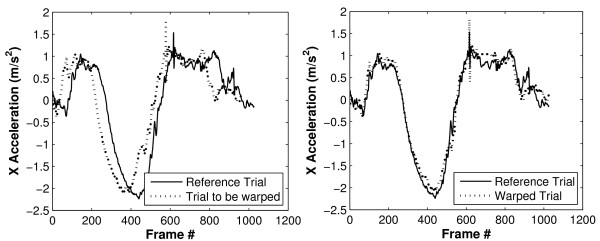
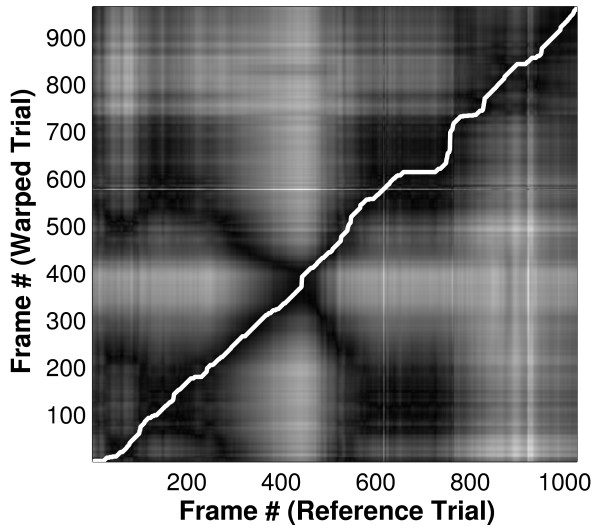
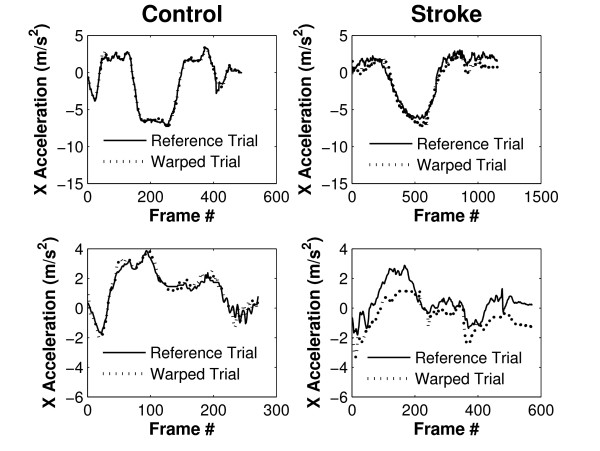
We employ dynamic time warping for curve registration to quantify two aspects of movement variability: 1) variability of the timing of the accelerometer signals' characteristics and 2) variability of the signals' magnitude. Six stroke patients and six matched controls performed several trials of a unilateral ('drinking') and a bilateral ('moving a plate') functional task on two different days, approximately 1 month apart. Group differences for the two variability metrics were investigated on both days.
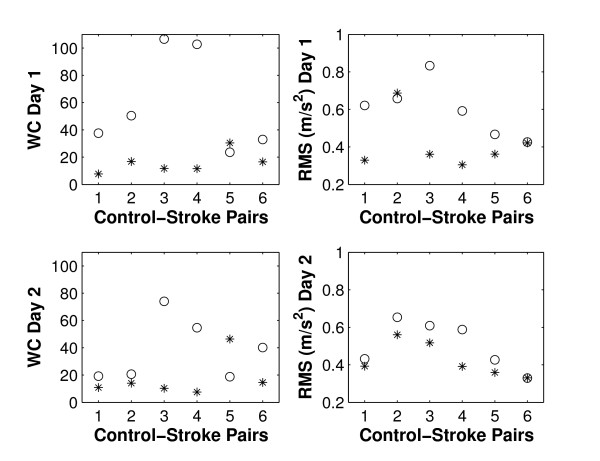
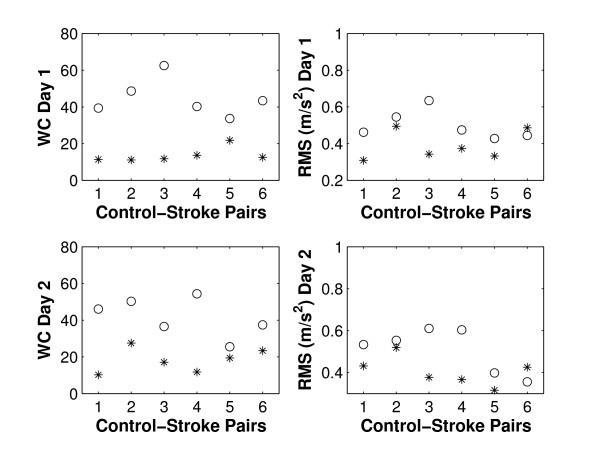
For 'drinking from a glass' significant group differences were obtained on both days for the timing variability of the acceleration signals' characteristics (p = 0.002 and p = 0.008 for test and retest, respectively); all stroke patients showed increased signal timing variability as compared to their corresponding control subject. 'Moving a plate' provided less distinct group differences.
This initial application establishes that movement variability metrics, as determined by our methodology, appear different in stroke patients as compared to matched controls during unilateral task performance ('drinking'). Use of a user-friendly, inexpensive accelerometer makes this methodology feasible for routine clinical evaluations. We are encouraged to perform larger studies to further investigate the metrics' usefulness when quantifying levels of impairment.
在评估中风后上肢功能障碍时,使用昂贵的运动捕捉系统进行详细的运动学分析与常规临床评估测试之间仍存在差距。特别是,尽管许多临床测试评估了功能性任务的表现,但用于表征上肢运动学的指标通常不适用于此类任务,且范围非常有限。本文报告了一种新颖、用户友好的方法,该方法允许在功能性任务执行期间评估上肢运动轨迹中的信号幅度和时间变异性。为了演示该技术,我们报告了一项研究,其中比较了一组中风患者和一组个体匹配的对照受试者在执行两项功能性任务期间收集的数据的时间变异性和信号幅度。
我们采用动态时间规整进行曲线配准,以量化运动变异性的两个方面:1)加速度计信号特征的时间变异性;2)信号幅度的变异性。六名中风患者和六名匹配的对照者在相隔约1个月的两天内对单侧(“喝水”)和双侧(“移动盘子”)功能性任务进行了多次试验。在这两天都研究了两组在两个变异性指标上的差异。
对于“从杯子喝水”,在加速度信号特征的时间变异性方面,两天均获得了显著的组间差异(测试和复测时p值分别为0.002和0.008);与相应的对照受试者相比,所有中风患者的信号时间变异性均增加。“移动盘子”的组间差异不太明显。
这一初步应用表明,在单侧任务执行(“喝水”)期间,我们的方法所确定的运动变异性指标在中风患者中与匹配的对照者相比有所不同。使用用户友好、价格低廉的加速度计使该方法在常规临床评估中可行。我们受到鼓舞进行更大规模的研究,以进一步研究这些指标在量化损伤程度时的有用性。