Kleywegt Gerard J
Department of Cell and Molecular Biology, Uppsala University, Biomedical Centre, Uppsala, Sweden.
Acta Crystallogr D Biol Crystallogr. 2009 Feb;65(Pt 2):134-9. doi: 10.1107/S090744490900081X. Epub 2009 Jan 20.
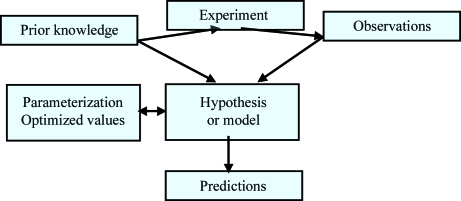
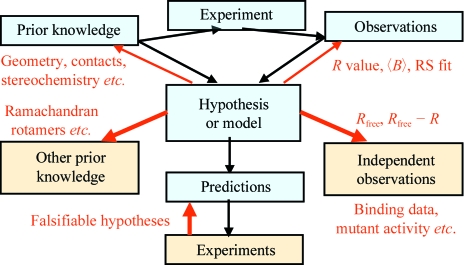
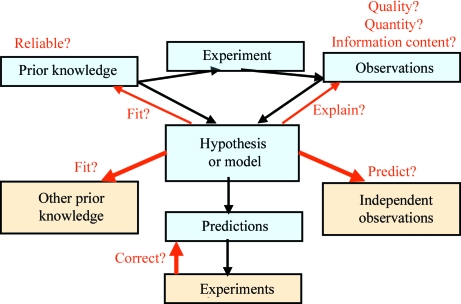
Limitations to the data and subjectivity in the structure-determination process may cause errors in macromolecular crystal structures. Appropriate validation techniques may be used to reveal problems in structures, ideally before they are analysed, published or deposited. Additionally, such techniques may be used a posteriori to assess the (relative) merits of a model by potential users. Weak validation methods and statistics assess how well a model reproduces the information that was used in its construction (i.e. experimental data and prior knowledge). Strong methods and statistics, on the other hand, test how well a model predicts data or information that were not used in the structure-determination process. These may be data that were excluded from the process on purpose, general knowledge about macromolecular structure, information about the biological role and biochemical activity of the molecule under study or its mutants or complexes and predictions that are based on the model and that can be tested experimentally.
数据的局限性以及结构测定过程中的主观性可能会导致大分子晶体结构出现错误。理想情况下,在对结构进行分析、发表或存档之前,可使用适当的验证技术来揭示结构中的问题。此外,潜在用户也可在事后使用此类技术来评估模型的(相对)优点。较弱的验证方法和统计数据评估模型重现其构建过程中所使用信息(即实验数据和先验知识)的程度。另一方面,较强的方法和统计数据则测试模型对结构测定过程中未使用的数据或信息的预测能力。这些数据可能是故意从过程中排除的数据、关于大分子结构的一般知识、有关所研究分子及其突变体或复合物的生物学作用和生化活性的信息,以及基于该模型且可通过实验进行测试的预测。