Ploss Alexander, Evans Matthew J, Gaysinskaya Valeriya A, Panis Maryline, You Hana, de Jong Ype P, Rice Charles M
Center for the Study of Hepatitis C, The Rockefeller University, New York, New York 10065, USA.
Nature. 2009 Feb 12;457(7231):882-6. doi: 10.1038/nature07684. Epub 2009 Jan 28.
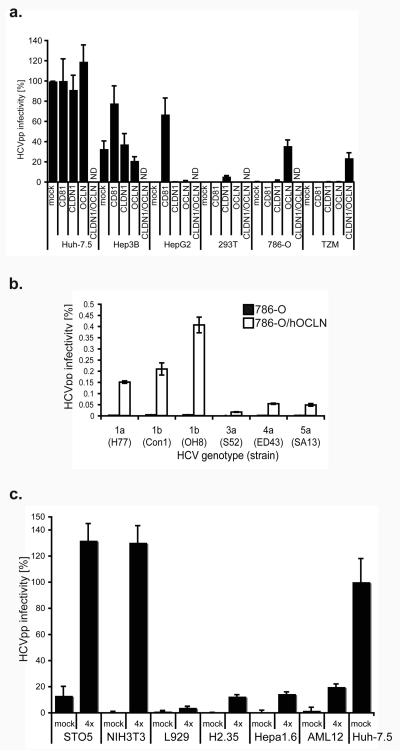
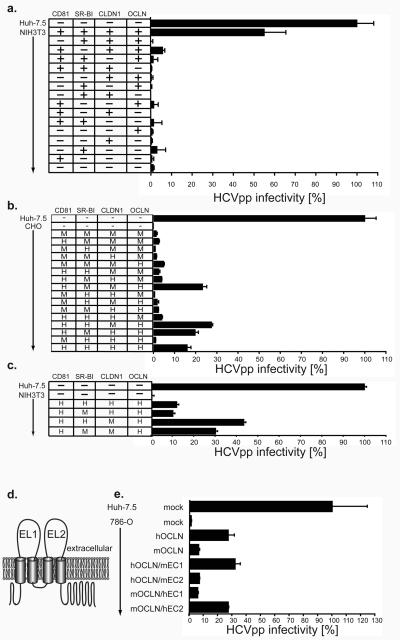
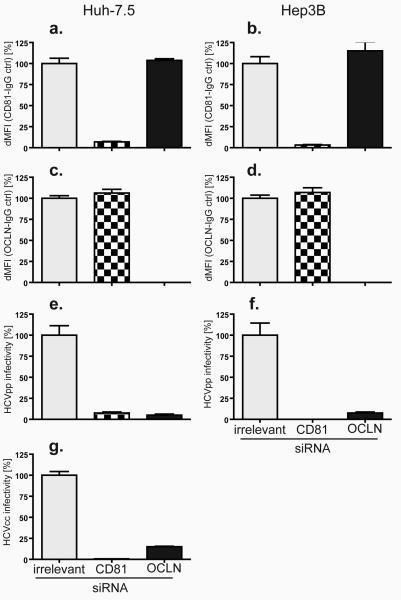
Hepatitis C virus (HCV) is a leading cause of liver disease worldwide. The development of much needed specific antiviral therapies and an effective vaccine has been hampered by the lack of a convenient small animal model. The determinants restricting HCV tropism to human and chimpanzee hosts are unknown. Replication of the viral RNA has been demonstrated in mouse cells, but these cells are not infectable with either lentiviral particles bearing HCV glycoproteins (HCVpp) or HCV produced in cell culture (HCVcc) (A.P., M.E. and C.M.R., unpublished observations), suggesting that there is a block at the level of entry. Here we show, using an iterative complementary DNA library screening approach, that human occludin (OCLN) is an essential HCV cell entry factor that is able to render murine cells infectable with HCVpp. Similarly, OCLN is required for the HCV-susceptibility of human cells, because its overexpression in uninfectable cells specifically enhanced HCVpp uptake, whereas its silencing in permissive cells impaired both HCVpp and HCVcc infection. In addition to OCLN, HCVpp infection of murine cells required expression of the previously identified HCV entry factors CD81 (ref. 4), scavenger receptor class B type I (SR-BI, also known as SCARB1) and claudin-1 (CLDN1). Although the mouse versions of SR-BI and CLDN1 function at least as well as the human proteins in promoting HCV entry, both OCLN and CD81 must be of human origin to allow efficient infection. The species-specific determinants of OCLN were mapped to its second extracellular loop. The identification of OCLN as a new HCV entry factor further highlights the importance of the tight junction complex in the viral entry process, and provides an important advance towards efforts to develop small animal models for HCV.
丙型肝炎病毒(HCV)是全球肝脏疾病的主要病因。由于缺乏便捷的小动物模型,急需的特异性抗病毒疗法和有效疫苗的研发受到了阻碍。限制HCV嗜性于人类和黑猩猩宿主的决定因素尚不清楚。病毒RNA已在小鼠细胞中得到复制,但这些细胞不能被携带HCV糖蛋白的慢病毒颗粒(HCVpp)或细胞培养中产生的HCV(HCVcc)感染(A.P.、M.E.和C.M.R.,未发表的观察结果),这表明在进入水平存在障碍。在此,我们使用迭代互补DNA文库筛选方法表明,人闭合蛋白(OCLN)是HCV细胞进入的必需因子,能够使小鼠细胞被HCVpp感染。同样,OCLN是人类细胞对HCV易感性所必需的,因为其在不可感染细胞中的过表达特异性增强了HCVpp摄取,而其在允许感染的细胞中的沉默则损害了HCVpp和HCVcc感染。除OCLN外,小鼠细胞的HCVpp感染还需要先前确定的HCV进入因子CD81(参考文献4)、B类I型清道夫受体(SR-BI,也称为SCARB1)和紧密连接蛋白-1(CLDN1)的表达。尽管小鼠版本的SR-BI和CLDN1在促进HCV进入方面至少与人类蛋白一样有效,但OCLN和CD81都必须是人类来源才能实现有效感染。OCLN的物种特异性决定因素定位于其第二个细胞外环。将OCLN鉴定为新的HCV进入因子进一步突出了紧密连接复合体在病毒进入过程中的重要性,并为开发HCV小动物模型的努力提供了重要进展。