Trouillas Marina, Saucourt Claire, Guillotin Bertrand, Gauthereau Xavier, Ding Li, Buchholz Frank, Doss Michael Xavier, Sachinidis Agapios, Hescheler Jurgen, Hummel Oliver, Huebner Norbert, Kolde Raivo, Vilo Jaak, Schulz Herbert, Boeuf Hélène
Université Bordeaux, Bordeaux, France.
BMC Genomics. 2009 Feb 9;10:73. doi: 10.1186/1471-2164-10-73.
Mouse embryonic stem (ES) cells remain pluripotent in vitro when grown in the presence of the cytokine Leukaemia Inhibitory Factor (LIF). Identification of LIF targets and of genes regulating the transition between pluripotent and early differentiated cells is a critical step for understanding the control of ES cell pluripotency.
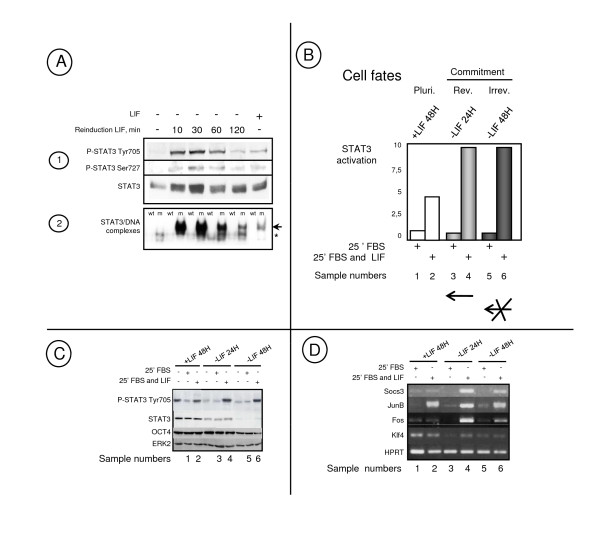
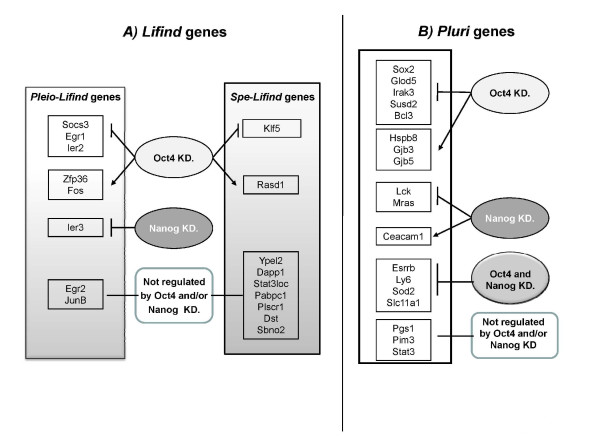
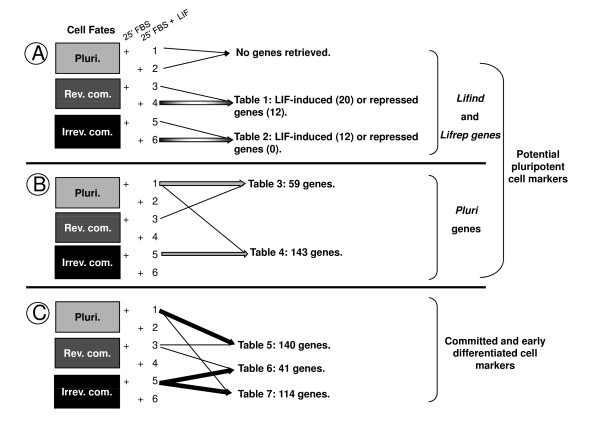
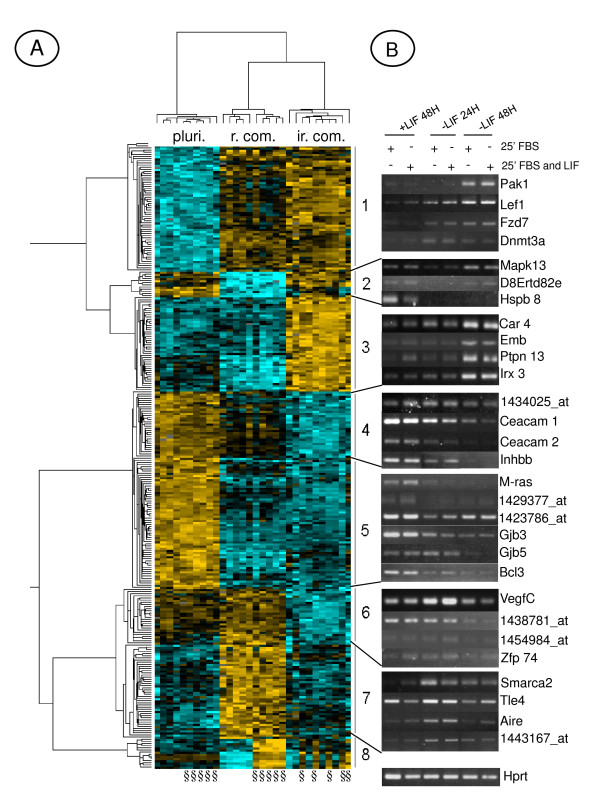
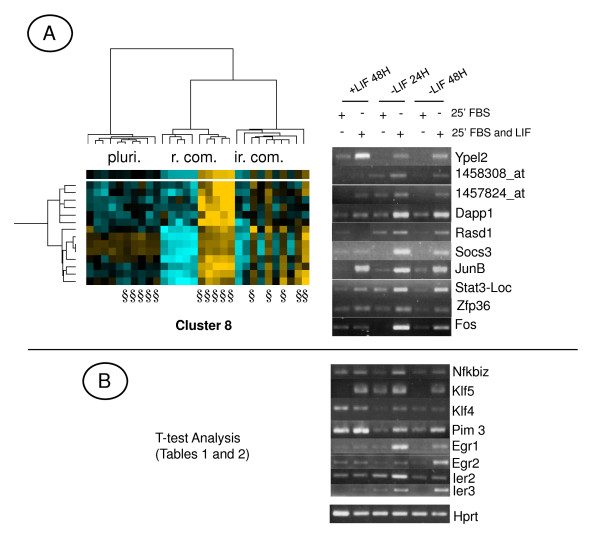
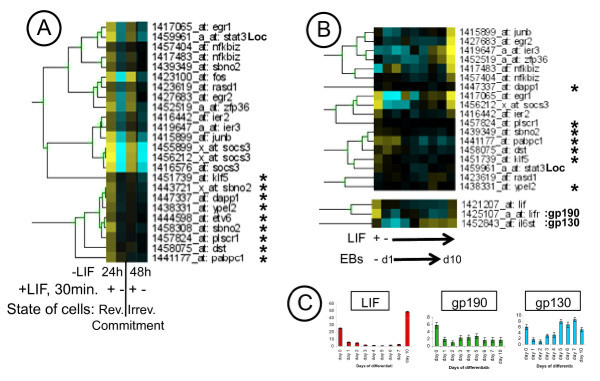
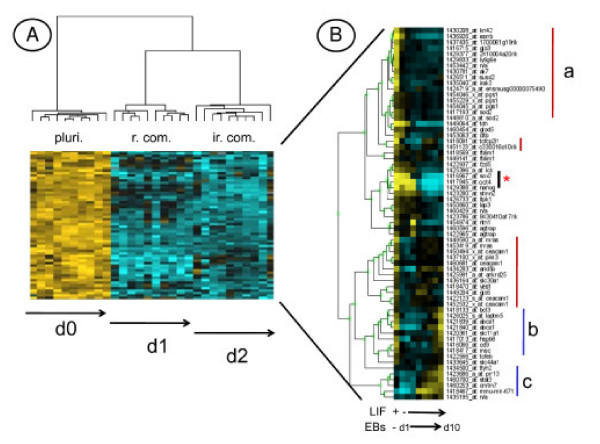
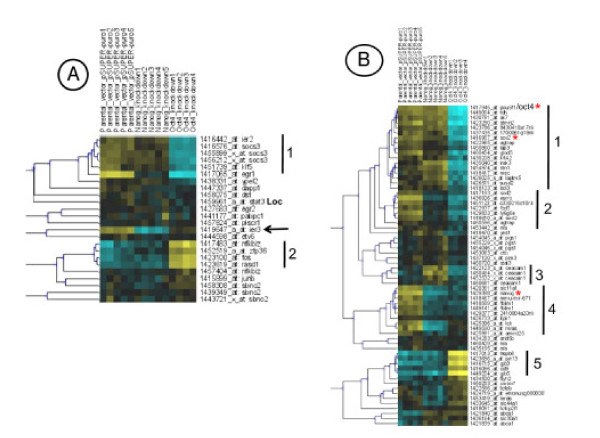
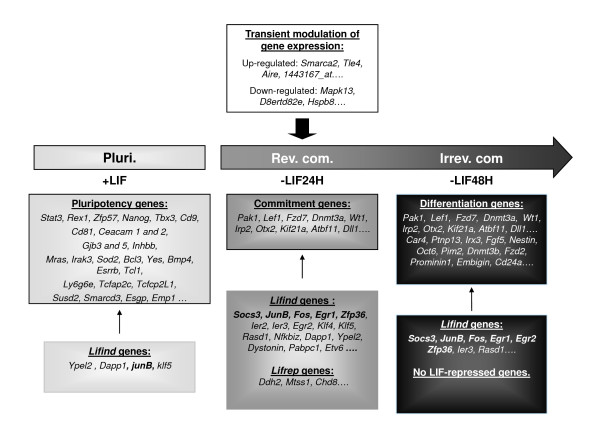
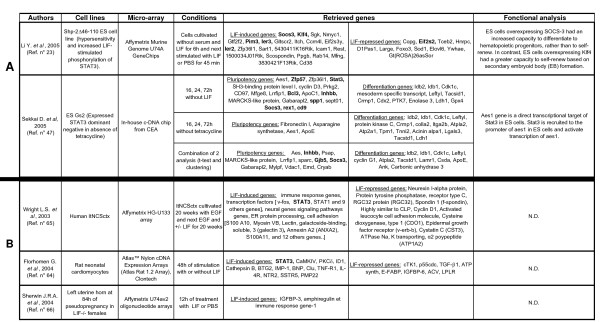
By gene profiling studies carried out with mRNAs from ES cells and their early derivatives treated or not with LIF, we have identified i) LIF-dependent genes, highly expressed in pluripotent cells, whose expression level decreases sharply upon LIF withdrawal [Pluri genes], ii) LIF induced genes [Lifind genes] whose expression is differentially regulated depending upon cell context and iii) genes specific to the reversible or irreversible committed states. In addition, by hierarchical gene clustering, we have identified, among eight independent gene clusters, two atypical groups of genes, whose expression level was highly modulated in committed cells only. Computer based analyses led to the characterization of different sub-types of Pluri and Lifind genes, and revealed their differential modulation by Oct4 or Nanog master genes. Individual knock down of a selection of Pluri and Lifind genes leads to weak changes in the expression of early differentiation markers, in cell growth conditions in which these master genes are still expressed.
We have identified different sets of LIF-regulated genes depending upon the cell state (reversible or irreversible commitment), which allowed us to present a novel global view of LIF responses. We are also reporting on the identification of genes whose expression is strictly regulated during the commitment step. Furthermore, our studies identify sub-networks of genes with a restricted expression in pluripotent ES cells, whose down regulation occurs while the master knot (composed of OCT4, SOX2 and NANOG) is still expressed and which might be down-regulated together for driving cells towards differentiation.
小鼠胚胎干细胞(ES细胞)在细胞因子白血病抑制因子(LIF)存在的情况下于体外保持多能性。鉴定LIF靶标以及调节多能和早期分化细胞之间转变的基因是理解ES细胞多能性控制的关键步骤。
通过对用或不用LIF处理的ES细胞及其早期衍生物的mRNA进行基因谱研究,我们鉴定出:i)LIF依赖性基因,在多能细胞中高度表达,在撤除LIF后其表达水平急剧下降[多能基因];ii)LIF诱导基因[Lifind基因],其表达根据细胞环境受到不同调节;iii)可逆或不可逆定向状态特有的基因。此外,通过层次基因聚类,我们在八个独立的基因簇中鉴定出两组非典型基因,其表达水平仅在定向细胞中受到高度调节。基于计算机的分析导致了多能基因和Lifind基因不同亚型的表征,并揭示了它们受Oct4或Nanog主控基因的差异调节。在这些主控基因仍表达的细胞生长条件下,对一组多能基因和Lifind基因进行单独敲低会导致早期分化标志物的表达发生微弱变化。
我们根据细胞状态(可逆或不可逆定向)鉴定出了不同组的LIF调节基因,这使我们能够呈现LIF反应的全新全局视图。我们还报告了在定向步骤中表达受到严格调节的基因的鉴定。此外,我们的研究鉴定出了在多能ES细胞中表达受限的基因子网,其下调发生在主控节点(由OCT4、SOX2和NANOG组成)仍表达时,并且可能一起下调以驱动细胞分化。