Walne Amanda J, Dokal Inderjeet
Centre for Paediatrics, Institute of Cell and Molecular Science, Barts and The London School of Medicine and Dentistry, Queen Mary University of London, London, UK.
Br J Haematol. 2009 Apr;145(2):164-72. doi: 10.1111/j.1365-2141.2009.07598.x. Epub 2009 Feb 4.
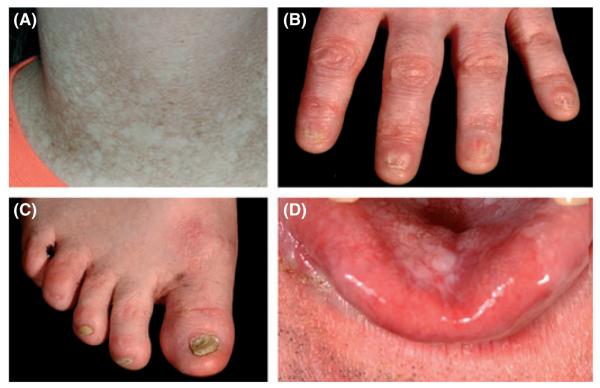
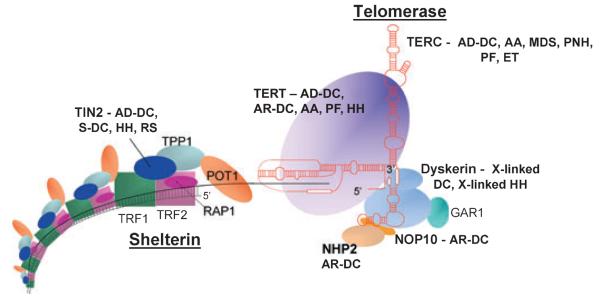
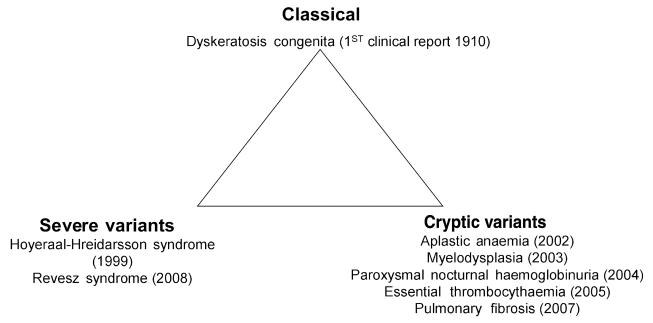
Dyskeratosis congenita (DC) is a rare inherited syndrome exhibiting marked clinical and genetic heterogeneity. It is characterised by mucocutaneous abnormalities, bone marrow failure and a predisposition to cancer. Bone marrow failure is the principal cause of premature mortality. Studies over the last 10 years have demonstrated that DC is principally a disease of defective telomere maintenance. All DC patients have very short telomeres and the genetically characterised cases of DC have mutations in six genes which either encode components of the telomerase complex (DKC1, TERC, TERT, NOP10, NHP2) or shelterin (TINF2); these are important in the elongation and protection of the telomeric end, respectively. These advances have led to the recognition of cryptic forms of DC, such as presentations with aplastic anaemia and myelodysplasia. They have also increased our understanding of normal haematopoiesis and provided new insights to the aetiology of some cases of aplastic anaemia and related haematological disorders.
先天性角化不良(DC)是一种罕见的遗传性综合征,具有显著的临床和遗传异质性。其特征为黏膜皮肤异常、骨髓衰竭以及易患癌症。骨髓衰竭是过早死亡的主要原因。过去10年的研究表明,DC主要是一种端粒维持缺陷的疾病。所有DC患者的端粒都非常短,且经基因鉴定的DC病例在六个基因中存在突变,这些基因要么编码端粒酶复合物的成分(DKC1、TERC、TERT、NOP10、NHP2),要么编码保护帽蛋白(TINF2);它们分别在端粒末端的延长和保护中起重要作用。这些进展使得人们认识到DC的隐匿形式,如再生障碍性贫血和骨髓发育异常的表现。它们还增进了我们对正常造血的理解,并为一些再生障碍性贫血及相关血液系统疾病的病因提供了新的见解。